
- Home
- Products
- Hot
- About Us
- Services
- Industry
- Contact
Views: 0 Author: Site Editor Publish Time: 2026-10-17 Origin: Site


Transitioning from bottled nitrogen or oxygen to compressed air for laser cutting assist gas offers massive cost reductions. However, you only realize these savings if the air purity remains flawless. Using standard shop air inevitably leads to blown optics, inconsistent cut edges, and excessive consumable spending. Unfiltered air carries microscopic water, oil, and dust directly into your delicate laser head. You must specify the exact air quality and compressor system architecture to protect fiber laser lenses. Doing so maximizes cutting speeds and guarantees an aggressive return on investment without operational downtime. We will break down exactly how to evaluate your setup, secure pristine air delivery, and keep your production running smoothly. You will learn the core metrics for purity, pressure, and flow. Armed with this knowledge, you can eliminate equipment bottlenecks and elevate your fabrication quality permanently.
Fiber laser cutting heads operate by focusing immense thermal energy through a precision glass lens. When you introduce compressed air into this environment as an assist gas, it travels directly over these sensitive optics. Even microscopic oil aerosols or tiny moisture droplets vaporize instantly under the intense laser beam. This vaporization deposits a hazy, baked-on film across the protective glass and focal lens. Once contaminated, the lens absorbs the laser's heat instead of transmitting it. This thermal buildup inevitably causes the lens to warp, crack, or shatter completely mid-operation.
Particulate contamination and moisture do more than just threaten your optics; they actively destroy your edge finish. Clean compressed air should aggressively eject molten metal from the kerf. When water droplets or oil mix into the air stream, they disrupt the gas flow dynamics and react thermally with the hot metal. This reaction causes severe oxidation issues, particularly on mild steel and aluminum. You will notice increased dross accumulation along the bottom edge of your cuts. Operators must then spend hours grinding and deburring parts manually before welding or painting, erasing any speed advantages the fiber laser originally provided.
Many fabricators try to save capital upfront by installing a cheap compressor setup. They quickly discover the recurring costs of poor air quality dwarf those initial savings. Replacing a destroyed focal lens costs anywhere from $500 to over $2,000 each time. If contaminated air causes a catastrophic failure during a critical production run, you also lose valuable manufacturing hours. The machine sits idle while technicians troubleshoot the head, clean the internal passages, and recalibrate the focal depth. Investing in proper air treatment upfront prevents this expensive, repetitive cycle of downtime.
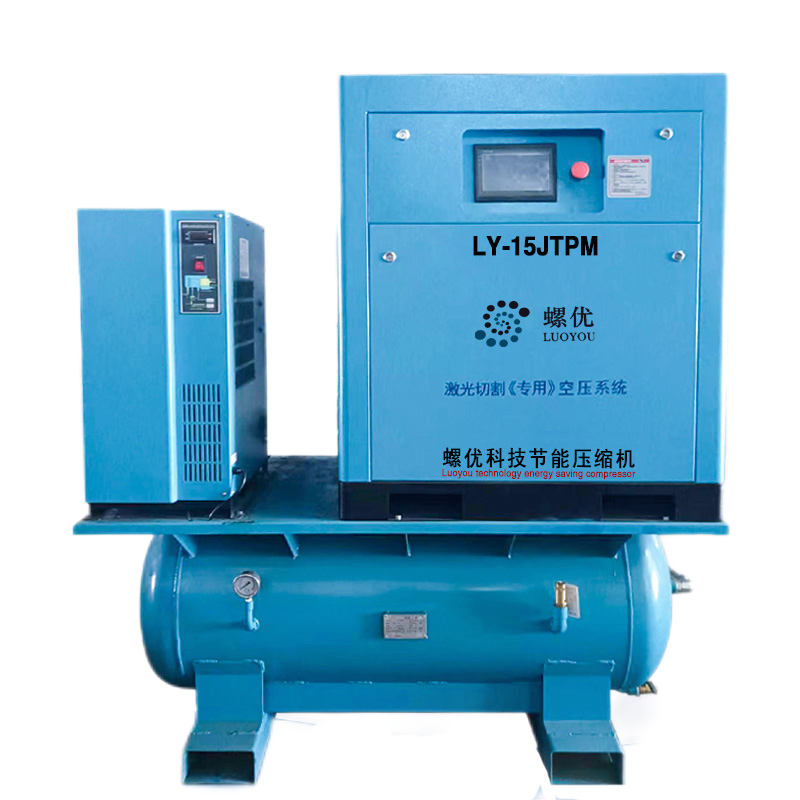
Understanding your baseline laser cutting air compressor requirements starts with matching high-pressure delivery to your material thickness. Standard pneumatic tools run fine on 90 to 100 PSI. Laser cutting, however, requires significantly higher force to blow viscous molten metal out of the cut zone. Most fiber lasers demand pressures ranging from 16 to 20 bar (230 to 290 PSI). If the pressure drops below the manufacturer's threshold, the assist gas fails to clear the kerf fast enough. The metal resolidifies, bridging the gap and ruining the part.
Pressure dictates the force, but flow rate determines sustainability. You need a continuous Free Air Delivery (FAD) volume at your target pressure. Your required flow rate depends entirely on two variables: the nozzle diameter and the material thickness. Larger nozzles vent air much faster than small ones. If your compressor cannot generate enough CFM (Cubic Feet per Minute) or m³/h to keep up with the nozzle output, the line pressure will steadily collapse during a long cut. You must size the compressor to exceed your laser's maximum flow demand by at least 20% to accommodate system wear and minor leaks.
Laser cutting operates as a 100% continuous demand application. Once the cutting head starts moving across a full sheet of steel, the assist gas flows continuously for minutes or even hours. Undersized receivers or intermittent-duty compressors will bottleneck your production severely. Piston compressors typically require rest periods to cool down; if you run them continuously, they overheat and seize. You need an industrial compressor designed for a 100% duty cycle to guarantee uninterrupted assist gas delivery.
To protect your equipment, the industry relies on the international ISO 8573-1 standard for compressed air purity. This framework categorizes air quality based on solid particulates, water, and oil. For laser cutting, you generally aim for Class 1.4.1 or Class 1.2.1.
Table: Recommended ISO 8573-1 Classes for Laser Cutting
| Contaminant Category | Recommended Class | Maximum Allowable Level |
|---|---|---|
| Solid Particulates | Class 1 | ≤ 20,000 particles at 0.01 - 0.5 microns |
| Water (Moisture) | Class 4 (or Class 2) | Pressure Dew Point of +3°C (or -40°C) |
| Oil (Liquid & Aerosol) | Class 1 | ≤ 0.01 mg/m³ residual oil concentration |
Meeting Class 1 for solid particles requires aggressive mechanical filtration. Your system must capture microscopic dust, pipe scale, and ambient debris down to 0.01 microns. Even tiny particles moving at high velocities can scratch the protective glass of the laser. High-efficiency particulate air filters, staged sequentially, catch larger debris first before polishing the air through a fine micro-glass media.
Moisture control revolves around the Pressure Dew Point (PDP). The absolute minimum requirement is Class 4, which dictates a PDP of +3°C (38°F). You can typically achieve this using a properly sized refrigerated air dryer. However, many premium laser manufacturers highly recommend aiming for Class 2, which requires a PDP of -40°C (-40°F). You must use a twin-tower desiccant dryer to hit this extreme level of dryness. Desiccant systems offer unparalleled optic safety, completely eliminating the risk of micro-condensation.
Oil is the fastest way to destroy a fiber laser lens. Standard compressors use oil for lubrication and cooling, and a small amount inherently escapes past the separator into the air stream. To hit the Class 1 standard of sub-0.01 mg/m³ residual oil, you need multi-stage coalescing filters followed by an activated carbon tower. The carbon bed adsorbs oil vapors chemically, ensuring no hydrocarbons travel down the pipe to your cutting head.
When selecting the core air generator, a laser cutting screw compressor dramatically outperforms traditional piston models. Piston compressors generate excessive heat and vibrate heavily, leading to significant oil carryover and moisture generation. They also cannot sustain a 100% duty cycle without suffering mechanical failure. Rotary screw compressors use twin interlocking rotors to compress air smoothly and continuously. They run cooler, produce drastically less oil vapor, and comfortably handle continuous-flow demands shift after shift without resting.
Fabrication shops often face floor space constraints. Equipment manufacturers now offer "all-in-one" skid packages specifically designed for fiber lasers. A tank-mounted package stacks the rotary screw compressor, refrigerated or desiccant dryer, multi-stage filtration, and a high-pressure receiver tank onto a single footprint. This integration minimizes installation complexities. Base-mount setups separate the components, which provides flexibility in layout but requires more extensive hard piping and floor space.
Fabrication shops rarely cut identical parts all day. Your material thickness and nozzle sizes change based on client orders, which means your air flow demand fluctuates constantly. A Variable Speed Drive (VSD) screw compressor automatically adjusts its motor speed to match your exact air demand in real time. Instead of running at full capacity constantly and wasting electricity, the VSD slows down during light cuts or machine setup times. This precise matching yields substantial energy savings over the lifespan of the equipment.
Your pristine air becomes useless if you push it through dirty plumbing. Never use standard PVC piping; high-pressure air makes PVC brittle, creating a severe explosion hazard. Similarly, black iron pipe introduces massive downstream risks. Even with a good dryer, trace moisture eventually causes black iron to rust internally. High-velocity air strips this rust scale and fires it directly into your expensive filter housings. We highly recommend using extruded aluminum piping or stainless steel. Aluminum features a smooth internal bore that prevents pressure drops, resists corrosion entirely, and guarantees clean delivery to the laser head.
Filters do not last forever. As they capture dirt and oil, their internal media saturates. Many operators ignore the differential pressure gauges mounted on filter housings. When a filter clogs, it forces the compressor to work harder, causing a massive pressure drop across the line. Worse, a fully saturated coalescing filter physically cannot hold more oil. The excess oil simply bypasses the media and travels directly to the laser head. You must treat filter elements as strict consumables and replace them on schedule.
Fabrication shops run hot, especially during summer months. High ambient temperatures severely degrade the efficiency of refrigerated dryers and air-cooled compressors. If your shop hits 100°F (38°C), your refrigerated dryer may fail to hit its required +3°C dew point, allowing moisture to pass through.
Follow these steps to optimize your installation environment:
When evaluating proposals, instruct buyers to look at the performance data for the entire skid, not just the base compressor. Every dryer and filter you add to the line creates a natural pressure drop. If you need 230 PSI at the laser head, a compressor rated for exactly 230 PSI will fall short once the air pushes through a desiccant dryer and four stages of micro-filtration. Ensure the vendor sizes the pump to overcome these internal system restrictions while still delivering the required baseline pressure to the machine.
A downed assist-gas compressor halts your entire laser cutting operation immediately. Without air, the laser cannot cut. Emphasize local technician availability when choosing a brand. You need a vendor who stocks maintenance kits, coalescing filters, and spare sensors at a facility near your shop. Fast response times matter more than marginal equipment discounts when your production schedule is on the line.
Do not accept verbal promises regarding air quality. Look for specialized compressed air providers who guarantee ISO 8573-1 air purity classes in writing. Review their warranty documents closely to see what happens if oil contamination reaches your laser optics. A reputable vendor will provide transparent maintenance schedules detailing exactly when you must replace oil, desiccant beads, and filter elements to keep the warranty active.
Specifying the correct compressed air system for your laser cutter is not a casual utility purchase. The compressor acts as a critical production component directly tied to your product quality, consumable lifespan, and overall machine uptime. Selecting a continuous-duty rotary screw compressor, sizing your pressure and flow correctly, and strictly enforcing ISO 8573-1 purity standards prevents catastrophic optic failures and eliminates costly edge-finishing rework.
Your next step is to audit your current air setup against the exact specifications provided by your laser manufacturer. Note your required PSI and maximum CFM demands based on your thickest materials. Contact a specialized compressed air provider to request a comprehensive site assessment. They can help you design a moisture-free, oil-free piping layout that protects your investment and keeps your laser cutting at peak speeds.
A: Usually, you cannot use standard shop air for a fiber laser. Standard compressors max out around 100 PSI, which falls short of the 230 to 290 PSI needed to blow molten metal out of the cut. Furthermore, typical shop air lacks the extreme filtration and drying required to protect sensitive laser optics. Using it will quickly contaminate and ruin your focal lenses.
A: Refrigerated dryers cool the air to drop its moisture content, achieving a pressure dew point around 38°F (+3°C). Desiccant dryers use absorbent materials to pull moisture out chemically, hitting a much drier -40°F (-40°C) dew point. Desiccant dryers offer superior protection against micro-condensation on laser lenses, especially if you route piping through cold environments.
A: You should typically replace your air filters every 2,000 to 4,000 hours. However, this heavily depends on your shop's ambient environment. Dusty fabrication shops load filters much faster. Always monitor the pressure differential indicator on the filter housing. Once it shows a significant pressure drop, replace the filter element immediately to prevent oil and particulates from bypassing the media.
A: Yes, you often need a booster compressor when processing thick plates. If your base rotary screw compressor maxes out at 150 PSI, a booster connects downstream to step the pressure up into the 230 to 300 PSI range. High pressure is mandatory to effectively flush heavy molten slag out of deep kerfs, ensuring a clean, dross-free edge finish.


