
- Home
- Products
- Hot
- About Us
- Services
- Industry
- Contact
Views: 0 Author: Site Editor Publish Time: 2026-08-26 Origin: Site


Selecting the wrong laser cutting air compressor leads to severe dross buildup, ruined focal lenses, and halted production lines. It turns what should be a smooth manufacturing process into a frustrating bottleneck. We often treat compressed air purely as a utility. However, in this context, it functions as a critical cutting gas. We call it air assist. It directly impacts edge quality and machine return on investment. If you get the specifications wrong, you risk damaging expensive equipment. You also waste valuable raw materials.
This guide bypasses marketing fluff. It provides a strictly technical framework. We rely on parameter-based guidelines to help you evaluate your options. You will learn exactly how to match compressor specs to specific laser systems. We cover everything from PSI and CFM to essential purity standards. This applies to both Fiber and CO2 machines. Let us dive into the operational details.
Many fabricators underestimate the role of laser cutting compressed air. It acts as a physical blade during the process. The air stream violently ejects molten material from the kerf. It also cools the heat-affected zone. We call this the HAZ. This immediate cooling protects the delicate laser head from radiant heat. Without enough airflow, slag clings to the bottom edge of the metal. We call this clinging material dross. Dross ruins your part finish. It demands extensive manual grinding. Manual post-processing wastes time and destroys profit margins.
You must compare air against alternative gases. Traditional sheet metal cutting relies heavily on bottled nitrogen or oxygen. Nitrogen provides a clean edge on stainless steel. However, bulk nitrogen costs accumulate rapidly. They drain monthly budgets. Oxygen accelerates the cutting of carbon steel through an exothermic reaction. Yet, oxygen leaves an oxide layer. You must remove this layer before painting or welding. Compressed air offers a highly economical substitute. It pulls nitrogen and oxygen directly from the atmosphere. You eliminate expensive bottle deliveries. You simply pay for the electricity to run the compressor.
A successful setup looks very specific. You achieve consistent edge quality without dross. You maintain zero optic contamination across months of operation. You experience absolute reliability during long shifts. If you notice yellowing on your lenses, your air system has failed. If pressure drops midway through a thick steel plate, your compressor is undersized. Success means the air utility becomes invisible. It works perfectly every time you start a cut.
| Assist Gas Type | Typical Material Application | Operational Reality |
|---|---|---|
| Nitrogen (Bottled/Bulk) | Stainless Steel, Aluminum | Delivers an excellent edge. It requires high recurring gas costs. |
| Oxygen (Bottled/Bulk) | Carbon Steel, Mild Steel | Exothermic reaction speeds up the cut. It leaves a hard oxide layer. |
| Compressed Air | Aluminum, Mild Steel, Galvanized | Highly economical. It demands excellent filtration and pressure stability. |
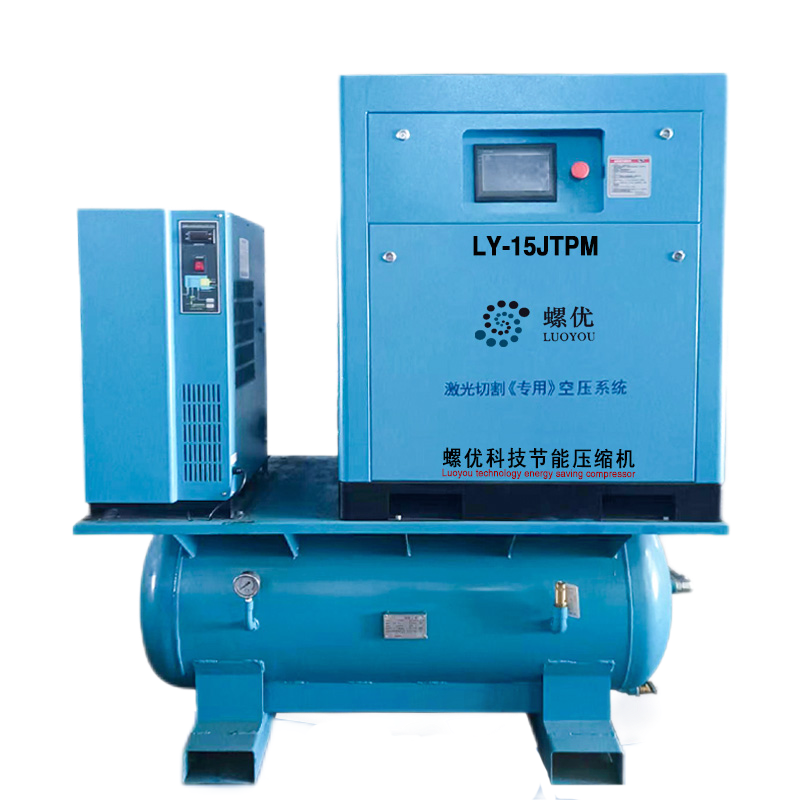
You cannot buy a compressor without knowing your exact pressure requirements. Different laser technologies demand wildly different setups. A system built for a hobby shop will fail in a metal fabrication plant. You must establish your baseline parameters first.
CO2 lasers dominate the non-metal market. They process acrylic, wood, leather, and fabric. These machines do not require extreme pressure. Standard requirements change based on the operation. Engraving requires very low pressure. You typically set the regulator between 10 and 15 PSI. The goal here is simple. You want a gentle breeze to push smoke away from the beam path. This keeps soot off the focal lens. It prevents thermal damage to the glass.
Cutting operations require medium pressure. You normally need 30 to 60 PSI. This stronger stream pushes vaporized wood or melted acrylic through the cut line. It prevents the material from catching fire. However, you must watch out for excessive pressure. Too much force creates chaos in a CO2 machine. It easily blows lightweight acrylic parts off the honeycomb bed. It scatters sticky debris into the gantry belts and linear rails. You must strike a careful balance.
Fiber lasers operate in a different reality. They handle thick carbon steel, stainless steel, and aluminum. The demands for metal cutting are immense. You typically need 16 to 25 Bar. This translates to a massive 230 to 360 PSI. Standard shop air compressors top out around 120 PSI. They are completely useless for fiber laser metal cutting.
The intense beam melts solid metal instantly. The assist gas must forcefully eject this heavy, dense molten slag before it hardens. Material thickness dictates the exact pressure. Thin gauge aluminum might cut cleanly at 150 PSI. A half-inch plate of carbon steel will demand over 250 PSI. If your pressure drops below the threshold, the slag solidifies inside the kerf. The part welds itself back together. You ruin the stock immediately.
People obsess over pressure. They often ignore volumetric flow. We measure this in Cubic Feet per Minute (CFM). This mistake ruins countless production runs. Sustaining high pressure means nothing if the volume runs out.
You must differentiate between static pressure and dynamic pressure. Static pressure is what the gauge reads when the machine sits idle. Dynamic pressure is what happens when the laser nozzle actually opens. The compressor must deliver the required CFM at the specific cutting PSI. If you have 300 PSI in the tank but only generate 5 CFM, the pressure will plummet the second the cut begins. You must verify the dynamic flow ratings on the manufacturer's datasheet.
The duty cycle trap catches many buyers. Duty cycle indicates how long a compressor can safely run within a specific timeframe. A 50% duty cycle means it can run for 30 minutes out of an hour. It needs the other 30 minutes to cool down. If you put a 50% duty cycle compressor in a commercial setting, it will run constantly. It will generate massive heat. The internal components will warp. The motor will burn out in a matter of months. Commercial fiber lasers require 100% duty cycle ratings.
Sizing the receiver tank correctly solves many flow problems. The air tank acts as a crucial buffer. It absorbs peak flow demands during long cuts. A large tank reduces compressor cycling. It prevents the motor from starting and stopping rapidly. This stabilizes your line pressure. A general rule of thumb suggests matching tank size to CFM output. However, high-pressure laser cutting often requires oversized tanks. They provide the necessary reservoir to prevent dynamic pressure drops.
Generating the air is only half the battle. You must clean it rigorously. Untreated compressed air holds water vapor, oil droplets, and microscopic dust. This represents a massive contamination risk.
Detail the catastrophic failure mode of wet air. When moist air hits a hot laser lens, thermal shock occurs instantly. The glass undergoes rapid, uneven cooling. Moisture turns into steam. Oil droplets bake onto the surface. Micro-explosions shatter the protective window. Sometimes they shatter the focal lens itself. A single drop of water can cause thousands of dollars in optical damage. It halts your production completely.
You must implement strict filtration standards. The industry relies on ISO 8573-1. You should aim for Class 1:2:1 or Class 1:4:1 depending on your specific laser head. We establish purity through a multi-stage approach.
| ISO 8573-1 Class | Solid Particulates (Microns) | Water Dew Point | Oil Content (mg/m³) |
|---|---|---|---|
| Class 1:2:1 | ≤ 0.1 | -40°C (-40°F) | ≤ 0.01 |
| Class 1:4:1 | ≤ 0.1 | +3°C (37°F) | ≤ 0.01 |
| Class 2:4:2 | ≤ 1.0 | +3°C (37°F) | ≤ 0.1 |
Choosing the actual machine architecture is your final step. The market offers two primary technologies. You must match the mechanics to your operational intensity.
Piston compressors use internal cylinders and valves to compress air. They are very common in general automotive shops. They are best for light-duty work. Intermittent CO2 laser users and hobbyists rely on them heavily. They handle short runs of acrylic or wood cutting perfectly.
However, they have severe limitations. They produce extremely high noise levels. They generate massive amounts of internal heat. The piston rings wear down quickly. This increases oil carryover risks. Oil slips past the rings and enters the air stream. Their biggest flaw is the limited duty cycle. Most piston units hover between 50% and 60%. If you push them harder, they fail prematurely. They cannot sustain the demands of industrial metal cutting.
A rotary screw compressor uses two interlocking helical rotors. As they turn, they continuously compress the air. They represent the standard for industrial applications. They are best for commercial fabrication shops. If you run fiber lasers across continuous shifts, you need this technology.
The advantages are undeniable. They offer a true 100% continuous duty cycle. They thrive when running constantly. They operate at much lower temperatures than piston units. This reduces the burden on your air dryers. They also produce much cleaner initial air output. The smooth rotation eliminates the extreme vibration found in piston models.
The implementation reality involves higher upfront capital expenditure. A screw machine costs significantly more to purchase initially. However, they offer tremendous energy efficiency. They scale their power draw to match your exact flow demands. Furthermore, they vastly reduce machine downtime. You spend less time fixing breakdowns and more time cutting metal. They are the only viable choice for serious metal fabrication.
Optimal air system selection is a strict balancing act. You must align Pressure (PSI), Volumetric Flow (CFM), and Air Purity (ISO standards). Focusing on just one metric leads to system failure. You cannot push dense slag with low pressure. You cannot sustain cuts without adequate flow. You will destroy expensive optics without pristine filtration.
We strongly advise checking your specific laser manufacturer's datasheet first. Look for the minimum dynamic CFM and PSI requirements before you ever look at compressor brands. Do not guess these numbers. Let the laser specifications dictate the compressor size.
As a next step, consult with an industrial air system specialist. Have them conduct a flow audit of your facility. Ask them to spec the appropriate dryer and multi-stage filtration sequence alongside the main compressor unit. Proper planning today prevents catastrophic optic failures tomorrow.
A: A typical 60W to 100W CO2 setup usually requires between 2 and 4 CFM at a dynamic pressure of 30 to 40 PSI. This largely depends on the specific air assist nozzle diameter you use. Always verify the flow at the regulator during an active test cut.
A: No. Standard shop compressors peak around 120 to 150 PSI. Industrial fiber lasers require extreme pressures ranging from 230 to over 300 PSI to cut thick metals. Additionally, basic shop setups lack the rigorous desiccant drying and multi-stage filtration necessary to protect laser optics.
A: When high-pressure air expands rapidly out of the nozzle, physics dictates that it cools down sharply. If your compressed air contains water vapor, this sudden temperature drop forces the vapor to condense directly onto the cold lens. You must install a refrigerated or desiccant air dryer.
A: You should generally replace inline filter elements every 2,000 to 4,000 operating hours. However, if your environment features high humidity, or if your compressor runs hot, you may need to change them every 1,000 hours. Always monitor the differential pressure gauges on the filter housings.


