
- Home
- Products
- Hot
- About Us
- Services
- Industry
- Contact
Views: 0 Author: Site Editor Publish Time: 2026-06-29 Origin: Site


Facilities often treat all air treatment components as interchangeable parts. You might think one filter does the exact same job as the next. This operational blind spot creates major headaches for maintenance teams. Many procurement engineers simply order replacements based on size alone. This ignores the specialized physics occurring inside each vessel.
Misunderstanding the specific roles of an air oil separator versus a precision filter leads to rapid element saturation. It causes crippling pressure drops and compromises downstream equipment. When bulk fluid hits the wrong media, entire systems fail. Production halts, and maintenance budgets vanish.
This article breaks down the mechanical differences between these two critical components. We will explore their installation hierarchy, evaluate working principles, and provide clear sizing criteria. You will learn how to optimize your pneumatic systems, prevent equipment damage, and eliminate energy waste across your facility. Making the right selection protects your investments and keeps your automated lines running smoothly.
Air oil separators act as the primary defense inside the compressor, separating bulk compressor fluid from the air and returning it to the system loop.
A precision filter sits downstream, targeting microscopic solid particulates and residual aerosols that escape the primary separator.
They are not an "either/or" choice; they form a sequential protection strategy critical for effective compressed air purification.
Incorrect sizing or sequencing leads to exponential energy waste due to unmanaged pressure drop.
You will typically find the air oil separator integrated within the compressor housing. Sometimes it sits immediately at the discharge port of an oil-injected compressor. This component handles brutal conditions. It processes incredibly hot, turbulent air heavily saturated with lubricating fluid.
Its primary function is recapturing large volumes of lubricating oil from the hot compressed air stream. The separator ensures this bulk fluid does not escape down the pipeline. It strips the heavy oil out and returns it directly to the compressor block. This creates a continuous lubrication loop.
The economic value of this bulk pre-treatment is massive. It prevents massive fluid loss and ensures continuous lubrication of internal rotors. It drastically reduces your replacement oil costs. Without a functioning separator, a standard compressor would pump its entire oil reservoir into your factory airlines within hours.
You install a precision filter far downstream in the air line. Planners often position it just before critical pneumatic machinery. This component acts as your end-point defense. It handles the subtle, microscopic threats that pass through upstream components.
Its primary function involves executing fine oil mist removal. It intercepts solid contaminants like pipeline rust, pipe scale, and degraded seal wear. It also captures trace moisture aerosols suspended in the airflow.
This precision brings immense economic value to your operation. It protects sensitive solenoid valves from sticking. It prevents severe product contamination during paint spraying or food packaging. It also eliminates the risk of solid particles scoring the internal cylinder walls of expensive pneumatic actuators.
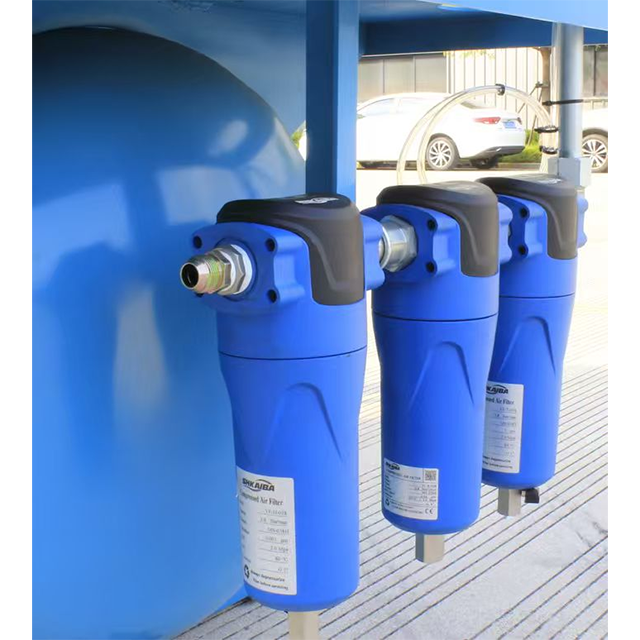
Separators handle heavy fluid burdens using physical dynamics. They rely heavily on centrifugal force, internal baffling, and stainless steel mesh. When the oily air enters the vessel, it spins rapidly. Centrifugal force throws heavy oil droplets against the outer walls. Gravity pulls this fluid downward into a collection pool.
Next, the air passes through a coalescence layer. Microscopic droplets collide within this media. They merge to form larger, heavier drops. These drops fall out of suspension.
The system operates on a continuous drain-back loop. Overpressure inside the vessel pushes the collected fluid back into the compressor. This cycle runs endlessly during operation.
Risk factor: High fluid volume creates heavy friction. A premium separator must feature strict electrostatic charging prevention. Proper grounding prevents static sparks from igniting combustible oil vapors inside the tank.
A precision compressed air filter utilizes dense, multi-layered media. Manufacturers typically build these from borosilicate glass microfibers. These fibers create an incredibly dense maze. They physically intercept micro-particles down to 1 micron or even 0.01 microns.
They capture fine aerosols through a combination of three physical principles:
Direct interception: Large particles simply crash into the fibers and stick.
Inertial impaction: Heavy particles cannot navigate the tight turns of the air stream. They collide with the media.
Diffusion (Brownian motion): Tiny particles bounce randomly within the air stream until they touch a fiber and become trapped.
Risk factor: Unlike separators, precision elements do not have infinite handling capacity. If a slug of bulk fluid hits this media, it instantly blinds the filter. The pores swell, and airflow stops completely.
You must frame the relationship between these components as a mandatory sequence. They do not compete with each other. They work together. You cannot use a fine media element to do a heavy fluid job. You cannot use a centrifugal vessel to capture microscopic dust. Order defines success.
Many facilities try to cut costs by skipping a high-quality primary separator. Sometimes they rely solely on an inline compressor filter element. This creates the saturated media trap. The downstream precision filter absorbs the bulk oil. Its microscopic pores swell instantly. The media becomes fully blocked. It acts like a concrete wall inside your pipeline.
Common Mistake: Installing highly rated sub-micron filters immediately after the compressor without bulk fluid pre-treatment.
Best Practice: Always follow the systematic hierarchy of purification to protect expensive micro-fiber elements.
An overloaded precision filter causes severe bottlenecks. It can trigger a system pressure drop exceeding 10 to 15 PSI. This forces the compressor to work much harder to maintain line pressure. It drastically inflates your electricity costs and wears out the compressor motor prematurely.
Bulk removal: The Separator handles heavy liquid volumes and massive oil reclamation.
Particulate/Micro-mist removal: The Precision Filter catches the invisible aerosols and pipe scale.
Odor/Vapor removal: Activated Carbon handles gaseous hydrocarbons (if application demands it).
Pressure drop acts as the primary enemy of pneumatic efficiency. We measure this resistance as ΔP (Delta P). Every 2 PSI of pressure drop increases your compressor energy consumption by roughly 1%. Over a full production year, this minor resistance wastes massive amounts of electricity. Managing airflow resistance directly impacts your bottom line.
A high-quality separator must maintain a minimal pressure drop. It must do this while processing massive volumes of turbulent air and fluid. You cannot compromise on construction quality. OEM-quality seals are non-negotiable. Strong grounding features ensure safety and sustained efficiency. Inferior seals leak, causing internal pressure losses and rapid component degradation.
Higher filtration efficiency inherently creates higher initial resistance. A 0.01-micron element naturally restricts air more than a 1-micron element. You should evaluate these components based on the element's pleated surface area. More surface area reduces the air velocity passing through the media. Lower velocity means longer element life and a significantly lower pressure drop.
Evaluation Metric | Air Oil Separator | Precision Filter |
|---|---|---|
Primary Efficiency Target | Bulk fluid volume processing | Micro-particle and aerosol capture |
Pressure Drop Driver | Internal baffling and fluid density | Media density and pore size |
Lifespan Indicator | Oil carryover levels at discharge | Differential pressure gauge reading |
Key Construction Feature | Electrostatic grounding / Mesh | Pleated borosilicate surface area |
Selecting the right components requires aligning your hardware with your environmental risks. You must evaluate your specific production demands to achieve effective compressed air purification. Use this quick-reference decision tree to guide your procurement strategy.
Think of machine shops, standard assembly lines, and general manufacturing facilities. These environments deal with basic pneumatic tools and standard cylinders.
Requirement: Standard OE-equivalent air oil separator + general purpose precision filter (e.g., 1-micron rating).
Focus: You want to balance replacement costs with basic protection. This setup prevents standard directional valves from sticking. It stops heavy rust from destroying air tools.
Facilities located in humid climates face unique challenges. Outdoor piping or non-climate-controlled warehouses generate massive amounts of condensate.
Requirement: Standard Separator + standalone Water Separator + Precision Filter.
Focus: Moisture control must be layered before the precision element. If you skip the water separator, liquid water will soak the fine filter media. This causes filter rot and sudden pressure drops. Layering ensures the fine media only handles aerosols, not puddles.
Food and beverage packaging, pharmaceutical production, and sensitive electronics assembly require absolute purity. Any contamination ruins the end product.
Requirement: Premium OE Separator + Multi-stage precision filter setup.
Focus: You need a strict sequence: Particulate filter, followed by Sub-micron coalescing, followed by Activated carbon. Adherence to ISO 8573-1 purity classes is mandatory here. You cannot cut corners on element quality or sequential ordering in these industries.
You must monitor your equipment closely to prevent catastrophic downstream contamination. Relying on calendar dates alone often leads to trouble. Watch for these specific mechanical warnings.
Sudden spike in compressor oil consumption: You find yourself needing to top-up the fluid reservoir frequently.
Heavy oil pooling: You discover thick fluid accumulating at the bottom of your main receiver tank.
Visible oil smoke: You observe a hazy mist or smoke exiting the compressor discharge port.
Sluggish actuation: Downstream pneumatic cylinders move slowly or stutter during extension.
Gauge warnings: The differential pressure gauge reading hits the red zone. This usually occurs when the drop exceeds 0.35 bar (or 5 PSI).
Visible carryover: You spot oil mist or liquid water escaping from the exhaust ports of your end-use application.
The real issue is not choosing between a separator and a filter. Understanding the difference helps you implement a holistic air treatment strategy. Each component handles a specific phase of the purification journey. You must respect their mechanical limits.
We advise readers to audit their current air quality setups immediately. Check your differential pressure gauges across the facility. Identify any missing sequential links in your pipeline. Document your pressure drops to uncover hidden energy waste.
Promptly consult with a purification specialist to specify exact micron ratings. Ensure your separator capacities match your specific compressor CFM ratings perfectly. Take action today by reviewing your technical product catalogs, utilizing a sizing calculator, or submitting a technical consultation form to protect your pneumatic investments.
A: No. A precision filter targets micro-aerosols and solid particulates. It cannot handle bulk oil volumes. If you subject it to heavy fluids, the filter element will instantly saturate. This ruins the media and blocks airflow. Always use a proper separator first.
A: You should replace these elements every 6 to 12 months. This equates to roughly 4,000 to 8,000 hours of operation. Monitor your differential pressure reading carefully. Ambient air quality heavily influences this timeline. High-dust environments require more frequent changes.
A: Oil mist typically stems from a failed or improperly seated air oil separator. Operating your compressor at incorrect temperatures also causes it. Additionally, saturated downstream filters lose their capability. When media becomes blocked, it can no longer perform effective oil mist removal.


