| Availability: | |
|---|---|
| Quantity: | |
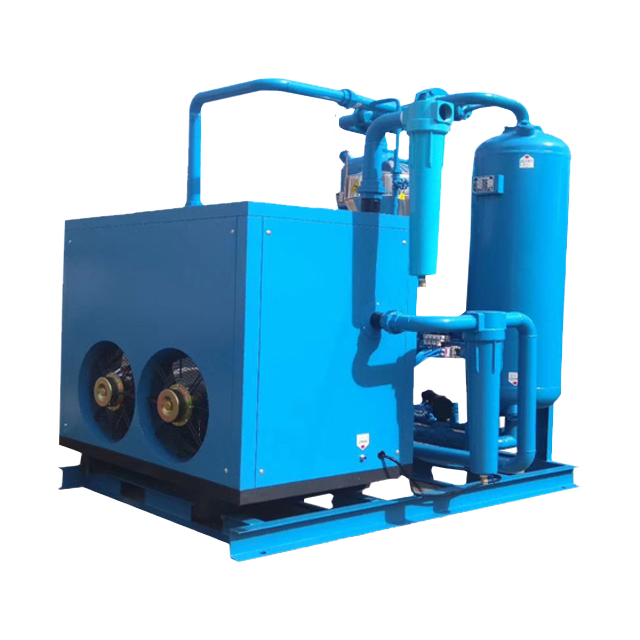
The combined air dryer integrates a refrigerated dryer and an adsorption dryer in a single unit, delivering pressure dew points from -40°C to -70°C for compressed air systems that need drying below the range of standalone refrigerated dryers. The refrigeration stage removes the bulk of the moisture with low energy consumption and no purge air loss; the adsorption stage finishes the drying to a low dew point. Regeneration uses electric heating with blowing cooling, and purge air consumption is held at 3-5% of rated flow. Commercial users deploy this dryer where process or product quality depends on stable, low-dew-point air.
High-temperature, high-humidity compressed air enters the refrigeration stage first. Cooling condenses gaseous water into liquid, which is separated and drained, cutting the moisture load before the air reaches the adsorbent.
The pre-dried air then passes through the desiccant bed, where remaining moisture is adsorbed down to a pressure dew point of -40°C to -70°C. The desiccant is regenerated in a heating plus blowing cooling cycle, and tower switching maintains continuous air supply.
Dried low-temperature air exchanges heat with incoming humid air, pre-cooling the inlet and lowering the load on the refrigeration system. The recovered heat supports regeneration, keeping operating cost under control.
· Refrigerated dryer, adsorption dryer, and oil-removal filtration are integrated in one skid; the compact layout simplifies installation and piping.
· Desiccant service life is stated at more than three times that of conventional adsorption dryers, reducing replacement cost.
· Microcomputer program control automates the operating cycle; an electronic automatic drain with float or level sensing discharges condensate without manual intervention.
· Tower bodies are designed and manufactured to pressure vessel specifications, with independent filling and discharge ports for adsorbent replacement.
· A process flow diagram on the panel shows operating status directly; a high-efficiency air-water separator with multiple drainage points protects downstream equipment.
· The long working cycle supports unattended operation over extended periods, reducing the operator involvement required in daily service.
The system is perfect and runs smoothly:Excellent refrigeration compressor and components are selected, the system is designed perfectly, and excellent pneumatic butterfly valves are selected inside the machine to ensure the stable operation of the equipment.

Electronic drainer:It adopts imported technology brands and selects an enlarged electronic automatic drainer to eliminate hidden dangers and faults caused by blockages.

Adsorption system:The design and manufacture of the tower body conform to the specifications of the pressure vessel, the selection of excellent desiccant, high compressive strength, non-hydrolysis, the adoption of special design, the continuous supply of air during the switching of the adsorption tower, the slow and stable filling program and switching design, the independent filling port and discharge port, easy to replace the adsorbent.
Flexible operation and clear layout:The panel is equipped with a clear process flow chart, which can directly display the operating status of the equipment, and the output is flexible and reliable.

Compressed Air System Configuration Drawing

The Luoyou series dryer operates continuously under the conditions of rated working conditions (i.e., inlet temperature 38C, inlet pressure 7Kgf/cm2, relative humidity 100% and maximum load 100%), and the outlet dew point will be guaranteed to reach the original design value. To choose a refrigerated dryer correctly, it is necessary to take into account the actual flow of compressed air, pressure, temperature, ambient temperature, and the required pressure dew point temperature. When the "pressure dew point" of compressed air is required to be below zero, a suction dryer is a better device for compressed air treatment.

The combined model integrates both technologies, offering the energy efficiency of a refrigeration dryer and the low dew point performance of an adsorption dryer. It eliminates the limitations of standalone units, providing a balanced solution for efficiency and performance.
Yes, the dryer is designed to process high-temperature inlet air, with a pre-cooling stage that prepares the air for efficient condensation and adsorption. It adapts to varying inlet conditions without sacrificing performance.
Routine maintenance includes checking and replacing the desiccant (when needed), inspecting the automatic drainer, and cleaning filters. The long desiccant lifespan and intelligent design minimize maintenance frequency.