
- Home
- Products
- Hot
- About Us
- Services
- Industry
- Contact
Views: 0 Author: Site Editor Publish Time: 2026-06-16 Origin: Site


Unconditioned compressed air is rarely just a simple functional utility. Instead, it acts as a highly concentrated source of contamination in manufacturing environments. This hidden threat quietly accelerates equipment wear and drives up product defect rates across your entire facility. The physical process of compressing ambient air significantly increases its water-holding capacity. It simultaneously concentrates ambient aerosols into a dense, problematic mixture. Without proper intervention, nearly 80% of these industrial contaminants easily bypass standard compressor defenses. These particles are often smaller than 2.5 microns, making them virtually invisible but highly destructive.
We provide technical buyers and facility engineers with a practical, evidence-based framework. You will learn how to evaluate, size, and implement a compressed air filter system correctly. We aim to help you eliminate localized condensation and protect sensitive pneumatic components. This guide empowers you to optimize energy usage while ensuring complete process integrity for your operations.
Risk Mitigation: Precision filtration acts as the final defense for downstream pneumatic tools, valves, and end-products.
The Energy Trade-off: Higher filtration precision increases system pressure drop (ΔP); balancing air purity with energy consumption is critical for ROI.
Compliance & Standards: Sizing and selection must be anchored to ISO 8573-1 purity classes, rather than arbitrary visual inspections.
Systematic Approach: Effective industrial air purification requires a multi-stage ecosystem, combining mainline filtration, point-of-use units, and automated drainage.
Air compressors pull in massive volumes of ambient air. This ambient air carries moisture, dust, and microscopic debris. Compressing this air heats it up significantly. As the hot air leaves the compressor room, it enters cooler distribution piping. We must understand a fundamental physical law here. Engineers call this the "Rule of 20."
For every 20°F drop in compressed air temperature, 50% of the suspended water vapor condenses. It transforms rapidly into liquid form as it travels downstream. This condensation creates massive challenges. Moisture accumulates rapidly inside your distribution network, setting off a chain reaction of contamination.
The resulting liquid never stays pure. It interacts with other elements to form destructive compounds. You face two primary threat categories:
Liquid and Sludge: Compressors naturally carry over trace amounts of lubricating oil. This oil mixes freely with condensed water. The resulting emulsion forms a highly acidic sludge. This toxic sludge aggressively corrodes metal pipework. It also strips essential lubrication away from internal pneumatic cylinders.
Micro-Abrasives: Unfiltered solid particulates act like liquid sandpaper. These micro-abrasives cause severe scoring on actuator seals. They wear down internal metal surfaces rapidly. This friction inevitably leads to premature valve failure and unexpected production halts.
Effective downstream equipment protection requires clear, measurable outcomes. You must evaluate your filtration success using specific performance metrics. Proper filtration minimizes system pressure fluctuations. It completely eliminates localized water-hammer effects. Most importantly, it ensures strict adherence to required cleanroom or specific manufacturing tolerances.
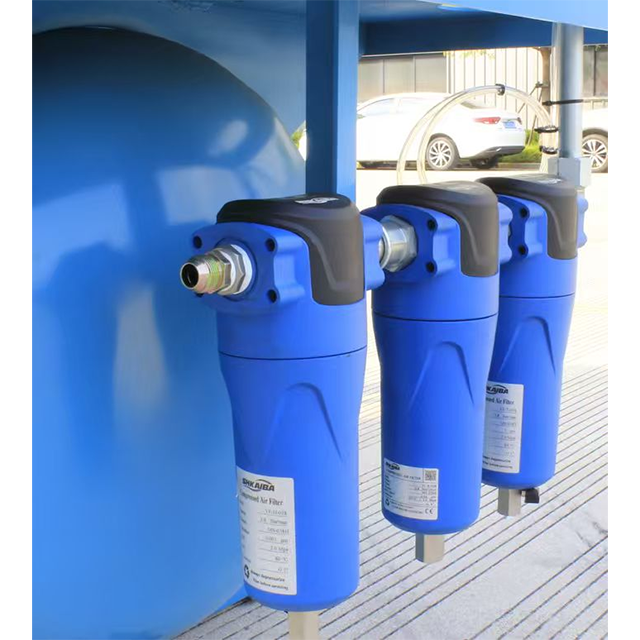
Evaluating your filtration needs requires a diagnostic-first selection approach. You cannot simply buy a generic unit. You must start by auditing the specific impurities present in your facility. Identify whether you are fighting liquid water, oil aerosols, dry dust, or gaseous vapors. Different contaminants require completely different capture mechanisms.
Manufacturers design these specific units for robust solid particle filtration. They utilize fine mesh structures or surface-loading membrane technologies. These materials effectively intercept dry contaminants like pipe scale and ambient dust.
These units typically act as general-purpose pre-filters. They capture bulk debris early in the distribution cycle. This positioning protects finer downstream media from premature clogging. They also safeguard primary pneumatic tools from catastrophic internal jamming.
Coalescing technology operates on a completely different physical principle. These units force microscopic aerosols to collide within dense fiber beds. The tiny aerosols merge into much larger droplets. Gravity then pulls these heavy droplets downward so the system can drain them.
Modern coalescing units offer incredible performance specifications. High-efficiency grades routinely capture particles down to 0.01 microns. They achieve an impressive 99.99% capture efficiency. You need these units as a combined oil mist removal filter and moisture removal filter. Sensitive environments demand them. Paint spraying operations, electronics assembly, and pharmaceutical plants rely heavily on coalescing technology.
Some processes cannot tolerate gaseous hydrocarbons or odors. These applications require activated carbon filters. They utilize adsorption mechanisms via highly porous carbon beds. The vast internal surface area traps gaseous molecules securely.
Performance specifications for carbon beds are exceptionally strict. They can reduce residual oil vapor content to as low as 0.002 PPM. However, you must use them strictly for vapor phases. You must always place coalescing filters upstream of carbon units. This prevents liquid fouling, which destroys the carbon bed instantly. Food packaging and breathing air applications make carbon filters mandatory.
Use the table below to compare these distinct technologies quickly.
Filter Category | Primary Contaminant Target | Capture Mechanism | Typical Precision |
|---|---|---|---|
Particulate | Dry dust, rust, pipe scale | Surface-loading mesh interception | 1 to 5 microns |
Coalescing | Water aerosols, oil mist emulsions | Droplet collision and gravity drainage | Down to 0.01 microns |
Activated Carbon | Hydrocarbon vapors, odors | Porous bed adsorption | Vapor phase (0.002 PPM) |
Engineers face a harsh physical reality regarding air purification. Tighter filtration media creates much higher resistance to airflow. We measure this resistance as Pressure Drop, or ΔP. Pushing compressed air through incredibly dense material requires more force. This extra force translates directly into increased electricity consumption.
Over-filtering inflicts a heavy financial penalty on manufacturing operations. We follow a strict engineering baseline metric here. Every 1 PSI of pressure drop consumes approximately 0.5% more compressor brake horsepower (BHP). These seemingly minor pressure drops accumulate rapidly across a large facility. They inflate your annual energy bills significantly. You must balance the need for air purity with the cost of energy.
You should evaluate media types carefully before purchasing. Compare traditional depth-loading cellulose media against modern alternatives. Modern nano-fiber and surface-loading technologies maintain a much lower ΔP over their lifecycle. They trap dirt on the surface rather than deep inside the material matrix.
We strongly advise against arbitrarily specifying "medical grade" filtration. Many facilities request ultra-high purity for general utility applications. This is a massive engineering mistake. Unnecessary precision chokes your air supply. It forces your compressors to run harder and hotter. This poor decision artificially inflates your lifetime energy costs.
You must stop viewing filtration as an isolated, single component. Treat it as an interdependent system instead. Comprehensive industrial air purification requires a holistic ecosystem approach. The air travels from the inlet, through the compressor oil separator, into inline filtration, and finally to the point-of-use. Each stage relies entirely on the success of the previous stage.
Building a resilient pipeline architecture requires sequential staging. Follow these necessary installation steps to protect your network:
Step 1: Mainline Bulk Removal. Install heavy-duty water separators first. Place general-purpose particulate filters immediately downstream of your main receiver tank. This stage handles the heavy lifting. It removes massive volumes of liquid and large pipe scale early.
Step 2: Point-of-Use Precision. Do not rely solely on compressor-room filtration. Place fine coalescing and carbon filters as close to the sensitive downstream application as physically possible. This specific placement catches newly formed condensation. It also traps pipe scale generated between the compressor room and the factory floor.
Perfect filters fail if you install them in poor pipeline architectures. You must detail your pipe layouts meticulously. Incorporate "drip legs" at low points in your piping network. These are deliberate vertical drops. They allow gravity to collect bulk water away from the main air stream.
Furthermore, upgrade your entire system from manual bleed valves. Install electronic auto-drains at every drip leg and filter bowl. Manual valves depend on human memory, which inevitably fails. Electronic drains purge moisture reliably. This prevents massive liquid slugs from building up and bypassing your filter media entirely.
Poor maintenance practices destroy the best filtration systems. Industry myths cause many facilities to run compromised equipment for months. You must break these bad habits to ensure continuous protection.
Many operators glance at a filter element and assume it functions well. They believe it looks clean enough. Clarify this misconception immediately. Human eyesight caps out at roughly 40 microns. However, precision filters capture sub-micron contaminants. These elements will look perfectly clean to the naked eye long after they are saturated. They degrade invisibly. Visual inspection provides zero technical value.
Facility engineers often treat DP gauges as air quality monitors. Explain to your team that DP gauges are uncalibrated blockage indicators. They often have a wide accuracy variance of ±25%. Furthermore, current airflow rates heavily influence their physical readings. A gauge might read green simply because the compressor runs at a low load.
The Risk: Relying on DP gauges creates dangerous blind spots. A ruptured filter element allows dirty air to bypass the media freely. Because there is no resistance, the DP gauge drops to zero. It stays in the green zone perfectly. Meanwhile, severe contamination floods your downstream equipment.
We recommend establishing rigid maintenance schedules immediately. Base these schedules strictly on operating hours. A common industry standard replaces elements every 8,000 hours or annually, whichever comes first. Anchor your sizing and replacement cycles to specific ISO 8573-1 target classes. This international standard categorizes purity into Particulate, Water, and Oil classes. Stop relying on gauge readings or visual checks. Follow the data instead.
Implementing precision filtration demands an initial capital expenditure, but the returns justify the cost entirely. The financial investment is quickly eclipsed by substantial energy savings. By utilizing modern media with low pressure drops, you reduce compressor workload. Furthermore, you avoid catastrophic equipment downtime and eliminate ruined production batches.
Use a logical shortlisting process for your facility. Map your required ISO 8573-1 purity classes by individual manufacturing zones. You do not need breathing-air quality for heavy pneumatic tools. Audit your current compressor oil carryover rates to understand your baseline contamination load.
Take proactive next steps today. Encourage your maintenance team to consult with a certified air systems auditor. They can measure your baseline pressure drops accurately. They will correctly size modular filtration units for your specific cfm flow rates. This ensures your downstream assets remain protected without wasting energy.
A: No. Using hot water, compressed air blow-off, or chemical solvents destroys the filter entirely. These aggressive cleaning methods tear the delicate sub-micron fiberglass or alter the internal membrane structures. Once you wash an element, it loses all structural integrity, rendering the filter completely useless for precision applications.
A: This situation likely indicates a ruptured filter element. The internal media has torn, allowing air to bypass the filtration layer entirely without resistance. Alternatively, your compressor might be running at a very low flow rate where the pressure drop simply isn't registering on the analog gauge.
A: Yes. Refrigerated dryers lower the system dew point to prevent new condensation from forming. However, they do not remove existing liquid aerosols, abrasive pipe scale, or heavy oil emulsions. You require both technologies working together for complete and reliable downstream equipment protection.


