
- Home
- Products
- Hot
- About Us
- Services
- Industry
- Contact
Views: 0 Author: Site Editor Publish Time: 2026-05-29 Origin: Site


Untreated compressed air introduces millions of contaminant particles per cubic foot. This invisible threat leads directly to premature pneumatic equipment failure. It causes expensive product spoilage. It also triggers unexpected facility downtime. You simply cannot afford to ignore your plant's air quality.
Selecting the right air compressor filter is not just about catching dirt. It requires a delicate balancing act. You must achieve the necessary air purity for your specific application. You must also minimize pressure drop to control skyrocketing energy costs. Finally, you need to standardize your daily maintenance workflows to prevent human error.
This guide provides a strict, evidence-based framework. You will learn how to evaluate, size, and sequence filters properly. We will show you how to meet industry compliance standards. You will discover how to achieve this without over-engineering your system. Follow these steps to keep your equipment running smoothly and efficiently.
Filter Types Serve Distinct Roles: Inlet filters protect the compressor, while inline filters (particulate, coalescing, adsorption) protect the end product.
ISO 8573-1 is the Benchmark: Selection should always start backward from the specific air purity class required by your application.
Beware the Pressure Drop: Over-filtering increases resistance; every 2 PSI of pressure drop increases compressor energy consumption by roughly 1%.
Drains Matter: The efficiency of an inline filter relies heavily on the correct selection of automated drainage systems.
Maintenance Economics: Relying on a differential pressure gauge, rather than just a calendar, prevents costly energy waste from clogged elements.
You cannot specify a filter until you understand what you are removing. Industrial air systems face four primary pollution threats. They originate from the ambient environment and the compressor itself.
Particulates: Ambient air contains massive amounts of microscopic dust. Your piping network also creates internal rust and scale. These solid particles act like sandpaper. They quickly erode pneumatic valves and score cylinders.
Water (Vapor and Liquid): The compression process concentrates atmospheric humidity. This humidity cools and condenses into liquid water. It causes internal pipe corrosion. It also ruins sensitive spray and coating processes.
Oil (Aerosols and Vapors): Most industrial compressors inject oil for lubrication and cooling. Some oil bypasses internal separators. It enters the air stream as fine mists or vapors. This oil degrades downstream pneumatic seals. It severely contaminates food or pharmaceutical products.
Microorganisms: Bacteria and fungi thrive in untreated networks. They love warm, moist, and oily environments. These microorganisms multiply rapidly inside air receivers. They pose severe health risks for breathing air or sterile packaging lines.
The science of compressor filtration relies on several microscopic mechanisms. Filters do not just act like simple sieves. They utilize advanced fluid dynamics.
Inertial Impaction & Interception: Large particles travel fast. They have high mass. They cannot navigate the twisting paths inside the filter media. They crash directly into the fibers. The filter traps them physically. Interception catches slightly smaller particles. These particles follow the airflow. However, they brush against the fibers and get stuck.
Diffusion (Brownian Motion): This principle is essential for capturing ultra-fine aerosols. Particles smaller than 0.1 micron lack the mass for impaction. They bounce erratically as gas molecules strike them. This chaotic movement is Brownian motion. It forces tiny particles to collide with filter fibers.
Adsorption: This is a chemical process. Active carbon filters rely on it. They feature immense internal surface areas. Odor molecules and oil vapors enter the carbon pores. Molecular bonding traps them tightly. Adsorption eliminates foul smells and dangerous gases.
The filtration journey begins outside the compressor and ends at your pneumatic tools. Different zones require entirely different filter technologies. Buyers often confuse equipment protection with product protection.
These components sit directly on or inside the air compressor unit. They protect the expensive host machine from premature death.
Inlet Air Filters: This is your first line of defense. It prevents large ambient dust from entering the intake valve. It stops dirt from scoring compressor rotors and cylinders.
Oil Filter for Compressor: Lubricated machines circulate oil constantly. An oil filter for compressor removes metal shavings and degraded oil sludge from the internal lubrication circuit. It prevents bearing failures.
Air Oil Separator: An air oil separator is critical for rotary screw machines. It strips heavy liquid oil from the compressed air. It does this before the air exits the compressor housing.
These units sit in the downstream piping network. They clean the compressed air before it touches your end product or automation equipment.
Dry Particulate Filters: Facilities usually install these after a desiccant dryer. Desiccant beads generate fine dust over time. This filter catches that dust before it travels downstream.
Coalescing Inline Filters: These are the workhorses of air treatment. They merge sub-micron oil and water aerosols into larger droplets. These heavy droplets fall to the bottom bowl for removal.
Adsorption (Active Carbon) Filters: You use these to remove gaseous oil vapors and odors. They require strict pre-filtering. Any liquid oil will instantly ruin the carbon bed.
FRL Units (Filter, Regulator, Lubricator): These sit at the point-of-use. They provide final, localized filtration. They protect specific pneumatic tools or robotic actuators right before air consumption.
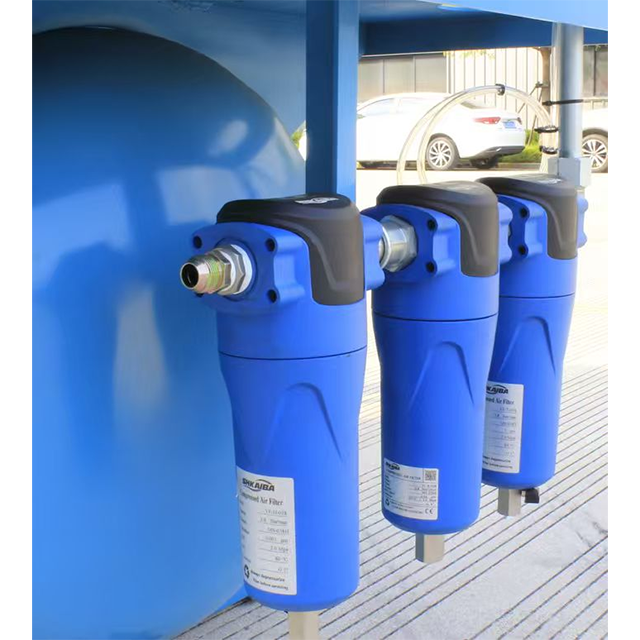
Purchasing filters randomly leads to disaster. You might starve your tools of air. You might allow dangerous contaminants into a sterile zone. Procurement and engineering teams should follow this strict, consultative decision-making matrix.
You must align your filter precision to industry compliance. Never guess your required air quality. ISO 8573-1 is the global benchmark. It defines exactly how much dirt, water, and oil is permissible.
ISO 8573-1 Class | Solid Particulates (Maximum Size) | Total Oil (Aerosol + Vapor) | Typical Industrial Application |
|---|---|---|---|
Class 1 | < 0.01 micron | < 0.01 mg/m³ | Pharmaceuticals, Food & Beverage packaging. |
Class 2 | < 0.1 micron | < 0.1 mg/m³ | Microelectronics assembly, Spray painting. |
Class 3 | < 5.0 micron | < 1.0 mg/m³ | General pneumatic tools, CNC machining. |
Airflow volume dictates your housing size. You must never undersize a compressed air filter. Ensure the housing and element are rated for the maximum CFM of your compressor. You must calculate this at your lowest operating pressure. High air velocity pushes liquids directly through the media. It creates a massive bottleneck.
Tighter filtration inherently increases pressure drop. This is an undeniable physics rule. Pushing air through a dense 0.01-micron media requires more energy than pushing it through a 5-micron mesh. If extreme energy efficiency is a priority over absolute purity, reconsider your choices. You might evaluate high-efficiency pleated media. You could also explore alternative mist eliminator vessels for heavy liquid loads.
Your filter bowl collects liquid. You must get that liquid out. Manual drains rely entirely on human memory. Operators forget to open them. The bowl fills up. The air stream then pushes the dirty water downstream. You must select an automated solution.
Drain Valve Type | Operation Mechanism | Best Use Case | Maintenance Risk Level |
|---|---|---|---|
Manual Drain | Operator twists a knob to release accumulated liquid. | Small, rarely used backup air systems. | High. Operators frequently forget to empty them. |
Semi-Automatic | Opens automatically when line pressure drops to zero. | Single-shift facilities turning off compressors at night. | Medium. Fails if the system stays pressurized 24/7. |
Float-Operated | Internal float rises with liquid level to open the valve. | General continuous manufacturing lines. | Low. However, heavy oil sludge can jam the float. |
Zero-Loss Electronic | Capacitive sensors trigger a valve without losing air. | High-efficiency, 24/7 critical industrial plants. | Very Low. High upfront cost but saves massive energy. |
You rarely use just one filter. Industrial systems require a cascade approach. You chain filters together to distribute the workload. This prevents finer elements from blinding prematurely.
You must follow strict sequencing rules. Never install an active carbon vapor filter without a coalescing filter upstream. Active carbon removes invisible vapors. It cannot handle bulk liquids. If liquid oil hits a carbon bed, it saturates the pores instantly. The expensive filter becomes useless in minutes.
A standard industrial setup follows a logical progression. You remove large debris first. You remove bulk water next. You tackle fine aerosols last.
Standard Manufacturing Setup: Compressor → Wet Receiver Tank → General Purpose Particulate Filter (e.g., 1 micron) → Refrigerated Air Dryer → High-Efficiency Coalescing Filter (e.g., 0.01 micron).
Medical or Breathing Air Setup: Follow the standard setup. Then add an Activated Carbon tower. Finally, install a highly rated precision filter post-drying to catch any stray carbon dust.
Installing the right housings is only the first step. Air treatment systems require ongoing vigilance. Ignoring filter maintenance creates massive operational risks. It also drains your facility's energy budget silently.
As a filter traps dirt, it clogs. Air struggles to push through the saturated media. This resistance is called pressure drop. The compressor must work harder to maintain system pressure. The electricity cost of overcoming a 10 PSI pressure drop will far exceed the purchase price of a new replacement element. Trying to save money by delaying filter changes actually costs you thousands in wasted electricity.
You should completely avoid guesswork. Base your replacement cycles on three concrete metrics:
Manufacturer Operating Hours: Most elements carry an 8,000-hour lifespan rating. Track compressor runtime closely.
Annual Scheduled Shutdowns: Many plants replace all elements during a fixed holiday shutdown. This ensures a fresh start for the year.
Differential Pressure Gauge Readings: This is the most accurate method. The gauge measures resistance across the housing. When the needle hits the red zone, replace the element immediately. Do not wait for a calendar date.
Standardize your replacement protocols. Do not just swap the paper element and walk away. When changing a coalescing element, inspect the automated drain valve simultaneously. Clean the float mechanism. Remove any sticky oil sludge. A fresh filter element is useless if a jammed drain causes the bowl to flood.
Base your final vendor selection on filter housing durability. Look for thick aluminum or steel construction. Verify the local availability of replacement elements. Always demand verified third-party ISO testing certificates from the manufacturer.
Your immediate next step is to conduct a compressed air audit. Baseline your current air quality. Check your existing pressure drops across all housings. Map your facility's specific point-of-use requirements carefully. You must gather this data before procuring any new equipment.
A: A particulate filter captures solid dirt and dust. It traps these dry particles directly within its media network. A coalescing filter handles liquids. It merges tiny, sub-micron oil and water aerosols into larger droplets. These heavy droplets then fall into a bottom bowl for drainage. You use particulate filters for dry dirt and coalescing filters for wet aerosols.
A: You typically replace the separator every 4,000 to 8,000 hours of operation. This depends heavily on your rotary screw compressor's usage. High operating temperatures significantly shorten its lifespan. Poor ambient air quality and degraded synthetic oil also accelerate wear. Always check your manufacturer's specific maintenance schedule.
A: No. Inline filters cannot remove water vapor or humidity. They only remove liquid water droplets and aerosols. To eliminate actual water vapor, you must install an air dryer. Refrigerated or desiccant dryers alter the dew point to extract humidity from the air stream.
A: The most common cause is a heavily saturated or dirty filter element. Air struggles to pass through clogged pores. Another major cause is an undersized housing. If you push too much CFM through a small filter, resistance spikes. Finally, internal component failures or jammed flow diffusers can block the airflow.


