| Availability: | |
|---|---|
| Quantity: | |
The operational excellence of the Low-Pressure PM Rotary Screw Air Compressor is rooted in its advanced mechanical and electrical engineering. Unlike conventional compressors adapted for low-pressure applications, this system is engineered from the ground up to optimize the compression cycle. The working principle relies on the seamless synergy between three core technical mechanisms: the direct-drive permanent magnet motor, the real-time variable speed drive control, and the specialized asymmetric rotor profile. Together, these components ensure that ambient air is drawn in, compressed, and delivered with maximum physical efficiency and minimal energy dissipation.
At the heart of the compression process is the direct coupling of the Permanent Magnet (PM) motor to the main compression unit (airend). In traditional compressor designs, power is transferred from the motor to the rotors via belts or gearboxes. These intermediate transmission methods inherently introduce mechanical friction, alignment deviations, and power losses. The direct-drive mechanism eliminates these physical barriers by mounting the motor and the male rotor on a single, continuous shaft.
This coaxial configuration guarantees zero transmission loss, ensuring that 100% of the motor's mechanical rotational force is directly applied to the compression cycle. Furthermore, the PM motor utilizes high-strength rare-earth magnets to generate a stable, continuous electromagnetic field. This allows the motor to maintain high torque and optimal operational efficiency across a wide range of speeds, particularly during the specific low-pressure operational phases where standard induction motors often experience significant efficiency drops.
The Variable Speed Drive (VSD) acts as the central nervous system of the compressor's operational cycle. The working principle of the VSD is based on a continuous, closed-loop feedback mechanism. Highly sensitive pressure sensors are installed within the air discharge network to continuously monitor the actual system pressure. When pneumatic demand at the application site fluctuates, these sensors transmit real-time data to the VSD controller.
Instead of utilizing the inefficient load/unload cycles common in fixed-speed compressors—which mechanically force the intake valve to open and close repeatedly—the VSD instantaneously adjusts the electrical frequency supplied to the PM motor. By modulating the frequency, the system precisely controls the rotational speed of the motor and, consequently, the rotors. If the air demand decreases, the motor slows down proportionally; if demand increases, the motor accelerates. This continuous physical modulation ensures that the volume of compressed air generated perfectly matches the exact requirements of the end-use equipment, preventing over-pressurization and wasted mechanical effort.
The actual physical compression of air takes place within the airend, which houses a pair of precisely engineered, intermeshing helical rotors. For low-pressure applications, standard rotor profiles often suffer from internal air leakage and inefficient compression ratios. To counteract this, this compressor utilizes an advanced asymmetric tooth design specifically optimized for low-pressure environments.
As the rotors turn, air is drawn into the spaces between the rotor lobes. The asymmetric profile creates a tighter seal along the meshing line and minimizes the blow-hole area—the tiny gaps where compressed air can leak back into the intake side. By reducing internal backflow, the volumetric efficiency of the compression chamber is significantly enhanced. The optimized geometry ensures that the physical work done by the rotors is entirely dedicated to moving and compressing the air to the target low-pressure threshold, maximizing the airflow output per kilowatt of mechanical power exerted.
When evaluating compressed air solutions, the true value lies well beyond the initial purchase price. The Low Pressure PM Rotary Screw Air Compressor is strategically engineered to deliver exceptional commercial value by significantly reducing the Total Cost of Ownership (TCO) while elevating overall plant productivity and operational stability.
Electricity consumption typically accounts for the vast majority of an air compressor's lifecycle cost. The advanced combination of permanent magnet motors and VSD (Variable Speed Drive) technology delivers exceptional energy savings compared to conventional fixed-speed compressors. By intelligently adapting its output to match your facility's real-time air demand, it eliminates the wasteful energy spikes associated with constant idling and unloading. This precise control reduces overall energy consumption, directly lowering monthly utility bills and accelerating your Return on Investment (ROI). Furthermore, these significant energy reductions align perfectly with global decarbonization goals, helping your enterprise meet stringent energy efficiency mandates and sustainability targets.
Maintenance expenses and unexpected downtime can severely impact manufacturing profitability. Designed with a highly efficient transmission structure, this compressor completely eliminates traditional wear components such as belts and gears. Without these parts, there is no need for routine tensioning, alignment, or frequent mechanical replacements. This maintenance-free advantage drastically reduces the workload on your facility's service personnel. In addition, its durable design extends the service intervals for essential consumables, such as air filters, oil filters, and premium lubricants. By minimizing both routine maintenance tasks and the risk of mechanical failure, this system ensures significantly lower lifecycle costs and maximizes your production uptime.
Engineered with long-term sustainability in mind, the Low-Pressure PM Rotary Screw Air Compressor actively supports industrial decarbonization efforts. Beyond simply reducing power draw, the system is constructed using high-efficiency materials and optimized operational processes that minimize its overall environmental footprint. It contributes to a cleaner facility by reducing waste generation, lowering noise pollution, and optimizing fluid usage over its operational life. For companies committed to green manufacturing standards and seeking to improve their corporate environmental responsibility profiles, this compressor serves as a strategic asset that perfectly balances high-volume production needs with ecological preservation.
Consistent, uninterrupted airflow is the lifeblood of modern industrial operations. The precision-engineered rotors and robust PM motor at the heart of this compressor ensure unwavering performance, even during demanding 24/7 production cycles. It is specifically optimized to handle high airflow demands at low pressure without experiencing thermal stress, overheating, or performance degradation over time. This continuous operational reliability means facility managers can trust the system to maintain stable pressure levels, preventing costly production halts and ensuring that critical downstream equipment operates flawlessly shift after shift, year after year.
The Low-Pressure PM Rotary Screw Air Compressor is specifically engineered to meet the demanding requirements of industries that rely on continuous, high-volume, and low-pressure compressed air. By delivering the exact pressure needed for specific industrial processes, facilities can avoid the massive energy waste associated with generating high-pressure air only to reduce it at the point of use. This targeted approach not only significantly lowers operational costs but also enhances the stability and efficiency of production lines across various sectors.
In the highly competitive textile production industry, compressed air is a critical utility, particularly for yarn processing and modern air-jet loom operations. The low-pressure rotary screw air compressor provides the precise, consistent airflow required to keep textile machinery running smoothly. Unlike standard compressors that may cause pressure fluctuations, this dedicated low-pressure system ensures a steady stream of air, which is vital for maintaining delicate yarn tension and preventing yarn breakage during high-speed weaving. By delivering reliable air directly at the required pressure, textile plants can achieve uninterrupted production, improve fabric quality, and drastically reduce the energy consumption typically wasted through pressure reduction valves in traditional setups.
Heavy-duty industries such as cement and glass manufacturing heavily depend on efficient material handling systems. For pneumatic conveying processes, the compressor’s ability to generate high airflow at low pressure is highly advantageous. It efficiently transports bulk materials—such as cement powder, fly ash, silica sand, and other raw ingredients—through extensive pipeline networks. Utilizing low-pressure air for these conveying tasks prevents the degradation or damaging of delicate material particles while minimizing abrasive wear on the conveying pipelines and internal components. This gentle yet powerful material handling method ensures a continuous supply of raw materials to kilns or mixing stations, ultimately lowering maintenance frequency and optimizing overall energy efficiency in harsh industrial environments.
In the food and beverage processing sector, maintaining strict hygiene standards while managing operational costs is a primary concern for facility managers. This low-pressure compressor plays a vital role in supporting automated packaging lines, fermentation processes, and large-scale grain conveying. When transporting sensitive bulk ingredients like flour, sugar, or grains, the low-pressure compressed air provides a smooth, controlled flow that prevents material compaction or damage. Furthermore, its clean operation and stable air delivery help ensure that production environments remain compliant with industry hygiene requirements. By replacing oversized high-pressure systems with a dedicated low-pressure solution, food processing facilities can achieve precise pneumatic control, reduce energy overheads, and maintain consistent production throughput.
Selecting the right air compressor is crucial for operational success in high-volume manufacturing. For processes that inherently require low pressure, utilizing a specialized low-pressure rotary screw compressor eliminates the inefficiency of over-pressurization. This targeted application approach helps procurement teams and plant managers reduce equipment wear, lower lifecycle costs, and achieve a more sustainable production footprint. Whether it is for continuous weaving, heavy bulk material transport, or delicate food processing, this compressor is designed to perfectly align with the specific pneumatic demands of these high-consumption industries, ensuring reliable performance tailored to real-world applications.
Designed for high-airflow industrial applications, this low-pressure PM rotary screw air compressor ensures a consistent and reliable supply of low-pressure compressed air. By maintaining stable pressure levels even under fluctuating operational loads, it helps facilities avoid pressure drops, ensuring uninterrupted performance for critical manufacturing processes while optimizing overall system efficiency.
As reflected in the broad capacity ranges within our technical specifications, the equipment dynamically adapts to varying airflow requirements. This rapid response capability ensures that your facility receives exactly the required volume of low-pressure air at any given moment, effectively eliminating idle running and minimizing unnecessary energy consumption during production shifts without detailing complex internal mechanisms.
To streamline facility management, this compressor series features advanced IoT-enabled smart monitoring. Plant managers and maintenance teams can remotely access real-time operational data, including current pressure levels, motor performance metrics, and automated maintenance alerts. This intelligent system supports proactive and predictive maintenance strategies, allowing personnel to identify and resolve potential mechanical issues before they lead to costly production downtime, thereby maximizing equipment lifespan and operational reliability.
LY-CV series | Working Pressure | Capacity | Power | |||
Bar | Psig | (m3/min) | Cfm | KW | HP | |
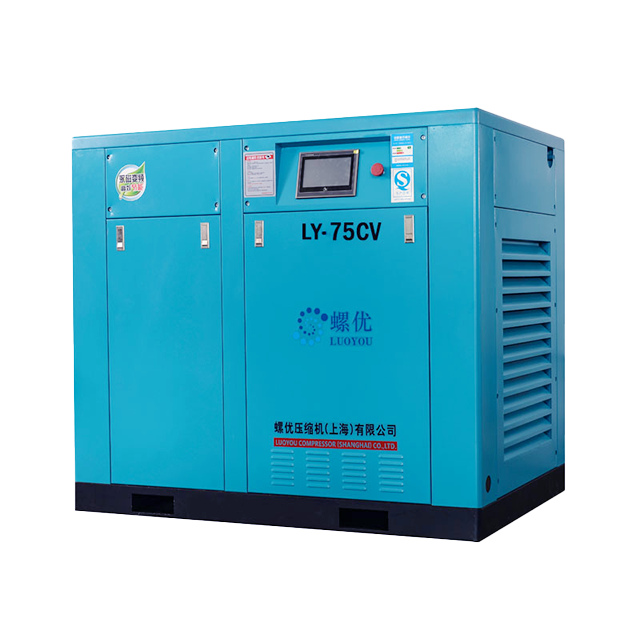
LY-75CV | 4.0-5.0 | 58-73 | 4.3-14.5 | 152-512 | 55 | 75 |
LY-100CV | 4.0-5.0 | 58-73 | 5.8-19.5 | 205-689 | 75 | 100 |
LY-120CV | 4.0-5.0 | 58-73 | 7.2-24.2 | 254-855 | 90 | 120 |
LY-150CV | 4.0-5.0 | 58-73 | 8.2-27.5 | 290-971 | 110 | 150 |
LY-175CV | 4.0-5.0 | 58-73 | 10.2-34.5 | 360-1218 | 132 | 175 |
LY-215CV | 4.0-5.0 | 58-73 | 12.6-42.2 | 445-1490 | 160 | 215 |
LY-270CV | 4.0-5.0 | 58-73 | 15.7-52.5 | 554-1854 | 200 | 270 |
LY-300CV | 4.0-5.0 | 58-73 | 17.3-58 | 611-2048 | 220 | 300 |
LY-350CV | 4.0-5.0 | 58-73 | 18.8-63.1 | 664-2228 | 250 | 350 |
LY-375CV | 4.0-5.0 | 58-73 | 22.3-74.8 | 788-2642 | 280 | 375 |
LY-30CV | 2.1–3 | 30–44 | 1.8–6.5 | 64–230 | 22 | 30 |
LY-50CV | 2.1–3 | 30–44 | 3.4–11.6 | 120–410 | 37 | 50 |
LY-75CV1 | 2.1–3 | 30–44 | 5.1–17.2 | 180–607 | 55 | 75 |
LY-175CV2 | 2.1–3 | 30–44 | 4.6–15.8 | 162–558 | 55 | 75 |
LY-100CV1 | 2.1–3 | 30–44 | 7.2–24.2 | 253–855 | 75 | 100 |
LY-100CV2 | 2.1–3 | 30–44 | 6–20,5 | 212–724 | 75 | 100 |
LY-120CV1 | 2.1–3 | 30–44 | 8.9–30 | 314–1059 | 90 | 120 |
LY-120CV2 | 2.1–3 | 30–44 | 7.2.9–24.2 | 254–855 | 90 | 120 |
LY-150CV1 | 2.1–3 | 30–44 | 10.9–36.5 | 385–1289 | 110 | 150 |
LY-150CV2 | 2.1–3 | 30–44 | 9.6–32. 4 | 339–1144 | 110 | 150 |
LY-175CV1 | 2.1–3 | 30–44 | 14.2–47. 6 | 501–1681 | 132 | 175 |
LY-175CV2 | 2.1–3 | 30–44 | 11.3–37. 9 | 339–1338 | 132 | 175 |
LY-215CV1 | 2.1–3 | 30–44 | 12.8–42. 8 | 452–1511 | 160 | 215 |
LY-215CV2 | 2.1–3 | 30–44 | 15.7–52. 7 | 554–1861 | 160 | 215 |
LY-250CV | 2.1–3 | 30–44 | 19.1–63. 8 | 645–2253 | 185 | 250 |
LY-270CV | 2.1–3 | 30–44 | 21–70. 2 | 742–2479 | 200 | 270 |
LY-350CV | 2.1–3 | 30–44 | 27.5–80 | 972–2830 | 250 | 350 |
The Low-Pressure PM Rotary Screw Air Compressor is specifically designed for sectors that require continuous, high-volume airflow at lower pressure levels. Typical applications include textile manufacturing, cement and glass production, and food and beverage processing. For facility managers and procurement teams in these fields, choosing a dedicated low-pressure system rather than stepping down a standard high-pressure compressor prevents significant energy waste and ensures a more stable, reliable air supply for critical production lines.
The Variable Speed Drive (VSD) technology continuously adjusts the motor's operating speed to precisely match the real-time compressed air demand of your facility. Unlike traditional fixed-speed compressors that frequently run unloaded or overproduce air, the VSD system eliminates idle energy waste. This precise load matching means the equipment only consumes the exact amount of power necessary for current production requirements, serving as a highly effective method to lower daily operational costs.
Yes, this compressor features an integrated IoT-enabled smart monitoring system. Maintenance teams can remotely access real-time operational data, monitor system health, and receive automated alerts for potential operating deviations. This remote diagnostic capability supports predictive maintenance strategies, helping to prevent unexpected downtime, optimize service schedules, and ensure continuous production reliability without requiring constant on-site supervision.
Sustainability is achieved through a combination of enhanced energy efficiency and reduced mechanical waste. The pairing of a Permanent Magnet (PM) motor with VSD technology drastically cuts electricity consumption, directly lowering the overall carbon footprint of your operations. Furthermore, the streamlined transmission design eliminates the need for consumable belts or gears, which minimizes mechanical wear and extends routine maintenance intervals. This results in fewer replacement parts and reduced lubricant disposal over the equipment's lifecycle, actively supporting greener manufacturing practices.