
- Home
- Products
- Hot
- About Us
- Services
- Industry
- Contact
Views: 0 Author: Site Editor Publish Time: 2026-08-03 Origin: Site


Industrial air compressors are almost universally sized for peak capacity and maximum pressure. Facility managers adopt this conservative strategy to prevent frustrating production bottlenecks. However, most industrial plants operate at peak demand less than 20% of the time. Compressed air generation accounts for a massive portion of industrial electricity usage. During non-peak hours, these pneumatic systems experience significant partial-load demand. Compressors misaligned with this operating reality waste enormous amounts of energy daily. They suffer from highly inefficient capacity control mechanisms. This misalignment causes severe blowdown losses and excessive mechanical idling. Ignoring these partial-load conditions directly erodes your operational profitability.
This guide breaks down how you can evaluate compressor technologies based on actual utilization profiles. You will learn to prioritize verifiable performance metrics over standard marketing claims. We will explore lifecycle expenses and critical operational risks associated with modern capacity control systems. You can use these insights to optimize your next major equipment purchase confidently.
Facility operations rarely consume compressed air at a constant, unchanging rate. Shift changes heavily influence your baseline pneumatic requirements. Varying production schedules also create unpredictable spikes in usage. Intermittent pneumatic tool actuation drives rapidly fluctuating airflow needs throughout the day. We define this dynamic, ever-changing usage pattern as variable air demand. You must map this profile accurately to ensure long-term system reliability.
System leaks also artificially inflate your variable demand profile. A facility might lose 20% of its generated air through poorly maintained piping networks. This constant bleed forces the machine to cycle unpredictably. Fixing these leaks changes the underlying demand curve significantly. You should conduct a comprehensive leak audit alongside your routine usage evaluation.
Many engineers fall victim to the dangerous peak capacity trap. They size equipment strictly for hypothetical worst-case production scenarios. They often fail to analyze the average historical utilization rate. This critical oversight leads to severely oversized units on the factory floor. Oversized fixed-speed machines spend excessive time in unloaded operating states. They consume up to 30% to 40% of their full-load power continuously. Surprisingly, they produce absolutely zero usable air during this idling phase. This represents a pure, unrecoverable loss of electrical energy.
This mechanical mismatch causes rapid system degradation over time. Compressors undergo frequent rapid cycling between loaded and unloaded states. This constant shifting accelerates mechanical wear significantly across internal components. Inlet valves deteriorate much faster under these harsh, repetitive conditions. Motor bearings and electrical contactors also suffer from premature failure. You will likely experience increased maintenance downtime as a direct result.
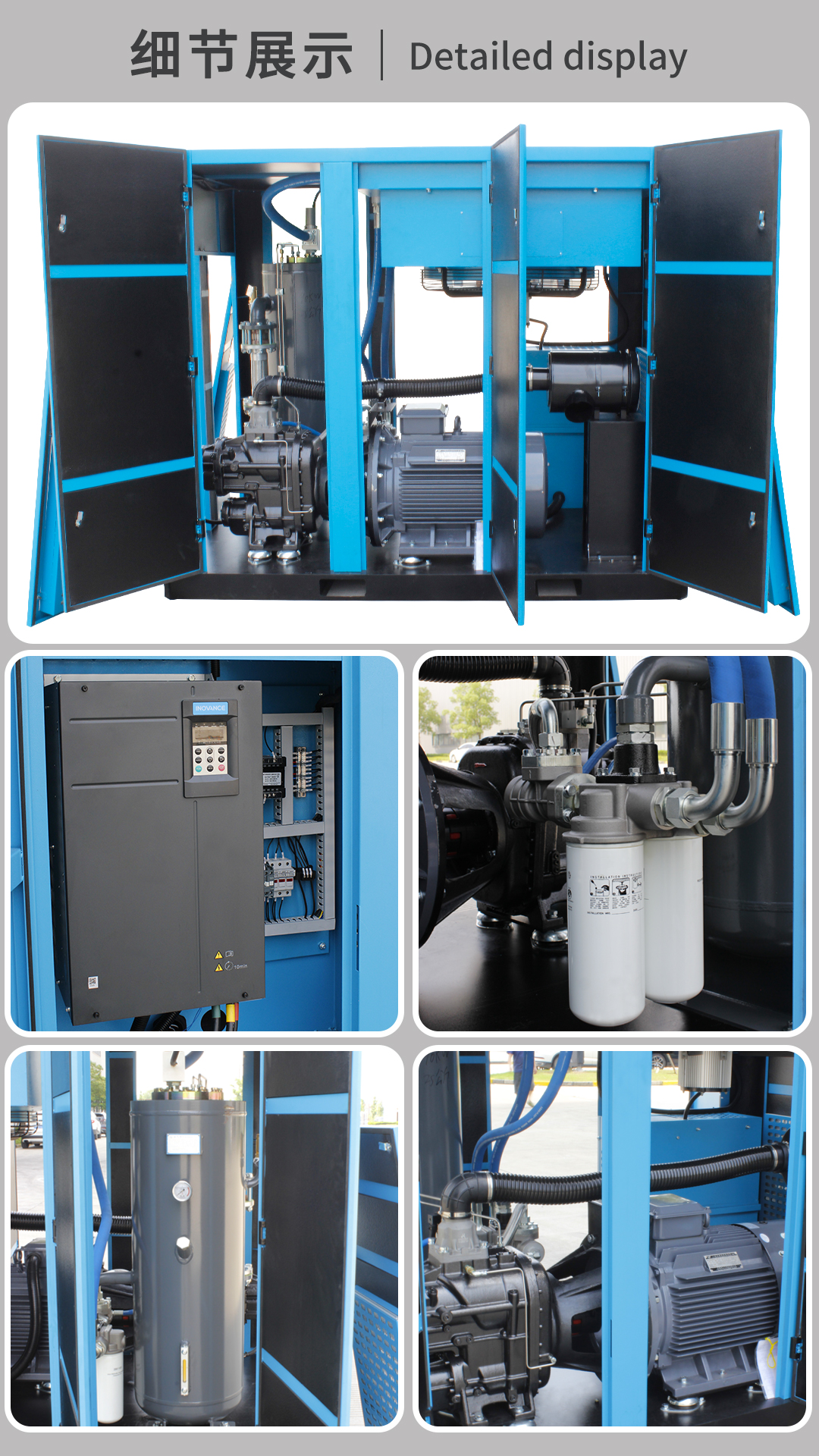
Fixed-speed capacity control typically relies on modulation or load/unload mechanical mechanisms. The main electric motor runs continuously at a fixed, constant RPM. Output changes by physically throttling the inlet valve or fully unloading the airend. This rigid design operates highly efficiently at 100% maximum load. However, it becomes highly inefficient when plant demand drops to 50% capacity. Energy consumption remains disproportionately high despite the drastically lower air output.
Conversely, a variable speed air compressor operates using a fundamentally different approach. It dynamically adjusts the motor RPM to perfectly match real-time plant demand. This advanced technology maintains near-linear energy consumption across its entire turndown range. It also eliminates dangerous electrical current spikes associated with traditional hard starts. The integrated drive provides smooth, reliable soft-starting capabilities. This reduces peak demand charges on your monthly utility bills.
Traditional fixed-speed motors draw up to six times their full-load current during startup. This massive inrush current penalizes your facility through peak utility demand charges. A soft-starting inverter gradually ramps up the motor frequency smoothly. It keeps the starting current closely aligned with the actual operating current. This electrical gentleness extends the lifespan of internal windings and drive belts.
Rotary screw models pair exceptionally well with VSD electrical technology. They maintain optimal compression efficiency across a wide variety of operating speeds. They do not require the wide pressure bands necessary in standard load/unload systems. This stable pressure control reduces artificial demand across your entire plant network. You can safely maintain a tighter, lower overall system pressure.
Compressor Control Technology Comparison
| Feature | Fixed-Speed (Load/Unload) | Variable Speed Drive (VSD) |
|---|---|---|
| Motor RPM | Constant (100% Speed) | Variable (Matches Demand) |
| Part-Load Efficiency | Poor (High idle energy use) | Excellent (Near-linear power use) |
| System Pressure Control | Wide pressure bands required | Tight, consistent pressure control |
| Starting Current Spikes | High (Hard starts) | Eliminated (Soft starts) |
Evaluating a partial load compressor requires looking past basic full-load marketing claims. You must compare Specific Power metrics accurately across different manufacturers. This vital value measures kilowatts consumed per 100 cubic feet per minute (cfm). You should review standardized CAGI data sheets carefully during procurement. Examine the specific power at 40%, 60%, and 80% capacities specifically. This reveals the true compressor efficiency under realistic, daily operating conditions.
Lifecycle Cost (LCC) analysis is another mandatory evaluation step for plant engineers. You must weigh capital expenditure (Capex) heavily against operational expenditure (Opex). VSD units usually carry a 20% to 30% upfront price premium. However, they often achieve full financial ROI within 12 to 24 months. Highly variable manufacturing applications see the fastest and most reliable returns.
Compressors typically operate for ten to fifteen years before requiring replacement. Over this extensive lifespan, initial purchase price accounts for merely ten percent of total expenditure. Routine maintenance claims another ten percent of the overall budget. Electricity consumption dominates the remaining eighty percent of the financial pie. Therefore, optimizing partial-load performance yields massive dividends over the equipment's entire life.
Finally, consider local energy compliance codes and available financial incentives. Many regional utility providers offer substantial rebates for upgrading industrial equipment. They provide prescriptive or custom rebates for installing variable-speed technologies. These incentives drastically alter your net Capex calculations during budgeting. They make advanced inverter drives far more accessible for budget-conscious facilities. Always consult your local energy provider before finalizing a purchase order.
Variable speed technology is not a universal cure for every pneumatic issue. You must understand exactly when these advanced drives underperform mechanically. Running a variable-speed unit continuously at 100% load is surprisingly problematic. It is actually less efficient than a comparable fixed-speed baseline machine. You lose roughly 2% to 3% of electrical energy across the inverter drive. You should reserve VSDs strictly for fluctuating application scenarios.
Minimum turndown limits present another serious technical risk for facility operators. Operators should avoid running units consistently below 20% to 30% capacity. Low RPM operation severely limits the internal cooling fan effectiveness. This prevents the machine from reaching its proper minimum operating temperature. Consequently, moisture condensation builds up rapidly within the lubrication oil circuit. This water contamination degrades oil viscosity and destroys internal bearing life.
Inverter drives are also highly sensitive to ambient environmental conditions. Manufacturing facilities often contain heavy airborne particulates like dust or metal shavings. Extreme summer temperatures also threaten sensitive solid-state electrical components. Plant managers must invest in specialized NEMA-rated protective enclosures. Sometimes, remote drive mounting in a climate-controlled electrical room becomes necessary.
Furthermore, inverter drives can introduce electrical harmonic distortion into your facility's power grid. These harmonics interfere with sensitive electronic equipment nearby. You might need to install line reactors or harmonic filters alongside the drive. This additional hardware increases the initial installation complexity. Always consult an electrical engineer to evaluate your plant's power quality beforehand.
You must establish a proper data baseline before upgrading any equipment. Never purchase heavy industrial machinery based on rough estimation alone. Mandate a comprehensive 7-day minimum data logging audit from your vendor. This audit must capture flow, pressure, and exact power consumption accurately. It will highlight weekend usage, shift-change drops, and peak behavioral spikes. You need this empirical data to justify the initial capital investment.
Many successful plants utilize a proven base and trim operational strategy. This is the lowest-risk architecture for multi-compressor installations today. You size a robust fixed-speed machine to handle the constant base load. Then, you deploy a VSD screw compressor to trim the fluctuating production peaks. This strategic combination guarantees maximum efficiency across all possible production phases.
Managing a base and trim system requires a sophisticated master controller. This central brain monitors system pressure drops in real-time. It commands the fixed-speed unit to remain fully loaded during standard shifts. It then smoothly accelerates the VSD machine to cover any sudden pneumatic spikes. This orchestration prevents both machines from fighting each other for control.
Implement a strict vendor evaluation checklist during the final procurement phase. Require every vendor to provide a simulated, custom energy profile. They must map their proposed machine's performance curve directly for you. It should overlay perfectly against your facility's audited demand data.
Selecting machinery based on partial-load realities is a strategic energy investment. It moves well beyond a basic industrial procurement task. You must prioritize empirical data over outdated assumptions to protect your bottom line.
Embracing variable-speed technology provides a direct solution for fluctuating demand. However, rigorous data logging validates the actual financial return properly. Careful consideration of operating constraints ensures lasting equipment reliability over time.
A: The operational range typically spans from 20% to 100% capacity. However, optimal efficiency and reliability remain between 40% and 80%. Running consistently below the 20% threshold presents serious mechanical risks. It causes poor internal lubrication and allows dangerous moisture condensation inside the oil circuit.
A: Traditional load/unload control schemes keep the internal motor spinning continuously. The machine consumes roughly 30% of its full-load kilowatt rating while idling. It uses this massive amount of energy just to overcome internal mechanical friction. It produces absolutely no compressed air during this unloaded phase.
A: Industry experts generally discourage this risky practice. Standard motors and airends are not engineered for variable speeds. Retrofitting often causes severe motor overheating. You also risk rapid bearing failure due to low RPM oil flow. Furthermore, drive incompatibility can void your existing equipment warranties entirely.


