
- Home
- Products
- Hot
- About Us
- Services
- Industry
- Contact
Views: 0 Author: Site Editor Publish Time: 2026-09-14 Origin: Site


Uncontrolled moisture in compressed air systems creates massive problems for industrial facilities. It leads directly to premature pneumatic equipment failure. It causes severe product contamination on production lines. It also triggers expensive compliance breaches in regulated sectors. You must handle air moisture properly. Choosing between a refrigerated vs adsorption air dryer is rarely a simple task. You do not just pick the "best" unit from a catalog. Instead, you match moisture removal capacity to your specific operational baseline. You must also align this choice strictly with industry standards like ISO 8573-1.
We wrote this guide to provide an evidence-based comparison. It will help technical buyers and facility managers evaluate technical compatibility. We focus heavily on risk mitigation and lifecycle efficiency before you procure new equipment. You will learn how ambient conditions dictate specific technology choices. We will also explore why dew point metrics matter most for system health. Finally, we uncover the hidden operational demands behind desiccant regeneration cycles.
You cannot select air treatment equipment without defining your success criteria first. The pressure dew point (PDP) acts as this primary metric. It represents the exact temperature where water vapor condenses into liquid water. This condensation happens at your current working system pressure. You must keep your air temperature above this specific dew point.
Establishing the correct baseline requires careful calculation. If you over-specify your PDP target, you waste massive amounts of energy. Pushing your system harder than necessary inflates your operating expenses drastically. You will pay for extreme dryness you do not actually need. Conversely, under-specifying your target brings immediate operational disaster. Liquid water will form inside your pipes. This leads directly to internal rust formation. Winter temperatures will freeze your air lines solid. Your expensive pneumatic tools will suffer rapid degradation.
We recommend a clear decision rule for facility managers. You must outline the exact threshold for your plant. Does your facility operate entirely indoors? Do you only need to prevent liquid water formation? If so, a +3°C (38°F) PDP works perfectly. This meets ISO 8573-1 Class 4 requirements. However, many industries require zero vapor presence. Medical air lines, direct food contact areas, and microelectronics manufacturing fall into this category. Here, sub-zero PDP targets become mandatory. You cannot bypass this fundamental physical requirement.
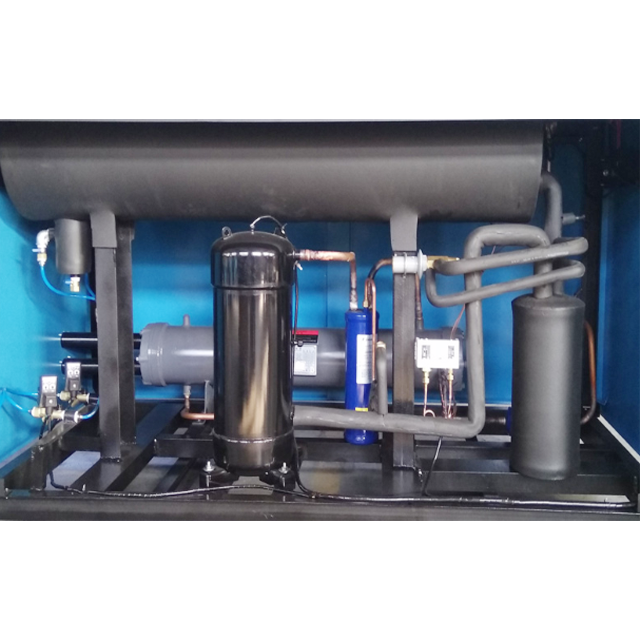
Refrigerated units dominate standard manufacturing plants worldwide. They operate using a straightforward, highly reliable cooling process. Warm, wet air from the compressor enters a heat exchanger. The system uses commercial refrigerants to drop the incoming air temperature. The air cools down to approximately 3°C (38°F). This sudden temperature drop forces water vapor to condense into liquid droplets. A moisture separator then collects this liquid water. An automatic drain valve expels it from the system entirely. Finally, the system reheats the outgoing dry air. Reheating prevents pipe sweating downstream.
You will find several system variations on the market. Standard units use internal fans for air-cooling. These air-cooled units offer a compact, standard footprint. They work perfectly in normal indoor room temperatures. However, hot environments demand a different engineering approach. High ambient temperatures cripple air-cooled condenser efficiency. In these harsh environments, you should deploy a water-cooled freezing dryer. These units use a dedicated liquid loop to reject internal heat. They stabilize drying performance during brutal summer months.
These units offer distinct operational pros. You face a much lower initial capital investment. The maintenance burden remains minimal. You never have to worry about messy desiccant replacements. Overall energy consumption stays relatively low compared to alternative technologies. They provide highly reliable service for general pneumatic tooling operations.
However, you must understand their specific cons and limitations. They absolutely cannot prevent freezing in outdoor pipes during winter. Their mechanical cooling circuits simply cannot reach sub-zero temperatures. Furthermore, they fail completely to meet stringent ISO 8573-1 Class 1 or Class 2 moisture requirements.
Critical applications require a completely different moisture removal strategy. We often call these adsorption systems desiccant dryers. They rely on a heavy-duty dual-tower design. These robust metal towers contain specialized media like silica gel or activated alumina. The process relies on physical adsorption rather than cooling. One tower actively dries the incoming wet air. The desiccant beads trap water molecules inside their microscopic pores. Simultaneously, the second tower regenerates its saturated desiccant bed. A controller swaps their roles every few minutes.
System variations exist based on how they handle regeneration. Heatless models use a portion of the freshly dried air to purge moisture. We call this purge air. Heated purge models use external electrical heaters to reduce this air loss. For peak efficiency, facilities often install a microthermal adsorption dryer. This unit acts as a highly efficient technological hybrid. It utilizes very minimal heat alongside extremely low purge air volumes. This advanced design optimizes daily operating expenses significantly.
The pros of adsorption technology center on extreme performance. They easily achieve ultra-low dew points. Ratings ranging from -40°C to -70°C (-40°F to -100°F) are industry standard. They guarantee 100% prevention of downstream freezing. This remains true even in harsh sub-zero outdoor climates. They easily meet all sterile and critical manufacturing compliance regulations.
The cons and limitations revolve around financial and energy impacts. They require a significantly higher upfront budget. You face ongoing, expensive desiccant replacement schedules. They also carry severe hidden energy penalties. The purge air loss can easily consume 15% of your total compressor capacity in basic heatless models.
Proper procurement requires a structured evaluation method. Setting up a comprehensive air dryer selection framework simplifies the buying process. You must evaluate multiple dimensions simultaneously. Single-variable decisions usually lead to expensive operational mistakes.
Refrigerated units win easily on initial price tags. They also draw much less raw electrical power. Desiccant units cost substantially more upfront. Furthermore, they demand careful calculation of regeneration energy. You must account for the exact cost of purge air generation. Wasting 15% of your compressed air is highly expensive over a ten-year lifespan.
Desiccant models demand significantly more vertical floor space. They utilize large twin towers and complex valving networks. They often require heavy-duty concrete mounting pads. Refrigerated units offer a compact, simple footprint. You can often tuck them into small compressor room corners. They represent a true plug-and-play installation.
Refrigerated units require basic HVAC-style maintenance. You must perform periodic refrigerant top-offs. You also need to clean the condenser coils regularly. Desiccant units require intense, specialized maintenance. You must perform mandatory silencer checks. You must also schedule full desiccant bed replacements every few years. This requires plant downtime and specialized labor.
Ambient intake temperature affects both systems differently. High ambient room temperatures harm refrigerated systems directly. Their internal cooling circuits struggle to reject heat into a hot room. Conversely, desiccant dryers handle hot rooms better mechanically. However, high inlet air temperatures reduce the moisture-holding capacity of the desiccant beads.
Air Dryer Technology Comparison Matrix
| Feature Category | Refrigerated Dryer | Adsorption (Desiccant) Dryer |
|---|---|---|
| Target Pressure Dew Point | +3°C (38°F) | -40°C to -70°C (-40°F to -100°F) |
| Initial Investment (CAPEX) | Low to Moderate | High |
| Operating Costs (OPEX) | Low (Standard electricity draw) | Moderate to High (Purge air loss + Heater power) |
| Maintenance Burden | Minimal (Coil cleaning, drain checks) | Heavy (Desiccant replacement, valve rebuilds) |
| Best Application Environment | Indoor piping, general manufacturing | Outdoor piping, food, pharma, electronics |
| ISO 8573-1 Moisture Class | Class 4 | Class 1 or Class 2 |
Buying the right technology only solves half your moisture problem. You must also implement it correctly. Poor installation design destroys expensive air treatment equipment rapidly. Facility managers must understand specific rollout risks.
You must install coalescing oil filters upstream of any desiccant unit. We cannot overstate this strict requirement. Oil vapor from lubricated compressors will permanently contaminate a desiccant bed. The oil coats the microscopic pores of the activated alumina. This destroys its ability to absorb water vapor. You will ruin a massive capital investment instantly. Refrigerated units handle trace oil better, though filtration remains a best practice.
You must check your existing compressor capacity carefully. We often see facilities add a heatless adsorption unit blindly. They fail to account for the 15% purge air requirement. If your current compressor already runs at 100% capacity, you have a major problem. The new dryer will steal air needed for production. This triggers severe pressure drops across your entire plant network.
Your overall facility layout matters heavily. Installing a refrigerated unit seems cheap and easy indoors. However, facility managers often forget about their piping runs. If your downstream pipes route outside in freezing climates, condensation will occur. The air leaves the dryer at +3°C. It then hits a -10°C outdoor pipe. The remaining vapor condenses immediately. That condensation will freeze solid. It will block airflow entirely. You must map your complete piping network before selecting a dryer type.
Your final equipment choice comes down to matching technology to your specific plant realities. Selecting the wrong dryer wastes thousands of dollars annually.
We recommend taking specific next-step actions before buying:
A: Yes. Engineers use specific hybrid configurations to reduce the massive moisture load on the desiccant beds. This setup cools the air first, removing bulk water. It saves highly expensive purge air during regeneration. However, it increases total system complexity. You will also need a much larger installation footprint.
A: You typically replace the desiccant media every 3 to 5 years. This timeline assumes you maintain proper upstream oil filtration strictly. If compressor oil bypasses your filters, it will coat the beads. This oil contamination ruins the desiccant immediately. You must replace it regardless of its age.
A: Yes. Air-cooled models reject internal heat directly into the surrounding room. They require excellent ambient ventilation to function. If the compressor room gets too hot, cooling efficiency drops drastically. In these persistently hot environments, a water-cooled model becomes the strongly preferred engineering choice.


