
- Home
- Products
- Hot
- About Us
- Services
- Industry
- Contact
Views: 0 Author: Site Editor Publish Time: 2026-09-13 Origin: Site


Plant engineers often face a frustrating dilemma when managing moisture in modern pneumatic systems. You must achieve critical moisture control without triggering the massive energy penalties of a purely desiccant setup. Striking this delicate balance remains vital for profitable, reliable operations. Excess moisture quickly degrades sensitive equipment and ruins valuable end products. However, relying entirely on raw desiccant beds forces compressors to constantly purge expensive air. This wastes energy and places unnecessary wear on your entire generation system.
This article details the exact pressure dew point capabilities of combined refrigerated and desiccant technologies. We provide a structured framework to help you evaluate if this hybrid strategy fits your facility. Read on to discover how you can achieve superior drying performance without sacrificing energy efficiency. You will learn how to protect your assets while optimizing your daily energy consumption safely.
A baseline combined setup easily reaches this strict temperature threshold. It forms the industry standard for preventing costly freeze-ups. Outdoor piping faces severe temperature drops during winter months. Moisture inside these exposed pipes can rapidly freeze solid. Ice blockages destroy pneumatic valves and rupture expensive supply lines. You avoid these catastrophic failures by maintaining a -40°C pressure dew point. We see this configuration heavily utilized across diverse manufacturing environments today. It protects sensitive pneumatics from insidious internal rust. It also ensures automated cylinder strokes remain perfectly timed and accurate.
Certain specialized manufacturing processes demand ultra-dry environmental conditions continuously. Standard activated alumina desiccants cannot always reach these extreme levels reliably. You need specific structural configurations to hit ultra-low dew points safely. Engineers often specify advanced molecular sieves for these highly demanding applications. A low dew point combined air dryer utilizes these specialized materials expertly. It successfully drives remaining moisture down to -70°C. Microelectronics fabrication requires this exact level of dry air constantly. Pharmaceutical packaging lines also depend on it deeply. Any trace moisture could ruin expensive semiconductor wafers instantly.
Many plant operators confuse these two distinct measurement terms. Atmospheric dew point refers to moisture in unpressurized ambient air. Pressurizing air forces water vapor into a much smaller physical volume. This drastically increases the natural condensation temperature of the gas. You must always specify compressed air dew point for active systems. It remains the only reliable metric for pressurized industrial environments. Using atmospheric values for system design guarantees catastrophic internal condensation. Always verify your sensor readouts reflect the pressurized state accurately.
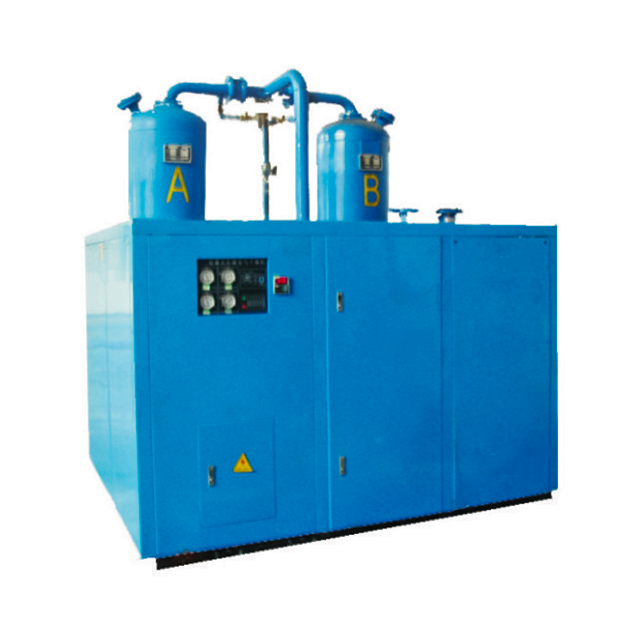
Hot, saturated air leaves the compressor element naturally after generation. It enters the integrated refrigerated dryer section first. This primary section drops the initial air temperature directly to +3°C (+38°F). The sudden chilling process immediately condenses vast amounts of water vapor. Liquid condensate then drains out of the system automatically through valves. You remove up to 85% of total system moisture during this phase. We consider this a massive bulk moisture drop. It heavily reduces the subsequent adsorption load on downstream chemical beds.
The partially dried air moves onward through internal piping. It enters the twin-tower desiccant section next for final treatment. The chemical beads now face a dramatically lighter operational workload. They only treat the remaining 15% of total system moisture. This targeted approach represents true deep drying efficiency in action. The desiccant acts as a highly precise final polishing stage. It adsorbs residual vapor molecules aggressively into microscopic pores. It smoothly drives the final dew point down to the required targets.
Standard heatless desiccant dryers waste immense amounts of compressed air. They often consume 15% to 20% of your total air capacity. They use this valuable air merely to purge wet regeneration towers. A combined dryer system changes this wasteful dynamic completely. The initial refrigerated phase handled most of the water already. Therefore, the desiccant needs significantly less purge air for bed regeneration. You can dramatically reduce this purge requirement to just 1% to 5%. This massive reduction frees up vital compressor capacity immediately.
The ISO 8573-1 standard dictates international air purity requirements. It categorizes air quality based on solid particulates, water, and oil. We strictly focus on the water vapor column for drying applications. Understanding these classes prevents costly over-engineering or dangerous under-sizing.
Table 1: ISO 8573-1 Moisture Classes Summary
| ISO 8573-1 Class | Maximum Pressure Dew Point | Typical Industry Application |
|---|---|---|
| Class 4 | +3°C (+38°F) | General shop air, standard pneumatic tools |
| Class 2 | -40°C (-40°F) | Automotive painting, precision instruments |
| Class 1 | -70°C (-100°F) | Semiconductors, critical pharmaceuticals |
Many manufacturing applications do not require extreme dryness to function safely. General shop air often functions perfectly at Class 4 standards. A standalone refrigerated dryer is entirely sufficient here. You should actively avoid over-engineering your system unnecessarily. Adding desiccant beds for simple Class 4 targets wastes tremendous energy. It severely complicates maintenance without offering any tangible operational benefits.
This strict level maps directly to standard specialized industrial needs. We see it used extensively in general industrial air treatment today. Plant instrumentation air absolutely requires a -40°C dew point constantly. Automotive painting lines also demand this exact moisture standard rigidly. Any moisture here ruins costly paint finishes instantly upon application. Packaging facilities rely on Class 2 for consistent, rust-free cylinder actuation.
Highly sensitive sectors strictly mandate Class 1 moisture levels globally. Pharmaceutical manufacturing cannot tolerate any airborne water vapor near open products. Semiconductor fabrication requires absolute atmospheric purity constantly to prevent micro-corrosion. Critical food and beverage processing also demands Class 1 environments. Any stray moisture introduces severe bacterial growth risks into food lines. Achieving this requires specialized combined drying configurations engineered precisely.
Follow these steps to specify your required class:
Chart 1: System Comparison Chart
| Operational Metric | Standalone Desiccant Dryer | Combined Hybrid Dryer |
|---|---|---|
| Purge Air Required | 15% - 20% | 1% - 5% |
| Moisture Load on Desiccant | 100% | 15% (After Refrigerated Drop) |
| Physical Footprint | Standard | Slightly Larger |
| Maintenance Complexity | Moderate | Dual-Technology Management |
Not every facility needs a complex hybrid approach to manage moisture. You must evaluate your specific system flow size carefully. Small setups might not yield fast energy returns from advanced technology. We typically recommend hybrid units for medium to larger operations. Systems producing above 500 CFM (14 m³/min) hit the ideal threshold perfectly. At these higher volumes, the energy savings mathematically justify the investment quickly. The massive reduction in wasted purge air offsets any equipment premiums.
You must address physical space requirements carefully before purchasing new equipment. Combining two distinct drying technologies requires a slightly larger physical footprint naturally. Plant managers must allocate adequate floor space for these specialized units. Managing dual technologies on one skid introduces slight maintenance complexities initially. You have to service refrigerant circuits alongside complex desiccant switching valves. However, modern designs integrate these distinct components seamlessly together. Electronic controllers monitor both operational phases simultaneously. This deep integration significantly simplifies daily operator interactions and diagnostics.
Even the best systems fail if operators ignore environmental realities. We frequently encounter facilities struggling with unpredictable dew point fluctuations. You must actively manage several external variables to guarantee stable performance.
Air compressors generate immense physical heat during their compression cycles. Higher-than-rated ambient temperatures create massive operational problems rapidly. Inlet temperature spikes can quickly overwhelm the initial refrigerated section. It loses its vital cooling capacity immediately under severe heat stress. This sudden failure causes a catastrophic cascade into the downstream desiccant beds. Liquid water floods the sensitive chemical media suddenly. The saturated beads fail to adsorb any remaining vapor afterward.
Compressor lubricants often bypass internal mechanical separators unfortunately. We emphasize the absolute necessity of strict coalescing pre-filtration always. Oil carryover poses a highly lethal threat to chemical desiccant beds. The microscopic oil aerosols will permanently coat desiccant beads over time. This slick coating blocks the crucial adsorption pores entirely. It destroys the deep drying capabilities of your system forever. You must replace ruined media entirely to restore lost performance.
Many industrial facilities struggle due to faulty sensor setups daily. A common operational pitfall involves entirely false dew point readings. Poorly placed hygrometers measure stagnant dead air zones highly inaccurately. Uncalibrated sensors naturally drift away from true values over extended time. You might falsely think your air remains perfectly dry. Meanwhile, hidden moisture silently corrodes your expensive downstream pneumatic equipment. We strongly recommend calibrating probes annually to guarantee absolute measurement accuracy.
Combined dryers deliver immense strategic value for modern industrial plants. They perfectly balance stringent moisture control with vital energy sustainability. You no longer have to sacrifice compressor capacity to achieve ultra-dry air. By utilizing a refrigerated phase for bulk moisture removal, you protect the desiccant media and slash purge air requirements drastically. This hybrid approach represents the pinnacle of modern pneumatic reliability.
Take actionable steps to upgrade your system efficiently. First, conduct a formal compressed air audit to identify existing moisture vulnerabilities. Second, log your current inlet temperatures accurately over a typical production week. Finally, calculate your current purge air volumes to establish a clear baseline for future vendor evaluations. These precise data points will ensure you specify the exact combined drying system your facility truly needs.
A: No mechanical system removes 100% of moisture perfectly. However, reaching a -70°C PDP reduces vapor to statistically negligible levels. It safely prevents condensation under almost all earthly operating conditions. You achieve perfectly dry working air without pointlessly pursuing impossible absolutes.
A: High ambient heat directly limits the refrigerated dryer's physical cooling capacity. This creates a severe derating factor for the entire unit. The initial bulk drop removes far less water than designed. This sharply increases the moisture load on the downstream desiccant bed, potentially causing dangerous dew point spikes.
A: Desiccant life is often extended significantly in combined systems. The chemical media typically lasts three to five full years. The upstream refrigerated unit proactively protects beds from heavy liquid slugging. However, you must maintain strict oil filtration consistently to achieve this prolonged lifespan.


