
- Home
- Products
- Hot
- About Us
- Services
- Industry
- Contact
Views: 0 Author: Site Editor Publish Time: 2026-09-15 Origin: Site


Designing a reliable pneumatic system requires finding a careful balance. You must protect sensitive downstream equipment without inflating your monthly utility bills. Choosing the wrong filtration level immediately disrupts this delicate equilibrium. Over-filtering causes excessive energy consumption and demands frequent, costly maintenance interventions. Conversely, under-filtering invites disaster through pneumatic tool failure, severe product contamination, or serious compliance violations. Both extremes introduce severe commercial risks to your daily operations.
Our comprehensive guide delivers a compliance-focused, highly practical framework for facility managers. We will teach you how to pinpoint the exact filtration required for your unique industrial applications. You will learn to map specific micron requirements to global ISO standards confidently. We also cover how to implement staged filtering sequences to maximize equipment lifespan. Read on to master these critical design principles and build a highly optimized compressed air network.
Choosing a compressed air filter micron rating involves understanding significant commercial trade-offs. Finer filter media creates inherently higher airflow resistance. Industry engineers call this resistance the energy penalty. Standard industry metrics reveal a stark operational reality. Every 2 psi increase in filter pressure drop raises overall compressor energy consumption by roughly 1%. This hidden cost accumulates rapidly across annual 24/7 manufacturing operations. Your system expends extra horsepower simply to push air through overly restrictive barriers.
Maintenance frequency also shifts dramatically based on your selection. Smaller micron ratings naturally blind or clog much faster than coarser alternatives. You should frame this rapid clogging as a predictable operational expense. It is not a product flaw or a manufacturing defect. It simply proves the tight element is successfully capturing microscopic debris. Budgeting for these frequent changes ensures continuous system reliability.
You must carefully contrast these energy and maintenance expenses against vital system protection. Compromised downstream air quality creates massive financial risks. Contaminated air ruins spoiled food batches instantly. It destroys expensive automotive paint finishes, requiring labor-intensive rework. Heavy particulate loads can severely damage intricate CNC valves, halting production lines entirely. Optimal filtration balances these competing financial pressures effectively.
Facility managers often install the tightest available filter across the entire plant "just to be safe." This reactionary approach guarantees bloated energy bills. It also ensures endless maintenance headaches as elements collapse under inappropriate loads. Always filter to the precise requirement of the equipment, not beyond it.
Guesswork has no place in modern pneumatic system design. You should use ISO 8573-1 standards as your authoritative evaluation lens. This global framework moves facility planning away from vague assumptions toward verifiable compliance. Establishing the correct particle filtration grade becomes a highly structured, logical process. It protects your capital investments flawlessly.
Table: ISO 8573-1 Particle Classes and Target Industrial Applications
| ISO Class | Required Rating | Target Applications | System Impact |
|---|---|---|---|
| Classes 1 & 2 | 0.01 to 0.1 microns | Pharmaceuticals, food processing, electronics | High pressure drop, frequent changes required. |
| Classes 3 & 4 | 1 micron | Paint spraying, precision pneumatics, robotics | Moderate energy penalty, balanced lifespan. |
| Classes 5 & 6 | 5 to 40 microns | Sandblasting, heavy air tools, shop air | Minimal pressure drop, long maintenance intervals. |
Classes 1 and 2 represent highly sensitive operational environments. These applications demand extreme 0.01 to 0.1-micron ratings. Target industries include pharmaceutical manufacturing and sterile food processing. Electronics assembly lines and breathable medical air systems also require this absolute purity. Any microscopic breach can trigger massive product recalls.
Classes 3 and 4 serve standard industrial applications perfectly. These systems generally require dependable 1-micron ratings. You will find this middle-tier level in high-end paint spraying booths. Precision factory pneumatics and automated assembly robotics similarly rely on this robust protection class.
Classes 5 and 6 support general utility air requirements. They require basic 5 to 40-micron ratings. Target applications involve highly abrasive sandblasting operations. Heavy pneumatic impact tools and basic workshop air networks perform reliably under these more forgiving classes.
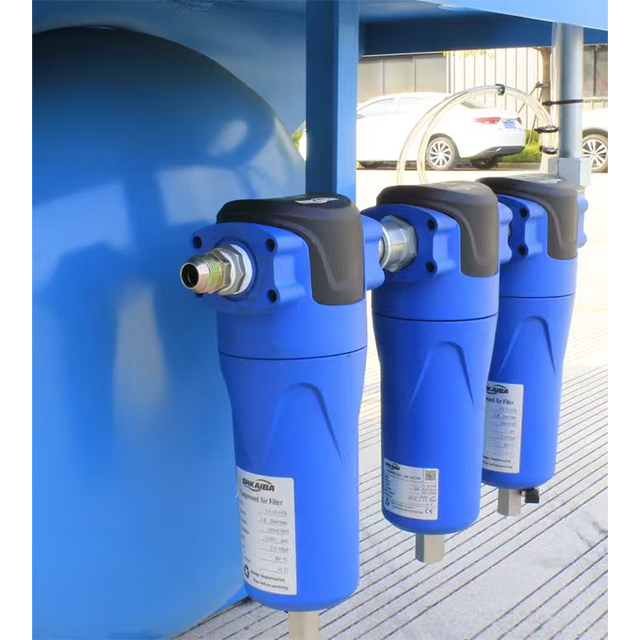
Industrial facilities rarely rely on a single filter unit. You must build a comprehensive, multi-layered defense strategy. General purpose particulate filters act as your necessary first line of defense. These robust units range from 1 to 40+ microns in density. They excel at trapping highly abrasive pipe scale. They capture heavy ambient plant dust easily and intercept bulk moisture effectively before it travels further.
Coalescing filters handle the invisible, microscopic threats. A dedicated ultra-fine air filter captures tiny liquid aerosols and sub-micron particulates down to 0.01 microns. However, these highly sensitive units possess a fatal weakness. They absolutely cannot handle heavy initial contaminant loads. They will collapse rapidly under bulk moisture or large rust flakes.
This physical vulnerability introduces the critical "Filtration Train" rule. Sequential staging is absolutely mandatory for system survival. Placing an ultra-fine element directly downstream of a bare compressor guarantees immediate failure. You must design a staged sequence to ensure long-term stability.
Basic marketing spec sheets only tell half the story. You must evaluate the physical construction of the media itself. Standard cellulose elements degrade rapidly under high moisture conditions. They swell, lose structural integrity, and eventually allow unfiltered air to bypass the media entirely. Conversely, pleated borosilicate glass microfiber offers vastly superior field performance. It boasts higher dirt-holding capacity and resists moisture degradation completely. It maintains a rigid matrix under extreme airflow stress.
Third-party validation ensures reliable real-world performance. We strongly advise industrial buyers to demand ISO 12500 testing documentation. A manufacturer’s stated micron rating means very little without objective proof. ISO 12500 protocols verify specific contaminant retention rates under highly standardized, repeatable conditions. This protects you from exaggerated marketing claims.
Finally, you must evaluate the housing and instrumentation together. The physical housing design impacts airflow dynamics and internal turbulence significantly. Mandate the strict inclusion of differential pressure gauges on all installed housings. These simple visual indicators transition maintenance schedules from calendar-based guesses to condition-based realities. You replace the internal element exactly when aerodynamic resistance reaches critical, costly levels.
Real-world industrial environments often complicate ideal engineering plans. You must anticipate these practical rollout risks before signing off on an installation. Addressing these variables early prevents costly operational disruptions.
Procuring the right equipment requires a methodical, step-by-step approach. Follow this logical sequence to finalize your filtration strategy successfully and efficiently.
Step 1: Conduct an end-use air quality audit. Walk your entire facility floor meticulously. Identify the single most sensitive pneumatic node in the building. Review the original equipment manufacturer manual for this machine. Determine its minimum acceptable ISO class requirement. You will base your entire upstream filtration strategy on this specific baseline.
Step 2: Request comprehensive pressure drop curves. Contact your shortlisted manufacturers for detailed data. Do not accept static, dry ratings. You need wet, saturated operational curves. Use this data to calculate true long-term operational and energy expenses over a continuous five-year period. Energy usage will dwarf the initial purchase price of the housing.
Step 3: Consult a qualified system architect. Design the proper staging sequence together. Ensure you size all housings appropriately to handle the facility's absolute peak CFM demand. Air expands and contracts based on pressure and temperature. Relying on expert architectural guidance prevents accidental system starvation during peak production shifts.
Higher filtration density is not inherently better for your operations. Optimal filtration provides exact, calculated protection for the required application without adding unnecessary resistance. Over-filtering wastes massive amounts of electricity daily. Under-filtering destroys valuable capital equipment and ruins end products.
Balancing strict ISO purity requirements ensures consistent manufacturing quality. Upgrading to robust borosilicate glass media drastically improves element longevity under harsh conditions. Implementing proper sequential system staging yields the greatest long-term operational efficiency possible.
Take proactive action today to optimize your plant network. Schedule a comprehensive system audit with your maintenance team this week. Request a custom sizing chart from your preferred equipment manufacturer. Contact a dedicated application engineer to resolve any persistent pressure drop issues immediately. Protecting your system correctly requires precision, not guesswork.
A: No. Placing a highly sensitive element directly in the main airstream causes rapid blinding. It will clog almost immediately from bulk moisture and large particulates. A staged approach using robust pre-filtration is absolutely mandatory to protect the final element and maintain steady airflow.
A: Finer ratings capture much smaller microscopic debris, causing them to clog significantly faster than coarse elements. Consequently, they require more frequent physical replacements. You should always verify replacement intervals using a differential pressure gauge rather than relying on an arbitrary calendar date.
A: Yes, every filter introduces some resistance into the network. However, you must differentiate between the initial dry pressure drop and the operational saturated pressure drop. The saturated drop is naturally higher. Proper component sizing minimizes this inevitable pressure reduction.
A: An absolute rating guarantees greater than 99% capture efficiency for particulates at the stated size. A nominal rating merely indicates an average capture rate, allowing some larger particles to pass through. You must require absolute ratings when designing systems for highly critical industrial applications.


