
- Home
- Products
- Hot
- About Us
- Services
- Industry
- Contact
Views: 0 Author: Site Editor Publish Time: 2026-08-14 Origin: Site


Many industrial plants still rely on standard 8-10 bar compressors for low-pressure applications. They often use pressure-reducing valves to artificially restrict the airflow. This habit seems convenient on the surface. However, it hides massive operational inefficiencies.
The "step-down" approach creates severe financial and mechanical penalties. Generating compressed air at high pressure only to regulate it down wastes tremendous amounts of electrical energy. Furthermore, running standard compressors outside their designed pressure bands accelerates wear on critical internal components. It forces the machine to work against its own mechanical limits.
Facilities needing high-volume air between 2 and 5 bar require a better approach. A dedicated low-pressure PM screw air compressor offers a purpose-built solution. You will learn how these specialized machines eliminate energy waste, protect your production line, and deliver exactly the pressure you need.
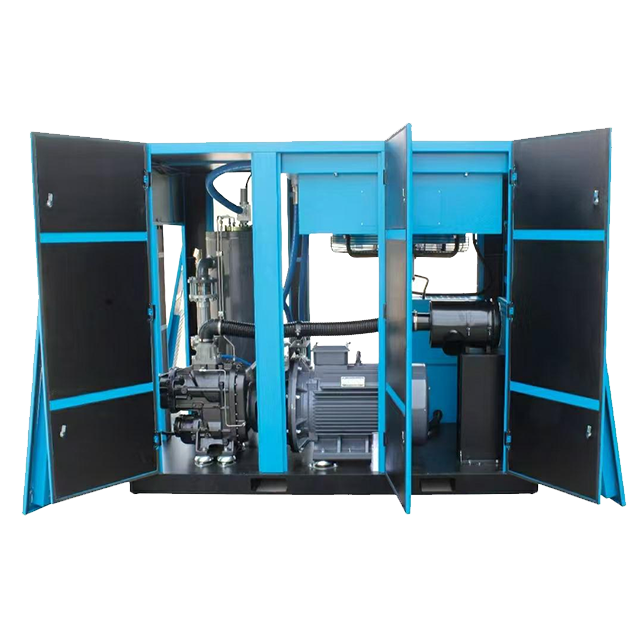
Many facility managers believe a dangerous myth. They assume lowering the pressure band on a standard compressor linearly saves money. This misunderstanding drives poor equipment choices. Producing air at 8 bar and restricting it to 3 bar through valves does not reduce the initial production cost. You still pay for the maximum compression effort. The step-down process simply throws the excess energy away as heat and friction.
Running a standard compressor at 3 bar causes severe operational issues. Standard air ends rely on high internal pressure differentials to circulate lubricating oil. When you drop the system pressure artificially, oil circulation becomes sluggish. Poor oil flow starves the bearings. It also severely increases the risk of overheating. The rotors lose their cooling medium, causing thermal expansion. This mechanical reality leads to premature air end failures and costly downtime.
The financial waste becomes obvious when you look at the energy gap. Industry engineers use a proven rule of thumb. Every 1 bar of excess pressure costs approximately 7% more energy. If you generate air at 8 bar but only need 3 bar, you over-pressurize by 5 bar. You are wasting roughly 35% of your compressor's total power consumption. This baseline financial waste drains maintenance budgets quickly.
A purpose-built low pressure rotary screw compressor operates fundamentally differently than standard models. Engineers design these air ends specifically for 2-5 bar applications. They feature much larger rotor diameters. The intake and exhaust ports are carefully optimized to move massive volumes of air. The internal compression ratios remain low. This specific geometry ensures the machine captures and compresses air efficiently without overworking.
Oil and cooling management also requires a different engineering approach. Because these units do not generate high internal pressure, they cannot rely on pressure differentials to push oil. Manufacturers install specialized mechanical oil pumps. Some brands utilize advanced gravity-fed cooling channels. These systems maintain proper lubrication at all times. They eliminate the risk of oil starvation, even when operating at a continuous 2 bar.
You must define clear success criteria before deploying one of these machines. A successful installation should deliver three distinct outcomes. First, it must provide a perfectly stable 3-bar air delivery without fluctuations. Second, the system must show zero signs of oil starvation or elevated rotor temperatures. Finally, you should observe a measurable reduction in the kW per 100 CFM metric. This confirms the machine runs at peak efficiency.
Pairing low-pressure air ends with a PM VSD motor (Permanent Magnet Variable Speed Drive) creates the ultimate industry standard. Standard induction motors struggle to adapt quickly to changing air flows. PM motors use rare-earth magnets to generate their magnetic field. This removes the need for electrical magnetization, slashing power consumption. The variable speed drive then precisely matches motor RPM to your real-time air demand.
These motors dominate in partial load conditions. A conventional motor loses massive efficiency when demand drops below 50%. In contrast, a PM motor maintains up to 96% efficiency even when air demand plummets to 25-30% of total capacity. This incredible turndown ratio prevents energy spikes. It ensures you only pay for the exact volume of air your plant uses at any given second.
The PM VSD technology also excels at eliminating idle waste. Traditional induction motors often run unloaded for long periods. They consume up to 30% of their full-load power while producing zero air. PM VSD systems utilize direct-drive responsiveness. They slow down or stop entirely during low demand. You eliminate transmission losses from belts or gears. The power transfer remains instantaneous and direct.
We must view this technology through a skeptic's lens to ensure proper application. PM motors contain sensitive magnets. They are highly vulnerable to high-heat and poor-ventilation environments. Extreme temperatures can demagnetize the rotors, causing catastrophic motor failure. You must provide a clean, well-ventilated compressor room. Regular cleaning of cooling fins is non-negotiable to protect the internal magnets.
You cannot justify a dedicated machine for occasional use. You must identify consistent, high-volume low pressure air demand. Certain manufacturing processes rely heavily on continuous 2-5 bar air. We look for specific application matching to guarantee successful deployments.
Primary use cases that justify a dedicated machine include:
Before purchasing equipment, you must conduct a professional flow meter audit. Attach data loggers to your current system for at least two weeks. Analyze the usage peaks and valleys. Demand must be consistently high-volume. If your plant only occasionally needs low pressure for brief cleaning cycles, it does not justify a dedicated unit. The data will reveal your true base load.
You must also anticipate strict piping constraints. Moving from high pressure to low pressure fundamentally changes air behavior. Low-pressure air requires much higher velocity to deliver the same CFM volume. Higher velocity creates massive friction inside standard pipes. If you do not increase your pipe diameters, this friction causes severe pressure drops. A poorly designed piping network will completely negate the compressor's efficiency gains.
Replacing an existing system requires precise financial modeling. You need to calculate a reliable payback period. Start by determining the CapEx (Capital Expenditure) of buying a new energy efficient compressor. Compare this against your projected OpEx (Operational Expenditure) savings. These savings come directly from eliminating pressure-reducing valves and lowering your daily kW consumption. In most continuous-run facilities, the operational savings offset the equipment cost within 12 to 24 months.
Evaluating vendor claims requires a strict, evidence-based approach. Many sales representatives promise unrealistic savings. You must demand verifiable performance data. Ask the vendor to provide data sheets conforming to ISO 1217 Annex C or E standards. Avoid any vendor promising "immediate" payback without first assessing your plant's piping infrastructure. A trustworthy partner will always inspect your downstream distribution before quoting a machine.
You can use a specific shortlisting logic to filter out poor equipment choices. We developed a standardized checklist to evaluate OEMs.
Vendor Evaluation Checklist
| Evaluation Criteria | Standard Machine Warning Sign | Purpose-Built Indicator |
|---|---|---|
| Air End Geometry | Uses a standard air end with modified gear ratios. | Features a dedicated low-pressure air end with oversized rotors. |
| Lubrication System | Relies purely on internal air pressure for oil flow. | Includes an independent mechanical oil pump. |
| Motor Cooling | Standard fan without ambient temperature guarantees. | Advanced liquid cooling or oversized fans for PM magnets. |
| Performance Data | Internal testing brochures only. | ISO 1217 Annex C or E certified data sheets. |
Always ask the OEM direct technical questions. Ask them, "Is this a true low-pressure air end, or a standard air end with a modified gear ratio?" Modified standard units will fail prematurely. Next, ask, "What is the cooling mechanism for the PM motor in high-ambient conditions?" Their answers will reveal their engineering depth and product reliability.
A low-pressure PM screw air compressor is not a universal fix for every manufacturing plant. It serves as a highly specific, high-ROI investment for continuous 2-5 bar applications. When applied correctly, it eliminates the massive energy waste associated with pressure-reducing valves. It protects your equipment from thermal failure and stabilizes your production line air supply.
Take actionable steps before requesting vendor quotes. First, book an independent air demand audit. Second, utilize a data logger on your current compressed air systems to map your true usage. Finally, inspect your existing piping network to ensure it can handle high-volume, low-pressure air flows without crippling pressure drops.
A: No. A VSD changes motor speed, but it doesn't change the physical geometry of the rotors or the internal oil pressure requirements. Running a standard air end too low will cause premature failure.
A: Routine maintenance is similar for oil, filters, and separators. The PM motor is virtually maintenance-free due to its direct-drive setup without greased bearings. However, cooling fin cleanliness is much more critical to protect the magnets.
A: PM motors offer a wider turndown range. They maintain higher motor efficiency across the entire speed curve. This avoids the severe efficiency drop-off standard VSD induction motors experience at very low RPMs.


