
- Home
- Products
- Hot
- About Us
- Services
- Industry
- Contact

Views: 0 Author: Site Editor Publish Time: 2026-02-22 Origin: Site


Rising energy costs, stricter efficiency targets, and increasing pressure requirements are forcing many industrial users to reassess their compressed air systems. In real production environments, high-pressure air is rarely optional—it is essential for maintaining productivity, precision, and safety. Yet high pressure often comes with high electricity bills, frequent maintenance, and accelerated equipment wear. This is why so many engineers and plant managers search for dual stage air compressor worth it when evaluating long-term investments. Luoyou Compressor, a Shanghai-based manufacturer supplying global markets since 2015, works closely with industrial customers to determine whether dual-stage technology delivers measurable economic value beyond basic performance claims.
In industrial compressed air systems, value is not defined by short-term affordability. Instead, it is shaped by how consistently and efficiently the equipment performs over years of operation.
At first glance, a dual stage screw air compressor carries a higher purchase price than a comparable single-stage model. This initial difference often becomes the main hesitation point during procurement discussions. However, compressors are not short-term assets. They typically operate for tens of thousands of hours across their service life. Electricity consumption, spare parts, maintenance labor, and downtime-related losses collectively outweigh the initial capital cost by a wide margin. When evaluated from a lifecycle perspective, the real question is not how much the compressor costs today, but how much it will cost to own and operate over the next decade.
Energy consumption dominates total compressor ownership cost. In many manufacturing facilities, compressed air represents one of the largest single energy expenses. As operating pressure rises, inefficiencies become more pronounced. Single-stage compressors must compress air to final pressure in one step, which increases power draw and thermal stress. Dual-stage systems distribute the workload more evenly, reducing energy loss per unit of compressed air delivered. Over continuous operation, even small efficiency improvements generate substantial annual savings.
Maintenance costs extend beyond scheduled service. High operating temperatures accelerate bearing wear, oil degradation, and seal fatigue. Over time, these factors increase failure risk and reduce system reliability. Unplanned downtime disrupts production schedules and often results in higher indirect costs than the repair itself. A compressor design that operates cooler and under lower mechanical stress contributes directly to long-term operational stability and predictable maintenance planning.
The efficiency advantage of dual-stage compression is rooted in thermodynamics and mechanical optimization rather than marketing language.
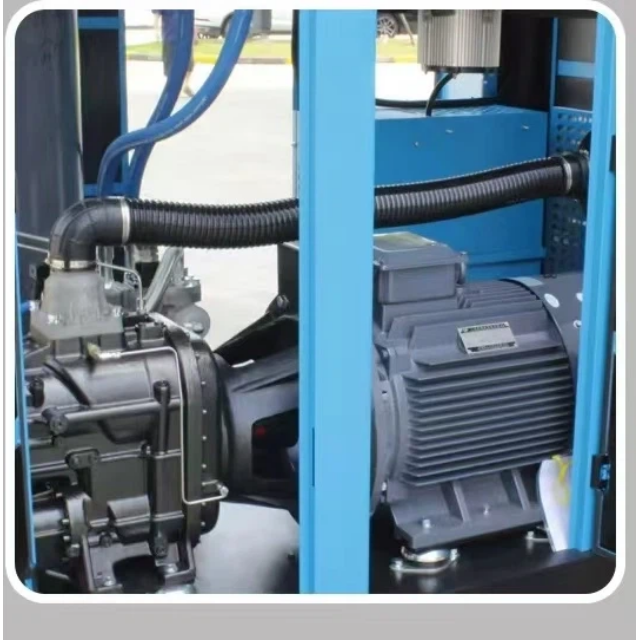
Dual-stage screw air compressors divide the compression process into two sequential steps. Each stage operates within a more favorable compression ratio, minimizing internal leakage and reducing resistance on the drive motor. This balanced approach allows the compressor to achieve required pressure levels with less energy input. The motor runs more smoothly, reducing peak load demand and improving overall electrical efficiency.
Between compression stages, air is cooled before entering the second stage. Cooler air is denser and requires less energy to compress further. Lower discharge temperatures also protect internal components from heat-related stress. Over extended operation, this thermal stability reduces oil oxidation, slows material fatigue, and helps maintain consistent performance even in demanding environments.
Many industrial applications operate continuously within the 8–13 bar pressure range. This is where dual-stage compression shows its strongest advantage. Single-stage systems can technically reach these pressures, but efficiency declines sharply as pressure increases. Dual-stage compressors are specifically engineered to perform efficiently at higher pressures, often achieving 15–20 percent better energy efficiency under real operating conditions.
Dual-stage technology is not a universal solution. Its value depends heavily on operating patterns and production requirements.
Facilities running compressors for multiple shifts or around the clock benefit most from energy-efficient designs. Continuous operation amplifies energy savings, shortening the return on investment period. In contrast, applications with short or irregular operating cycles may not fully realize the efficiency advantage. Understanding duty cycle is therefore critical when evaluating financial viability.
Processes such as laser cutting, robotic automation, pneumatic conveying, chemical processing, and surface treatment rely on stable high-pressure air. Pressure fluctuations can affect product quality and process repeatability. Dual-stage compressors provide more consistent output under load, supporting precision-driven applications where stability matters as much as capacity.
Electricity costs vary widely across regions. In areas with higher energy prices, efficiency improvements translate into faster payback. Many industrial users find that reduced power consumption alone offsets the higher purchase price of a dual-stage system within a few years. Beyond that point, the compressor continues to generate operational savings throughout its service life.
Comparing single-stage and dual-stage compressors highlights how design choices influence long-term economics.
Factor | Single Stage | Dual Stage |
Energy efficiency | Lower at high pressure | Higher at 8–13 bar |
Pressure stability | More fluctuation | More consistent output |
Long-term operating cost | Higher due to power use | Lower over lifecycle |
Heat and component wear | Higher thermal stress | Reduced mechanical wear |
This comparison illustrates that the decision is less about whether a compressor can meet pressure requirements and more about how efficiently and reliably it does so over time.
The effectiveness of dual-stage compression depends on engineering execution. Luoyou Compressor designs its two-stage screw air compressors to maximize practical efficiency and durability in industrial environments.
Luoyou integrates dual-stage compression with permanent magnet variable frequency drive technology. This allows the compressor to adjust motor speed precisely according to air demand, avoiding unnecessary energy consumption during partial load operation. The result is a system that not only performs efficiently at full load but also maintains efficiency across varying production conditions. In many applications, this combination reduces overall operating costs by 20–25 percent.
Lower operating temperatures and optimized mechanical balance enable longer maintenance intervals. Luoyou dual-stage compressors are designed for service cycles of up to 8,000 hours, reducing maintenance frequency and associated labor costs. Fewer interventions also mean less disruption to production schedules, supporting higher equipment availability.
Luoyou compressors are deployed across industries including heavy manufacturing, automotive production, mining, construction, chemical processing, and laser cutting. These sectors demand reliable high-pressure air under continuous load. The consistent performance of dual-stage systems in such conditions demonstrates their suitability for demanding applications where downtime is not acceptable.
Luoyou also supports complete compressed air systems by integrating refrigerated dryers and precision air filters. This ensures clean, stable air supply for sensitive processes. Optional oil-free configurations are available for pharmaceutical and food-grade environments, expanding the applicability of dual-stage technology across regulated industries.
Evaluating whether a dual stage air compressor is worth the investment requires a shift from short-term cost thinking to long-term performance analysis. For operations characterized by high pressure, continuous runtime, and strict reliability requirements, dual-stage technology delivers clear advantages in energy efficiency, thermal management, and lifecycle cost reduction. Luoyou Compressor approaches compressed air solutions as a supplier focused on measurable outcomes rather than theoretical specifications. If your facility is considering whether a two-stage air compression solution can improve efficiency and reduce operating costs, contact Luoyou Compressor to discuss customized system calculations and application-specific recommendations.
Q1: Does a dual stage air compressor consume less electricity at all pressure levels?
Dual-stage compressors offer the greatest efficiency advantage at higher pressure ranges, especially in continuous operation. At lower pressures, the difference compared to single-stage systems may be smaller.
Q2: How does dual-stage compression affect equipment lifespan?
By reducing discharge temperatures and mechanical stress, dual-stage designs help extend the lifespan of critical components, leading to longer service intervals and improved reliability.
Q3: Is a dual stage air compressor suitable for variable air demand?
When combined with permanent magnet VFD technology, dual-stage compressors adapt well to fluctuating demand, maintaining efficiency across partial and full load conditions.
Q4: Which industries benefit most from dual-stage air compressors?
Industries requiring stable high-pressure air such as laser cutting, automotive manufacturing, mining, chemical processing, and industrial automation see the most significant benefits.


