
- Home
- Products
- Hot
- About Us
- Services
- Industry
- Contact
Views: 0 Author: Site Editor Publish Time: 2026-02-19 Origin: Site


Factory managers rarely start with equipment types when planning a compressed air system. They usually begin with production problems: unstable pressure, rising energy costs, or tools that fail to perform consistently under load. This is exactly why people search for dual stage air compressor used for—they want to understand which applications truly require dual-stage technology and which do not. A dual-stage air compressor is not designed for every operating condition, but in certain high-pressure and high-demand scenarios, it becomes a practical necessity rather than an upgrade option. As a Shanghai-based manufacturer supplying industrial markets worldwide since 2015, Luoyou Compressor develops dual-stage screw air compressors specifically for applications where pressure stability, efficiency, and reliability directly affect production outcomes.
Understanding where dual-stage compressors are used starts with understanding why pressure stability and load behavior matter in industrial environments.
In many industrial processes, compressed air is not just a utility—it is part of the production mechanism itself. Pressure fluctuations can affect machining accuracy, automation timing, coating quality, and even product safety. At higher pressures, maintaining stability becomes more difficult because temperature rise and mechanical load increase inside the compressor.
Dual-stage compression helps stabilize pressure by dividing the compression work into two controlled steps. This reduces thermal stress and allows the system to maintain consistent output even when demand remains high for long periods. For applications that depend on precision or continuous operation, this stability directly supports product quality and process reliability.
Some facilities experience short bursts of high air demand, while others operate under constant load throughout the day. Dual-stage air compressors are particularly well suited for continuous high-pressure operation. When demand is sustained, efficiency losses and heat buildup become critical factors.
In peak-load-only scenarios, a single-stage compressor may handle demand adequately. However, in continuous-load environments, single-stage systems often operate near their limits, leading to higher energy consumption and accelerated wear. Dual-stage systems manage continuous load more effectively, making them a better match for factories where compressed air demand is steady rather than intermittent.
Modern manufacturing relies heavily on compressed air to power tools, control systems, and automated processes. In these environments, reliability and consistency are just as important as capacity.
Robotic assembly lines depend on precise timing and repeatable motion. Pneumatic actuators and tools require stable air pressure to function correctly. Pressure drops or fluctuations can disrupt synchronization, slow production, or cause quality issues.
Dual-stage air compressors are commonly used in robotic assembly because they provide stable high-pressure air under continuous operation. By reducing pressure variation and maintaining consistent airflow, they support smooth robotic movement and reliable cycle times. This is especially important in automotive and electronics manufacturing, where automation systems run continuously and downtime can be extremely costly.
Pneumatic control systems regulate valves, cylinders, and actuators across production lines. These systems are sensitive to pressure changes, particularly when multiple devices operate simultaneously. When air demand spikes, a compressor must respond quickly without losing efficiency.
Dual-stage compressors handle these situations more effectively by operating efficiently at higher pressures and maintaining stable output under load. This makes them suitable for complex automation systems where compressed air demand varies but overall pressure requirements remain high.
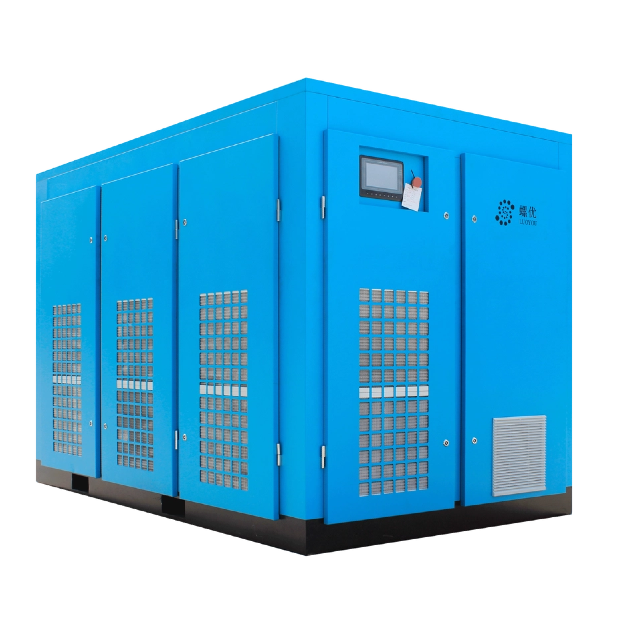
The automotive industry places high demands on compressed air systems, particularly in surface treatment and component manufacturing processes.
Paint spraying requires consistent air pressure to ensure uniform coating thickness and surface quality. Pressure instability can lead to uneven finishes, overspray, or material waste. In high-volume automotive production, these issues quickly translate into higher costs and rework.
Dual-stage air compressors provide the stable high-pressure air needed for paint spray systems to operate smoothly over long production runs. Their ability to maintain consistent output helps improve coating quality while reducing defects caused by pressure variation.
Tire manufacturing and automotive component production rely heavily on pneumatic systems for shaping, molding, and handling materials. These processes often require sustained high pressure and reliable airflow.
Dual-stage compressors are commonly used in these environments because they can deliver consistent pressure without excessive energy consumption. Their durability under continuous operation also supports the demanding production schedules typical of automotive plants.
Heavy industry environments place some of the most demanding requirements on compressed air systems. Equipment must operate reliably under harsh conditions while delivering high-pressure air continuously.
Industry | Air Pressure Need | Why Dual Stage |
Mining | High, continuous | Better thermal control and durability |
Construction | High, variable | Stable output under heavy load |
Chemical processing | High, controlled | Pressure stability for process safety |
Heavy manufacturing | High, constant | Energy efficiency and long service life |
In mining and construction, compressed air powers drilling equipment, heavy machinery, and pneumatic tools. These applications often involve dusty environments, continuous operation, and high mechanical stress. Dual-stage compressors perform better in these conditions because reduced heat and balanced compression help extend equipment life.
Chemical processing applications require compressed air for reactor pressurization and process control. In these settings, pressure stability is critical not only for efficiency but also for safety. Dual-stage systems help maintain controlled conditions, supporting consistent process performance.
Heavy manufacturing facilities, such as steel processing and large-scale fabrication, often operate compressors continuously at high pressure. Dual-stage technology reduces energy consumption and wear, making it a practical choice for long-term operation.
Understanding what dual-stage compressors are used for naturally leads to how they are implemented in real industrial systems. Luoyou Compressor designs its dual-stage screw air compressors as part of complete, application-focused solutions rather than standalone machines.
Compressed air quality matters as much as pressure in many applications. Moisture and contaminants can damage tools, reduce product quality, and increase maintenance requirements. Luoyou supports industrial users by integrating dual-stage compressors with refrigerated dryers and precision air filters.
This integrated approach ensures clean, dry air delivery for sensitive processes such as automation, surface treatment, and chemical processing. By addressing air quality at the system level, Luoyou helps users protect downstream equipment and maintain consistent production performance.
Certain industries require higher air purity standards. Pharmaceutical, food, and medical applications often demand oil-free compressed air to meet regulatory requirements and protect product integrity.
Luoyou offers optional oil-free configurations within its compressed air solutions to support these industries. Combined with dual-stage compression, these systems deliver high-pressure air with controlled purity, expanding the range of applications where dual-stage technology can be applied safely and effectively.
Beyond system configuration, Luoyou compressors are built with intelligent control systems that provide real-time monitoring and automatic performance adjustment. Noise reduction features support installation in noise-sensitive environments, while compact design simplifies installation in facilities with limited space.
Manufactured in Shanghai under CE and ISO 9001 quality management systems, Luoyou compressors are used across industries including machinery, automotive, electronics, textiles, construction, and building materials. The company’s global export footprint reflects the practical adaptability of its dual-stage systems in diverse industrial conditions.
A dual-stage air compressor is used where high pressure, continuous operation, and stable airflow are essential to production performance. Not every application requires dual-stage technology, but for manufacturing automation, automotive production, heavy industry, and process-driven environments, it provides clear operational advantages. Understanding dual-stage air compression applications helps facilities match equipment structure to real working conditions rather than relying on generic specifications. Luoyou Compressor manufactures dual-stage screw air compressors designed for these demanding uses, focusing on efficiency, reliability, and system integration. To discuss your specific operating conditions and explore suitable solutions, contact Luoyou Compressor.
Q1: Are dual-stage air compressors only used in heavy industry?
No. While they are common in heavy industry, dual-stage compressors are also widely used in manufacturing automation, automotive production, and surface treatment where stable high-pressure air is required.
Q2: Can a dual-stage air compressor handle fluctuating demand?
Yes. When combined with variable frequency drive technology, dual-stage compressors can adjust output to match changing demand while maintaining efficiency.
Q3: Is a dual-stage compressor necessary for paint spray applications?
For high-volume or continuous paint spraying, dual-stage compressors provide more stable pressure, which helps improve coating consistency and reduce defects.
Q4: How does air quality affect the applications of dual-stage compressors?
Clean, dry air protects tools and processes. Dual-stage compressors integrated with dryers and filters support applications where air quality directly affects production quality and equipment lifespan.


