
- Home
- Products
- Hot
- About Us
- Services
- Industry
- Contact
Views: 0 Author: Site Editor Publish Time: 2026-09-03 Origin: Site


In food and beverage manufacturing, compressed air operates as the critical "fourth utility." However, unlike municipal electricity or water, you bear complete responsibility for its purity. Relying on sub-standard air systems creates immense risks for your entire operation. Contaminated air can lead to disastrous product recalls. It frequently causes failed FDA or GFSI audits. Ultimately, poor air quality inflicts severe, irreversible brand damage. Facility managers constantly face a difficult balancing act. You must maintain strict air purity standards while optimizing operational efficiency. Selecting an oil free air compressor for food applications requires moving past flashy marketing claims. You need to evaluate equipment based on strict compliance thresholds and real-world sizing metrics. We will explore how to accurately define your specific application risks. You will also learn to size your pneumatic system correctly. Finally, we will compare the top compressor technologies available today to help you upgrade confidently.
Every food plant utilizes compressed air differently. You must first establish the specific business problem you are solving. Next, you need to determine the required level of clean compressed air based on your operational use cases. Industry experts generally categorize these applications into three distinct risk profiles.
In this scenario, air touches the food product directly. Examples include aeration, ingredient mixing, and the pneumatic conveying of raw materials. You might use air to push flour through delivery pipes. You might use it to aerate liquid dairy products. Because the air becomes part of the physical product journey, you have zero tolerance for oil or moisture. Even microscopic oil vapor can ruin subtle flavor profiles. It can also introduce harmful pathogens. For these applications, purity remains absolute.
Here, air touches packaging or surfaces. These surfaces eventually contact the food itself. Common examples include blow-molding PET bottles and cleaning stainless steel molds. You blow air into a bottle right before filling it. Any oil residue inside the bottle transfers directly to the beverage. Therefore, this category demands high purity. It also requires strict moisture control to prevent microbial growth on packaging surfaces.
This category involves air powering general plant machinery. It drives pneumatic valves, actuators, or automated packaging robots. The air does not interact directly or indirectly with the consumable product. Standard industrial air usually suffices here. However, cross-contamination via ambient plant air remains a minor risk. Exhaust air from a lubricated machine can linger in the facility atmosphere, eventually settling on production lines.
Best Practice: Always map every single drop point in your facility. Assign a clear risk category to each one. Never guess your purity requirements.
You need an authoritative framework for evaluating air purity claims. The ISO 8573-1 standard provides this precise, globally recognized framework. It measures solid particulates, water, and oil. For food manufacturers, oil concentration remains the primary compliance concern.
Many legacy facilities still rely on Class 1 air. The Class 1 standard allows up to 0.01 mg/m³ of oil. Plants often achieve this metric using lubricated compressors paired with multi-stage coalescing filters. On paper, this seems adequate for many processes.
However, the risk reality paints a much more dangerous picture. Filters degrade continuously during normal operation. They saturate over time. Eventually, they fail entirely. A sudden pressure drop can push oil aerosol right past the filter. A sudden temperature spike creates the exact same danger. The oil flows directly into the food line unnoticed.
Conversely, Class 0 guarantees 100% oil-free air. Engineers achieve this through purely mechanical design. The compression chamber contains absolutely no oil. The internal rotors spin without any liquid lubrication.
You must evaluate your options carefully. For direct and indirect contact, investing in a true Class 0 food processing air compressor makes strategic sense. It eliminates ongoing maintenance labor. You no longer need constant filter monitoring. It removes the extreme liability of accidental contamination.
ISO 8573-1 Oil Concentration Limits
| ISO Class | Maximum Oil Content (Aerosol, Liquid, Vapor) | Typical Technology Used |
|---|---|---|
| Class 0 | 0.00 mg/m³ (As specified by equipment user/manufacturer) | 100% Oil-Free Mechanical Design |
| Class 1 | ≤ 0.01 mg/m³ | Lubricated Compressor + Coalescing Filters |
| Class 2 | ≤ 0.1 mg/m³ | Lubricated Compressor + Standard Filters |
Moving buyers away from "rule-of-thumb" purchasing is crucial. You need a precise, engineering-backed evaluation. Relying solely on Horsepower (HP) leads to massive inefficiencies. A 50 HP compressor from one brand might deliver vastly different air flow than a 50 HP unit from another.
You must separate flow from pressure in your facility planning. First, identify the minimum acceptable pressure at the actual point of use. Do not just look at the compressor room gauge. Look at the actual processing machinery. You must factor in standard pressure drops. Piping causes friction. Desiccant dryers restrict air flow.
Over-pressurizing wastes significant electrical energy. You incur an approximate 1% energy penalty for every 2 PSI of excess pressure generated. Operating at 110 PSI when your machinery only requires 90 PSI is a massive waste.
Next, calculate aggregate CFM. You do this by summing the requirements of all pneumatic equipment.
You must plan for the future intelligently. Factor in seasonal production spikes. Consider planned facility expansions over the next three to five years. Ensure you secure adequate food production air supply for new packaging lines. However, do not aggressively over-size the unit today. Over-sizing causes inefficient short-cycling. The machine turns on and off too frequently. This wears out internal components prematurely.
Common Mistake: Buying a much larger machine "just in case" without analyzing baseline demand. This guarantees poor efficiency during normal daily operation.
You have several primary mechanical solutions available. You must match them to specific production profiles. Each technology offers distinct mechanical advantages and limitations.
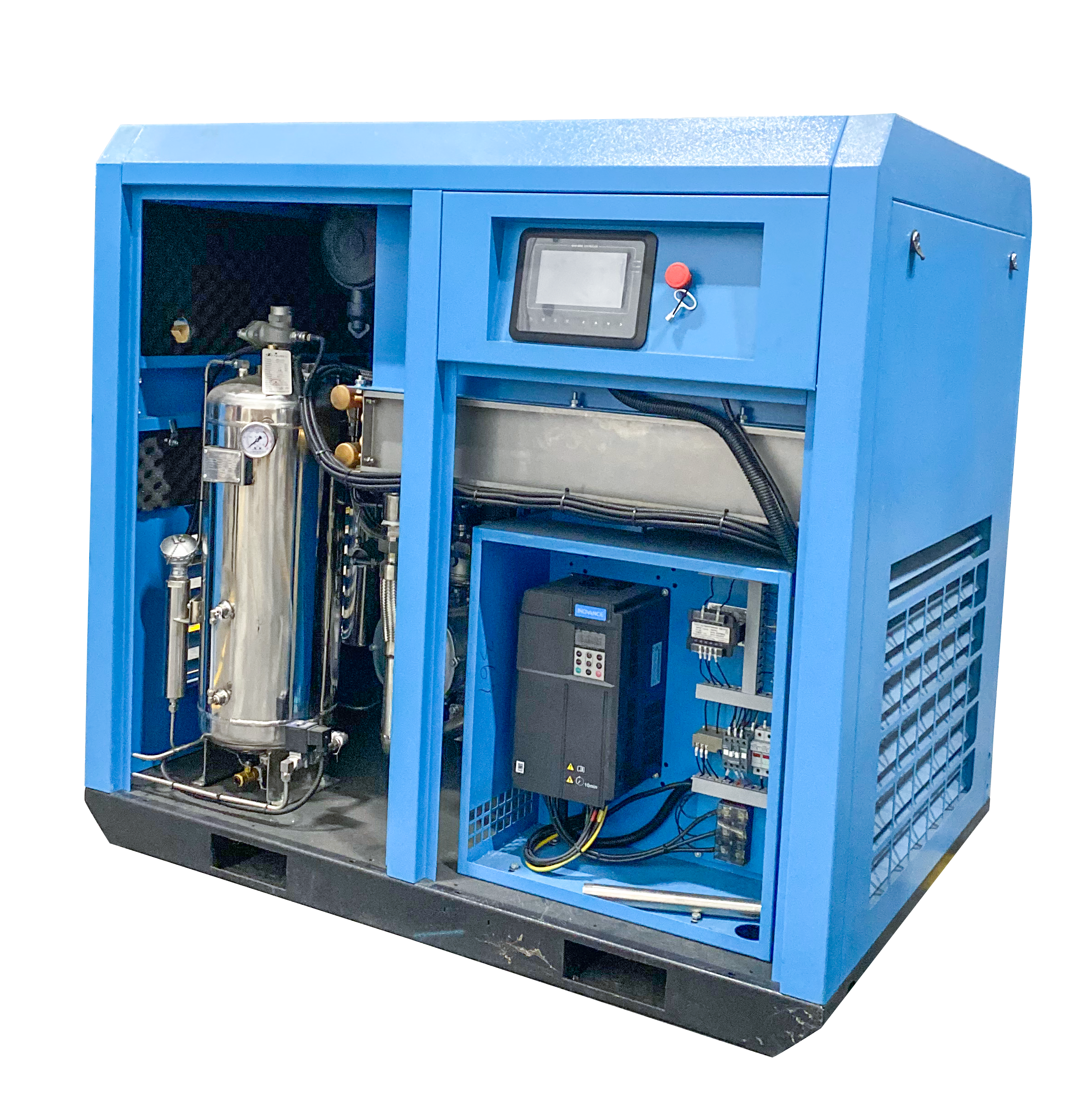
An oil free screw compressor utilizes twin helical screws. They compress air continuously through tight tolerances.
Scroll technology uses two spiral elements. One remains stationary while the other orbits inside it, trapping and compressing the air.
These dynamic machines transfer kinetic energy into pressure using a high-speed rotating impeller.
You must optimize your energy footprint proactively. Compressors consume vast amounts of electricity. Managing this consumption transforms facility overhead dramatically.
You should evaluate Variable Speed Drive (VSD) technology carefully. It shines in environments with fluctuating shift demands. For example, a bakery might run three shifts. Each shift carries drastically different pneumatic loads based on the recipe schedule.
A traditional fixed-speed machine runs efficiently only at 100% capacity. When demand drops, it unloads but still consumes substantial power while idling. VSDs adjust the motor speed directly. They match air demand perfectly in real time. This precise matching typically prevents 35-50% of the energy waste seen in traditional fixed-speed operations. You also avoid costly peak demand charges from your local utility company.
Food plants require immense amounts of hot water. You need it for sanitation processes. You need it for sterilization. During the air compression process, the machine generates tremendous heat. Typically, cooling fans just blow this heat into the atmosphere.
You can capture 80% or more of this rejected compressor heat. You route it through a specialized heat exchanger. This system pre-heats your boiler feed water. The boiler then uses far less natural gas or electricity to reach boiling temperatures. This integration radically improves plant-wide energy efficiency.
Selecting the right equipment serves as an exercise in robust risk management. Prioritizing ISO Class 0 equipment mitigates contamination liability immediately. Proper sizing prevents premature mechanical wear and protects your infrastructure. Integrating VSD technology controls your operational energy footprint.
Avoid guessing your pneumatic needs. Request a comprehensive compressed air audit first. A certified technician will data-log your current CFM and PSI usage over a full week. This empirical data empowers you to shortlist equipment confidently. Protect your brand reputation by investing in the correct mechanical design from day one.
A: While technically possible under ISO Class 1 or 2, it is highly risky. Food-grade oil is still a contaminant. It can easily alter taste, smell, and product safety. Furthermore, inline filters degrade over time. A true oil-free compressor (Class 0) represents the safest compliance route. It completely removes the risk of fluid transfer.
A: In industrial terms, people use them interchangeably. However, "oil-free" typically refers to the compression chamber itself having no oil. The gearbox might still contain lubrication. "Oil-less" often refers to smaller, consumer-grade units possessing no oil anywhere in the system. Always look for the ISO 8573-1 Class 0 certification regardless of the terminology.
A: Industry best practices and GFSI-recognized standards typically dictate regular testing. You should conduct compressed air testing at least annually. You must also test whenever major maintenance occurs on the compressor system. Continuous monitoring systems remain highly recommended for high-risk, direct-contact lines.


