
- Home
- Products
- Hot
- About Us
- Services
- Industry
- Contact
Views: 0 Author: Site Editor Publish Time: 2026-11-20 Origin: Site


A compressed air filter removes contaminants from the air delivered by a compressor. Depending on the element, it captures dust and rust, collects fine droplets of water and oil, or adsorbs oil vapor. This helps protect air tools, valves and cylinders.
Water vapor can pass through a coalescing filter and condense farther down the line. A dryer controls that risk by lowering the pressure dew point.
The intake filter cleans incoming air. Inside an oil-injected screw compressor, the air-oil separator recovers lubricant. The downstream line filter treats the air delivered to the equipment.
Choose the treatment stage by what is in the air. A micron rating describes particle size, while a moisture or oil problem also depends on whether the contaminant is a liquid droplet or a vapor.
| Treatment stage | What it handles | Where it helps |
|---|---|---|
| Particulate filter | Solid particles such as dust, rust and pipe scale | Protects pneumatic components and catches debris picked up in distribution. |
| Bulk water separator | Free liquid and larger droplets | Removes condensate after cooling and reduces the liquid load on downstream elements. |
| Coalescing filter | Fine droplets of water or oil and solid particles | Reduces oil mist and liquid aerosols before they reach sensitive equipment or later treatment stages. |
| Activated carbon filter | Oil vapor and some hydrocarbon odors | Polishes pretreated air when the process requires oil-vapor control. Upstream coalescing protects the carbon from liquid oil. |
| Compressed air dryer | Water vapor | Lowers the pressure dew point to limit condensation as the air cools downstream. |
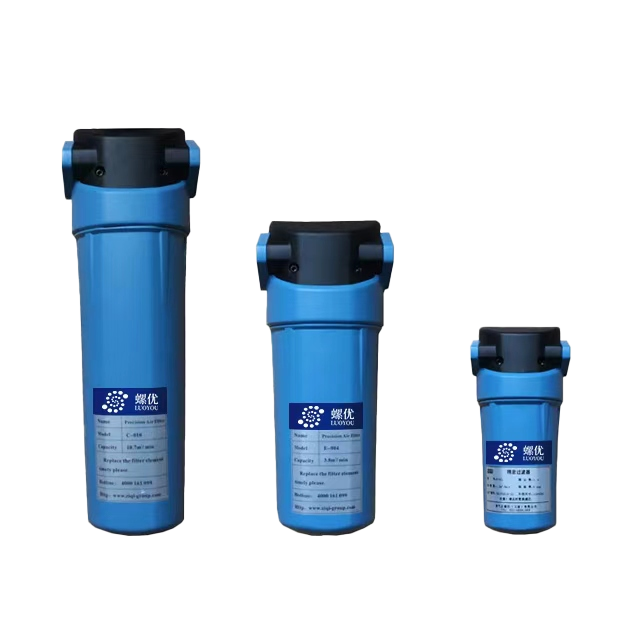
Luoyou’s Ultra-Fine Precision Compressed Air Filter is one example of a coalescing stage for residual oil mist. If the process specifies a limit for total oil, check whether the treatment also needs to control oil vapor.
Pressure dew point is the temperature at which water starts to condense at the stated air pressure. Condensation can form wherever a pipe gets colder than that dew point.
If a 75 kW PM screw compressor for mining feeds an outdoor line, choose a dryer that can keep the pressure dew point below the lowest expected pipe temperature while meeting the machine’s air-quality requirement. Verify dryer capacity at the expected flow and inlet conditions.
On a shared header supplied by a 75 kW, 8 bar PM VSD screw compressor, size the main filter for the airflow needed when several machines draw air at once.
With a low-pressure PM rotary screw compressor, check how much pressure the process can afford to lose across the treatment stages.
For a 37 kW, 16 bar laser-cutting compressor, check the housing, drain and dryer ratings at their installed pressures. The laser maker specifies purity and minimum inlet pressure for compressed-air assist.
It can. Intake air can carry particles and moisture, and distribution pipes can add rust or scale. Choose the treatment from the air quality required at the equipment and the contaminants present in the system.
Yes. Pipe scale, rust or debris from maintenance can enter the air after it leaves the main treatment equipment. If the branch is the source, fixing the contamination and placing a final particulate filter close to sensitive equipment can help.
Choose the treatment for the contaminant present. If you’re selecting air treatment with Luoyou, share the peak airflow, pressure at the proposed filter location and the air quality your equipment requires.


