
- Home
- Products
- Hot
- About Us
- Services
- Industry
- Contact
Views: 0 Author: Site Editor Publish Time: 2026-11-18 Origin: Site


Choose a compressed air dryer that can handle the peak airflow through its inlet at your operating pressure and temperatures, while reaching the pressure dew point your equipment needs. Start with your compressor’s delivered airflow and apply the correction factors for the dryer you’re considering.
For example, if 100 SCFM enters a dryer and site conditions reduce its capacity to 68.4% of its catalog rating, you need a nominal rating of at least 146.2 SCFM. A 150 SCFM unit clears the flow check in that case. Verify that it can also deliver the required dryness and outlet pressure.
For a single compressor feeding an inline dryer, start with the compressor’s full-load free air delivery (FAD) at the discharge pressure you plan to run. Find it on the compressor performance sheet. Motor horsepower, tank volume and pipe size do not tell you how much air the compressor delivers.
Put both ratings on the same reference basis before comparing them. FAD expresses delivery as a volume at specified inlet or reference conditions. Standard cubic feet per minute (SCFM) refers to a defined temperature, absolute pressure and humidity. Check those definitions on both sheets. If a meter reports actual cubic feet per minute (ACFM) at line pressure, convert that reading to the catalog’s SCFM basis before comparing. Ask the supplier for the reference conditions if the catalog lists only CFM.
A system that runs 60 SCFM most of the day but sends 100 SCFM through the dryer during production needs a model that can handle that 100 SCFM operating case. If a properly sized dry receiver serves part of the peak, use the maximum flow that still passes through the dryer.
Get the candidate dryer’s capacity chart at the desired pressure dew point. The Compressed Air and Gas Institute’s refrigerant dryer data sheet illustrates one common rating basis with saturated inlet air at 100°F, 100 psig inlet pressure and 100°F maximum ambient temperature. Compare those values with your site and use the conditions printed for the exact model.
Use the most demanding credible combination of flow, pressure and temperature. If the hottest day and the highest flow occur under different operating modes, check both operating cases. A correction factor applies within the model’s published operating limits.
If the chart gives capacity multipliers, multiply them as directed to find the combined factor. On-site capacity = nominal capacity × combined factor. To work backward, minimum nominal capacity = peak inlet flow ÷ combined factor.
Some catalogs give sizing multipliers to apply directly to the required flow. Follow the equation on that chart. When one table already combines inlet pressure and temperature, use that value once.
Suppose a single compressor sends 100 SCFM through its refrigerated dryer on the same flow basis as the catalog. For illustration, assume the candidate family uses capacity multipliers of 0.80 at 110°F inlet air, 0.90 at 90 psig inlet pressure and 0.95 at 105°F ambient air. All three conditions are within this hypothetical family’s published operating range.
Multiply 0.80 × 0.90 × 0.95 to get 0.684. Divide 100 SCFM by 0.684 to get a minimum nominal capacity of 146.2 SCFM.
| Nominal capacity | Capacity after correction | Result at 100 SCFM |
|---|---|---|
| 125 SCFM | 85.5 SCFM | Falls short by 14.5 SCFM |
| 150 SCFM | 102.6 SCFM | Clears the flow check by 2.6 SCFM |
Of these two sizes, shortlist the 150 SCFM unit. If another model family uses different factors or a different dew point rating, redo the calculation with that family’s data.
Pressure dew point (PDP) is the temperature at which water vapor starts to condense at the stated air pressure. For condensation control, choose a PDP below the lowest temperature the pressurized air will reach downstream. If the process or equipment specifies a stricter PDP, use that requirement.
A refrigerated dryer cools compressed air so moisture condenses and can drain away. A model rated near +3°C (+37°F) PDP is a candidate for indoor plant air when the lines stay warmer than that dew point and the equipment allows it.
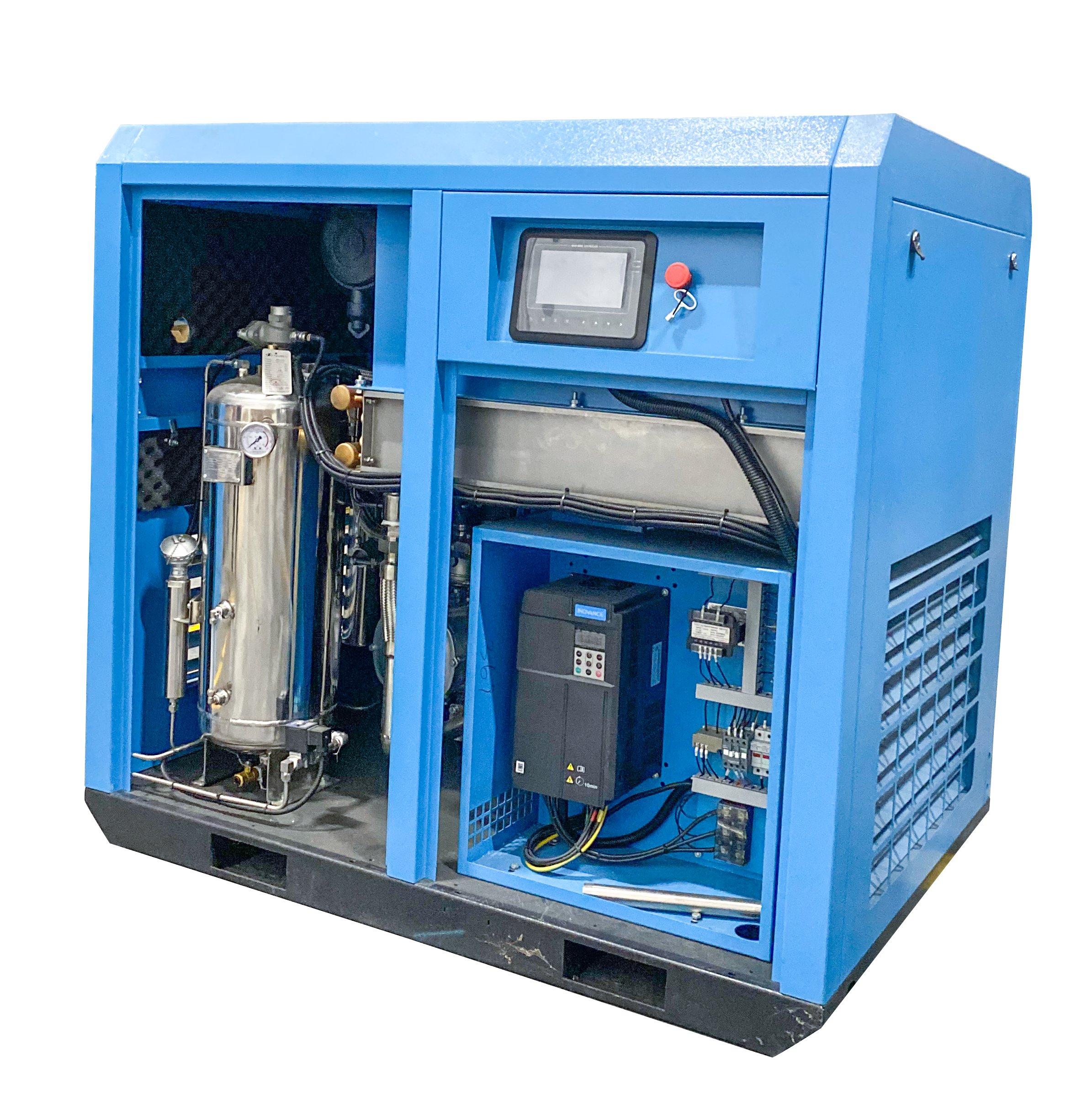
An adsorption dryer passes air through a desiccant bed that captures water vapor. It can reach lower PDPs for cold lines or moisture-sensitive processes. For example, if air in an outdoor line cools to 23°F (−5°C) at distribution pressure, a +3°C PDP would allow moisture to condense. Select a model capable of a PDP below the temperature the air reaches in that line. ISO 8573-1 specifies separate purity classes for water, oil and particles, so check each requirement independently.
Once you know the required dew point and corrected flow, compare LuoYou’s compressed air dryers by technology and capacity.
For a lower dew point, LuoYou’s Microthermal Regeneration Adsorption Air Dryer uses two desiccant towers. One dries the process air while heated purge air regenerates the other. Ask for the rated flow, outlet PDP and regeneration demand for the exact model at your inlet conditions.
Check whether a regenerative dryer’s capacity is quoted as inlet flow or usable dry-air outlet flow. If it draws purge air from the dried stream, part of the compressor’s output is used to regenerate the desiccant. Some units also use air during cooling or tower switching. Ask for net outlet flow during the relevant part of the cycle and include any demand spikes in the air-supply check.
For example, say your plant needs 180 SCFM of dry air and the dryer uses 8% of its inlet flow throughout the design case. The process receives 92%, so the required inlet flow is 180 ÷ 0.92 = 195.7 SCFM. Use at least 195.7 SCFM as the inlet-flow input for the capacity check in this example.
If the supplier quotes air loss as a fixed flow at your operating conditions, add that flow to the required outlet supply. If it quotes net outlet capacity at the same conditions, compare that figure directly with your demand. Check the loss basis before doing the calculation.
Keep a separate pressure budget. Subtract the pressure losses across the dryer, filters and downstream piping from the pressure available upstream of those components at peak flow. The remaining pressure must meet the requirement at the point of use. ISO 7183 identifies flow, pressure dew point, pressure drop and compressed-air loss as distinct dryer performance measures.
Yes, if it treats only a branch or a verified flow limit keeps its inlet load within its corrected capacity. Size it for the highest flow that can pass through that dryer and the PDP the branch needs. If it treats the full output, use that full-flow operating case.
Calculate a second design case using the additional loads or compressors expected to run at the same time. Compare the larger model with a future separate treatment line, especially if only one process needs drier air. Allow for the specific expansion you can describe.
Check the outlet PDP while the plant is busy, along with inlet flow, inlet temperature and the condensate drain. If the PDP meets the target and water still collects, check for piping that cools below that dew point or an open bypass admitting untreated air.
Send LuoYou the maximum dryer inlet flow and its reference basis, the lowest loaded inlet pressure, the hottest inlet air, the ambient or cooling-water conditions, your required PDP, and the minimum pressure at the point of use. Include any known filter and piping losses. If you have a regenerative dryer on the shortlist, include the dry airflow the plant needs during its busiest operating case.
Ask LuoYou to confirm the dryer size for your compressor. Request the proposed model’s capacity at your site conditions, its outlet dew point, the pressure drop at design flow and the net dry-air delivery.


