You are here: Home » Industry » Industry News » What Does a Compressed Air Dryer Do?

What Does a Compressed Air Dryer Do?

Views: 0     Author: Site Editor     Publish Time: 2026-11-19      Origin: Site

Inquire

facebook sharing button
twitter sharing button
line sharing button
wechat sharing button
linkedin sharing button
pinterest sharing button
whatsapp sharing button
kakao sharing button
snapchat sharing button
telegram sharing button
sharethis sharing button

A compressed air dryer removes water vapor and lowers the pressure dew point. This reduces condensation in pipes and tools, helping prevent internal rust, sticking pneumatic valves, and moisture defects in spray painting.

Where Does Water in Compressed Air Come From?

Water enters as humidity in the air the compressor takes in. The U.S. Department of Energy describes three treatment stages after compression.

  1. Cool the air. The aftercooler lowers the discharge temperature, so some vapor condenses into droplets.
  2. Remove the droplets. A separator collects the liquid, and a drain discharges it.
  3. Dry the air. The dryer removes more of the water vapor that remains after separation.

What Does Pressure Dew Point Tell You?

Pressure dew point (PDP) is the temperature at which water vapor starts to condense at a given pressure. Compare the air temperature with the PDP at the pressure in that part of the line.

One Dew Point, Two Air Temperatures

Suppose two branches receive air with a PDP of +3°C (about 37°F) at roughly the same line pressure.

  • +12°C (54°F). The air stays above its dew point, so its water vapor stays in the air.
  • +1°C (34°F). The air cools below its dew point, so some of its water vapor can condense.

Some refrigerated dryers reheat the outlet air after draining the condensate. The air gets warmer, but it still contains essentially the same amount of water vapor.

How Do Compressed Air Dryers Remove Water Vapor?

Where Water Goes in Three Types of Compressed Air Dryers
Dryer type How water leaves the air When to consider it
Refrigerated Chills the air so vapor condenses. A separator collects the liquid and a drain discharges it. General plant air when the required PDP is above freezing and the distribution conditions allow it.
Regenerative desiccant (adsorption) Water vapor adheres to the surface of a porous material. Regeneration releases that moisture and carries it out of the dryer. Processes that specify a low PDP or air lines that get colder than a refrigerated dryer’s outlet PDP.
Membrane Water vapor passes through the walls of hollow fibers. In many designs, a small sweep stream carries it away. A local branch or point of use when the membrane’s rated flow and dew-point reduction meet the application’s needs.

How a Twin-Tower Desiccant Dryer Keeps Drying

Luoyou’s microthermal regeneration adsorption dryer uses two towers that take turns drying the air.
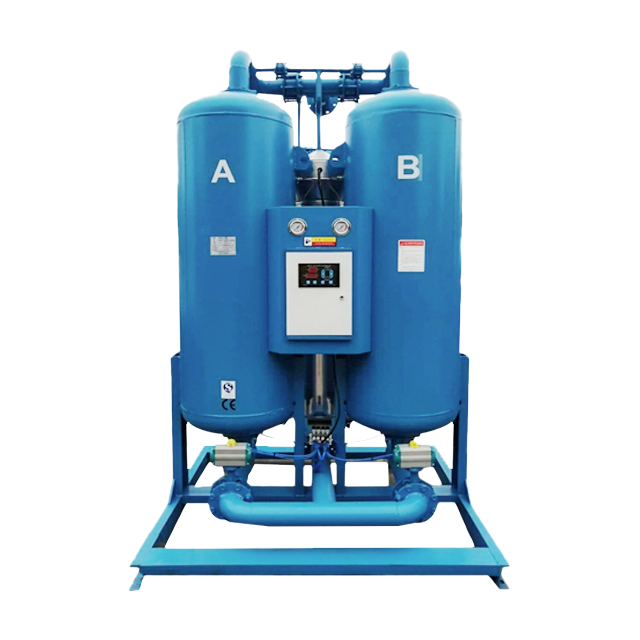
  • Drying tower. Its desiccant captures water vapor from the incoming air.
  • Regenerating tower. Heated dry air carries the collected moisture out at reduced pressure. When the towers switch, the regenerated bed takes over drying.
Luoyou adsorption dryer with two blue vessels labeled A and B
Towers A and B take turns drying incoming air and releasing the water they have collected.

Why Is There Still Water After the Dryer?

The location of the water and the dryer outlet PDP help narrow down the cause.

  • Water appears only in a cold branch. Compare the air temperature there with its local PDP. Water vapor can condense after the air leaves the dryer.
  • Outlet PDP rises at peak flow or with hotter inlet air. Compare actual flow, inlet air temperature, and pressure with the dryer’s rated conditions.
  • Liquid appears despite a normal outlet PDP. Check for separator or drain carryover on a refrigerated dryer. An open bypass can also introduce wet air downstream of the sampling point.

When Does a System Need Drier Air?

  • General indoor plant air. A refrigerated dryer is often sufficient if it meets the process moisture limit and the air stays above its PDP all the way to the tools.
  • Cold pipes or moisture-sensitive processes. A cold branch may need a lower PDP to prevent condensation. A process can also require deeper drying in a warm building.
  • One branch has a stricter limit. Consider drying that branch separately if the rest of the plant can use air at a higher dew point.

Frequently Asked Questions

Can a compressed air filter replace a dryer?

Particulate and coalescing filters capture particles and suspended droplets, respectively. A dryer removes water vapor. ISO 8573-1 assigns separate purity classes to particles, water, and oil.

Does an oil-free compressor still need an air dryer?

It can. An oil-free compressor still draws in humid air. Drying depends on the moisture limit at the point of use and how cold the air gets on its way there.

Specifying the Dew Point You Need

When comparing Luoyou’s compressed air dryers, share these conditions so you can ask what outlet PDP the proposed model can maintain.

  • Target dew point at the point of use
  • Peak airflow
  • Operating pressure
  • Highest expected dryer inlet temperature

Telephone

Subscribe To Our Newsletter

Promotions, new products and sales. Directly to your inbox.
Copyright © 2025 Luoyou Compressor (Shanghai) Co., Ltd. All Rights Reserved.