
- Home
- Products
- Hot
- About Us
- Services
- Industry
- Contact
Views: 0 Author: Site Editor Publish Time: 2026-08-29 Origin: Site


Investing in a premium oil-free screw air compressor effectively mitigates the risk of internal oil contamination during operation. However, this initial hardware upgrade does not automatically guarantee compliant point-of-use air across your entire facility. You must look beyond the machine itself to ensure true system integrity.
Regulatory bodies like the FDA, SQF, and ISO require empirical proof of air purity rather than just equipment spec sheets. Ambient air intake, legacy piping, and environmental factors can still introduce dangerous trace contaminants into your network. Facility managers often underestimate how easily these hidden variables compromise end-product quality.
This guide outlines how to establish an objective, audit-ready framework for your facility. You will discover practical methodologies to monitor and document ongoing system performance. We will show you exactly how to verify your clean air compressor system is actually delivering the required purity levels directly to your production floor.
Procurement teams often assume buying an oil free screw air compressor is the final step in their purity journey. They view this specific hardware as a complete, standalone solution. However, this assumption introduces significant operational blind spots. Compressors must ingest large volumes of ambient air to function. This surrounding air rarely remains pristine in typical industrial zones. It frequently contains high levels of environmental hydrocarbons. Common sources include nearby forklift exhaust, manufacturing fumes, chemical solvents, and general urban smog. The compression cycle naturally concentrates these trace elements, pushing them directly into your air network.
A successful verification protocol aggressively protects your business from these unseen variables. It eliminates liability by providing objective, indisputable data. You must prove the air interacting with your delicate end-products is entirely contaminant-free. This requires strict auditing practices and robust documentation. Facility managers cannot rely on assumptions when facing external regulatory inspectors. By implementing structured testing, you transform an assumed state of purity into a proven, verifiable fact.
Relying solely on the equipment type creates extreme financial and regulatory risks. You risk catastrophic batch rejections without downstream testing. Auditors routinely demand empirical evidence during compliance checks. If you lack testing data, you fail the audit. Furthermore, undetected legacy contamination often ruins products over extended periods. Many plants reuse old distribution piping from previous oil-injected systems to save capital. This pipework retains residual oil for years. This residual oil eventually leaches into your newly generated clean air stream. Therefore, active testing remains absolutely essential for maintaining strict quality control.
You need an authoritative framework to accurately measure success. ISO 8573-1 serves as the undisputed global standard for this exact purpose. It defines precise purity classes for oil free compressed air. Regulatory bodies globally respect and enforce this framework. It provides a highly necessary common language for facility managers, engineers, and third-party auditors. By aligning your verification efforts with ISO 8573-1, you remove subjectivity from your quality control process.
Understanding the fundamental difference between Class 1 and Class 0 is absolutely critical for compliance.
Verifying an oil-free system requires looking far beyond just oil. You must measure three primary contaminant pillars simultaneously. These include total oil, water moisture (measured as pressure dew point), and solid particulates. Moisture levels directly impact how oil vapors behave inside your piping. High dew points cause water vapor to condense into liquid. This liquid water interacts with trace oil vapors to create thick, destructive emulsions. These emulsions readily clog pneumatic valves, foul instrumentation, and ruin sensitive products. Therefore, comprehensive air testing must evaluate all three variables to ensure true system health.
| ISO 8573-1 Class | Maximum Total Oil Content (mg/m³) | Primary Application Context |
|---|---|---|
| Class 0 | Stricter than 0.01 (As specified by user) | Pharmaceuticals, specialized electronics, cleanrooms |
| Class 1 | ≤ 0.01 | Food and beverage, high-grade painting, textiles |
| Class 2 | ≤ 0.1 | General pneumatics, advanced automation |
| Class 3 | ≤ 1.0 | Basic manufacturing, robust power tools |
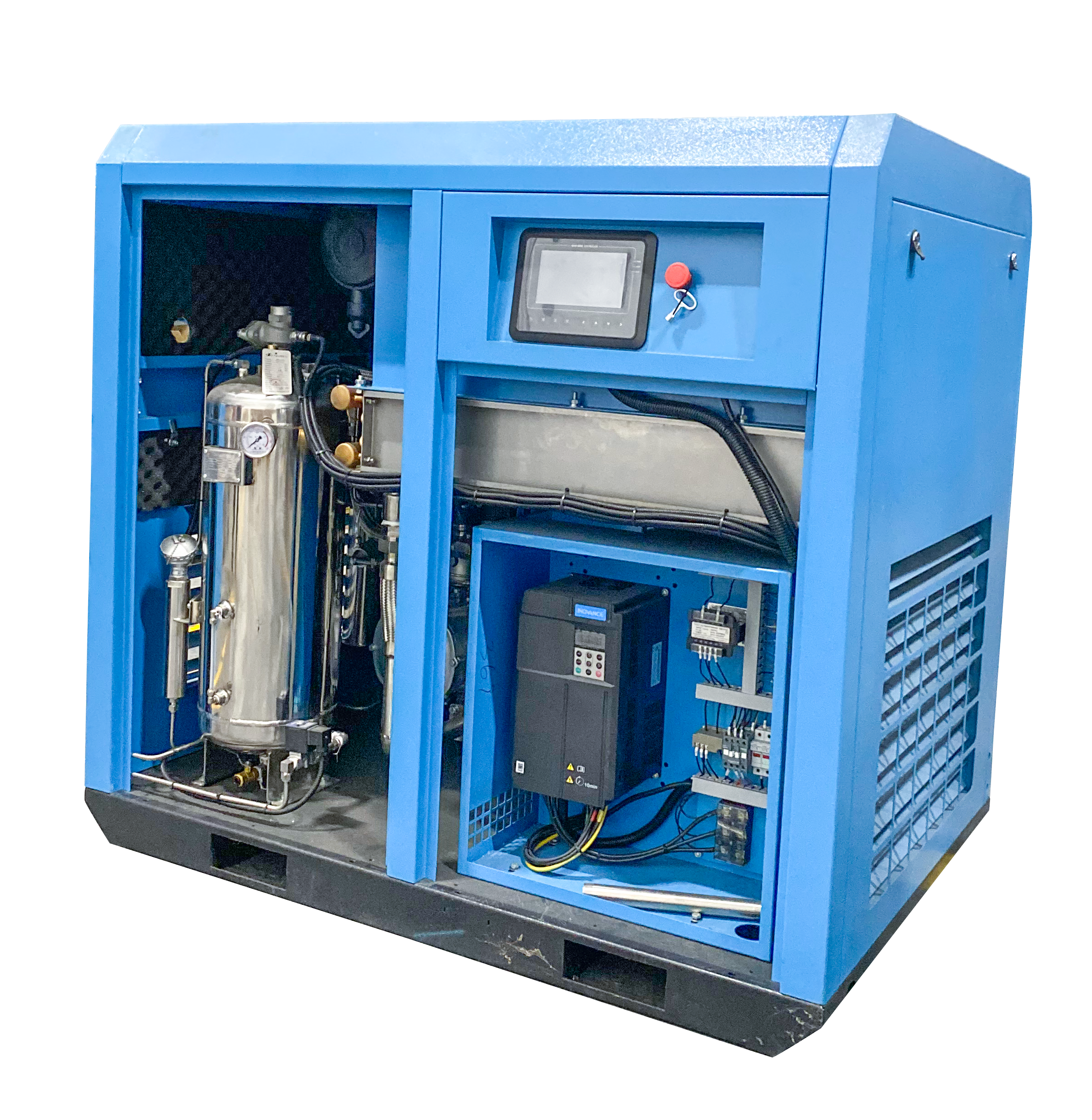
Facilities must adopt widely accepted methodologies for testing an industrial oil free compressor network. You simply cannot manage what you do not measure accurately. We strongly recommend dividing your testing strategy into three distinct solution categories. Each method serves a specific operational purpose, offering different balances of precision, cost, and response time.
This method involves taking physical air samples directly from your active pipelines. Technicians use highly specialized capture equipment at the critical points of use. They then send these physical samples to accredited external laboratories. The labs utilize gas chromatography and mass spectrometry (GC-MS) to analyze the contents.
This methodology provides absolute precision down to microscopic parts per million. GC-MS testing remains the gold standard for annual compliance reporting. It easily satisfies the most demanding FDA or ISO auditors. Furthermore, it establishes a highly accurate baseline for initial system validation. However, you must remember it only provides a snapshot in time. It cannot alert you to sudden contamination events occurring between testing cycles.
Modern industrial facilities increasingly rely on continuous inline monitoring systems. You install Photoionization Detector (PID) sensors directly into the distribution piping. These advanced sensors track real-time vapor concentrations 24 hours a day. They deliver constant data feeds to your central control system or SCADA network.
This continuous approach provides immediate alarms when trouble arises. It detects transient ambient spikes instantly. For example, imagine a diesel delivery truck idles near your compressor intake duct. The PID sensor registers the resulting hydrocarbon spike immediately. It triggers a system alarm or automated bypass valve. This swift action prevents prolonged exposure and actively protects your current production batch from silent contamination.
Detector tubes offer a highly cost-effective, immediate alternative to lab testing. Maintenance teams frequently use them for routine diagnostic checks. You pass a specific volume of compressed air through a chemically treated glass tube. The internal chemicals change color rapidly if oil vapors are present.
While extremely useful for fast diagnostics, they possess notable limitations. They completely lack the extreme accuracy of laboratory GC-MS analysis. They also remain highly prone to human error during the visual reading phase. Consequently, detector tubes are rarely sufficient for passing strict ISO compliance audits. They serve best as quick, supplementary tools to guide daily maintenance decisions.
Testing methodology only provides value if you test in the correct locations. Many operators mistakenly draw samples only at the immediate compressor output. This specific location rarely reflects the actual air quality reaching the final product. The air must be verified exactly where it matters most to your operation. Effective air quality verification depends heavily on strategic sensor placement and logical sampling zones.
Consider this standard framework for strategic sensor placement:
Determining your exact testing frequency requires careful industry logic. You must base these intervals on your specific operational risk profile. The Food & Beverage sector demands high frequency to prevent spoilage. Pharmaceutical manufacturing generally requires continuous inline monitoring or stringent monthly lab testing. A single contamination event in these fields causes massive product recalls and severe legal action. Conversely, a standard textile plant faces much lower consumer risks. Textile operations may only require basic annual third-party audits. Assess your acceptable risk threshold honestly before defining your corporate testing schedule.
Finding trace oil in a clean air compressor system often sparks intense disbelief. Operators typically consider it an impossible scenario. However, we must address this reality with balanced claims and healthy engineering skepticism. Trace contamination happens even with premium oil-free equipment. You must know how to identify the actual root cause rather than blaming the primary machinery prematurely.
Consider the following chart detailing common contamination mechanisms and their corresponding solutions:
| Risk Factor | Contamination Mechanism | Required Corrective Action |
|---|---|---|
| Legacy Pipework | Old piping retains residual oil. The clean, dry air strips this boundary layer, pushing aerosols downstream. | Replace the saturated distribution piping entirely, or install specialized POU filtration. |
| Ambient Intake | High-hydrocarbon environments near loading docks introduce dense exhaust vapors into the intake stream. | Relocate the compressor intake duct to a cleaner, elevated outdoor area. Upgrade intake pre-filters. |
| Faulty Equipment | Uncalibrated PID sensors or contaminated sampling capture bags create severe false positive readings. | Recalibrate inline sensors quarterly. Always utilize certified third-party technicians for compliance sampling. |
You must implement decisive corrective actions when contamination occurs. Upgrading intake filtration helps block bulk ambient hydrocarbons effectively. Relocating the primary intake pipe to a cleaner outdoor area often provides immediate relief from localized fumes. For legacy pipework issues, you must ideally replace the saturated distribution lines. If full replacement proves too costly for this quarter's budget, adding specialized activated carbon towers near the critical points of use helps handle the residual vapors. Remember to track the lifespan of these carbon beds, as they saturate rapidly when fighting severe legacy contamination.
Verifying air purity constitutes an ongoing operational requirement for modern manufacturing. It is never a one-time purchasing decision limited to the procurement phase. Your equipment choices matter, but your ongoing testing protocols ultimately protect your product.
When evaluating a verification partner or selecting monitoring equipment, apply strict shortlisting logic. Prioritize solutions offering fully ISO 8573-1 compliant reporting structures. Ensure their sensory equipment is specifically calibrated to detect trace vapors and microscopic aerosols, not just bulk liquids.
Your immediate next step involves deliberate action. We strongly recommend conducting an initial baseline Point-of-Use audit using GC-MS technology. This specific action establishes your current air quality accurately. Secure this definitive baseline before you invest heavily in permanent inline monitoring hardware.
A: Yes. Even though the compressor itself does not introduce oil, contamination still occurs. This happens if the ambient intake air contains environmental hydrocarbons like exhaust or chemical fumes. Furthermore, downstream distribution piping often retains residual oil from previous installations. This legacy oil easily leaches into the newly compressed clean air.
A: Class 1 enforces a strict, universal limit of 0.01 mg/m³ for total oil concentration. Class 0 represents a customizable standard negotiated directly between the user and manufacturer. It must be demonstrably stricter than Class 1. However, Class 0 is not a magical zero-contamination guarantee, as ambient air always contains trace impurities.
A: Testing frequency depends heavily on your specific industry risk profile. Continuous inline monitoring is highly recommended for critical applications like pharmaceuticals and food processing. For general manufacturing, comprehensive ISO 8573-1 laboratory audits should be conducted at least annually. You must also test immediately after any major system maintenance or piping modifications.


