
- Home
- Products
- Hot
- About Us
- Services
- Industry
- Contact
Views: 0 Author: Site Editor Publish Time: 2026-09-03 Origin: Site


Many facilities make a critical mistake when procuring new industrial equipment. They readily accept the factory-default parameters on new air compressors. These off-the-shelf configurations rarely match specific plant operations. They often create artificial demand and cause excessive equipment wear. Facilities experience inflated energy costs as a direct result. The specification phase is your real window of opportunity. You must align OEM screw air compressor controls with your actual demand profiles. This proactive alignment ensures seamless integration with existing SCADA systems. It also guarantees compliance with facility standards long before you sign the purchase order. In this article, you will learn exactly which parameters demand strict specification to optimize your pneumatic infrastructure.
Plug-and-play assumptions often lead to operational drift. Factory defaults use broad assumptions about system volume and generic air consumption patterns. This generalized approach inevitably wastes energy over time. You face the severe risk of "artificial demand" when systems operate just 2 or 3 PSI above the required plant pressure. This slight increase disproportionately inflates overall energy consumption. It also forces existing pipeline leaks to vent air faster, draining your system capacity.
Successful custom compressor settings establish clear, highly tailored operational baselines. They maintain exceptionally stable system pressure across varying production shifts. They maximize the turndown ratio for variable loads, ensuring machines only work as hard as necessary. Furthermore, customized configurations eliminate communication blindspots between the compressor and your plant operators.
Table: Impact of Generic Parameters vs. Engineered Configurations
| Configuration Style | System Pressure Stability | Energy Efficiency Impact | Wear and Tear |
|---|---|---|---|
| Factory Defaults | Fluctuates wildly based on arbitrary deadbands | High (Artificial demand increases kW usage) | Accelerated intake valve cycling |
| Custom Settings | Stable and matched to specific plant demand | Optimized (Lower specific power consumption) | Minimized through proper load sequencing |
You must target the true minimum pressure your facility demands. Do not base the optimal pressure setpoint on what the compressor room header can handle. Instead, base it on the most demanding point-of-use application in your plant. If a specific packaging machine requires 90 PSI, configuring the main header to run at 110 PSI wastes immense amounts of power. You must account for standard pressure drops across dryers and filters, but you should never artificially inflate the baseline.
The deadband dictates exactly when your machine loads and unloads. You must define the precise cut-in and cut-out pressure differential required for your specific piping network volume. This piping acts as a storage buffer. Setting the deadband too tight causes rapid cycling. Rapid cycling wears out intake valves, motor contactors, and bearings prematurely. Conversely, setting the band too wide wastes energy by forcing the machine to over-pressurize the system before finally unloading.
Different units require vastly different valve behaviors. Base-load machines benefit immensely from standard load/unload logic since they generally run at full capacity. Trim machines often need specific modulation guidelines to handle fluctuating production peaks smoothly. You must request distinct valve control behaviors based on each unit's assigned role in the network. Forcing a base-load unit to modulate restricts its efficiency and drives up operational costs.
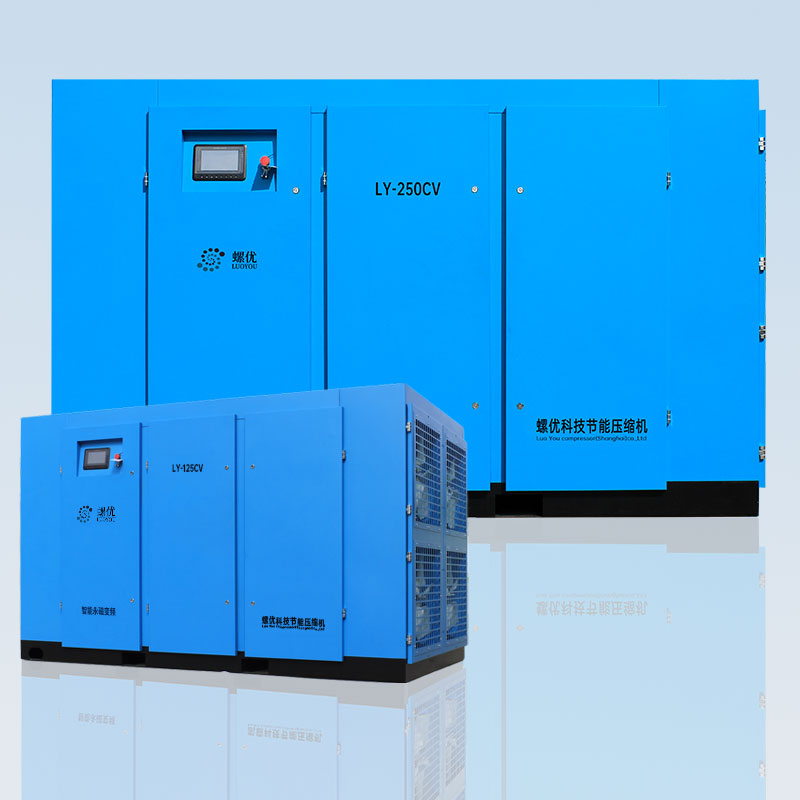
Generic Variable Speed Drive (VSD) settings fail in environments with highly fluctuating demand. Standard parameters cannot react fast enough to sudden pressure drops. You must specify the exact VSD control logic during the initial procurement phase. You must also detail the Proportional-Integral-Derivative (PID) loop tuning. Proper PID tuning prevents the motor from dipping below its minimum cooling speed. Running the motor too slowly causes dangerous overheating and premature winding failure.
Multi-unit master and slave configurations require strict sequencing rules. You must ensure the VSD trim unit responds instantly to demand spikes. The base-load unit should never unload before the VSD ramps up sufficiently to absorb the shift. We also recognize realistic limits to VSD efficiency. Oversized VSDs running consistently at 20% capacity are highly inefficient. They are also prone to severe oil carryover issues because the internal air velocity drops too low to separate lubricant effectively.
Modern industrial facilities must transition from local HMI reliance to centralized plant control. This modernization requires specific, robust communication protocols. You must specify exact industrial protocols like Modbus TCP/IP, EtherNet/IP, or PROFINET upfront in your documentation. This foresight completely avoids expensive post-installation gateway modifications or messy third-party signal converters.
You must mandate a fully mapped remote monitoring interface. This interface must expose critical data points directly to your central SCADA system. Access to these metrics drives predictive maintenance rather than reactive troubleshooting.
Security and compliance also matter significantly. Specify read-only access for general SCADA visibility. Restrict read/write access controls to authorized engineering terminals to prevent unauthorized remote parameter changes. Unrestricted access can lead to accidental parameter shifts that destabilize the entire pneumatic network.
You must rigorously address what happens when equipment malfunctions. Proper risk mitigation relies entirely on hardcoded protective parameters. You cannot rely on human intervention to prevent catastrophic mechanical failures.
You must differentiate clearly between high-temperature warnings and hard shutdown limits. High-ambient environments require customized thermal trip points to prevent nuisance trips during summer months. You also need strict phase reversal and voltage imbalance protections. These specific fail-safes shield the main motor from unstable utility grid power, saving you from expensive rewinding repairs.
Implementation requires physical, documented proof. Mandate that the OEM or the systems integrator demonstrates the control logic on-site. They must actively simulate minimum and maximum plant load scenarios during commissioning. This Site Acceptance Testing ensures the logic handles real-world conditions without faulting. If the VSD drive does not sequence correctly during the simulation, you must force the integrator to correct the PID tuning before signing the final handover documents.
You need a reliable method to evaluate competing OEM bids. Judge them based on their control capabilities and their willingness to customize firmware. Some vendors resist modifying their standard setup to protect their proprietary service models. You must select partners who prioritize your site demands over their standard operating procedures.
Here is the core specification checklist you must follow before finalizing any purchase order:
We encourage buyers to consult with an independent compressed air auditor or an experienced systems integrator. These external experts can help draft the final control RFQ effectively. They bring objective experience that highlights missing variables in your proposed specification sheets.
Physical compressor hardware is only as efficient as the control logic dictating its daily operation. Do not treat controls as an afterthought in your procurement cycle. They act as the absolute primary driver of your long-term energy consumption and equipment longevity. Taking the time to properly define load/unload differentials, PID responses, and SCADA mapping ensures seamless facility operations. Download a comprehensive specification template or contact your engineering team for an RFQ review today. Ensure your next installation matches your exact performance needs without compromise.
A: Modbus RTU/TCP is the most common baseline. However, EtherNet/IP and PROFINET should be specified for modern Allen-Bradley or Siemens plant environments to ensure seamless, high-speed data integration without expensive bridge modules.
A: VSD logic alters the actual motor RPM to match varying air demand precisely. Standard modulation restricts the inlet valve while the motor continues running at full speed. This difference makes VSD technology significantly more energy-efficient at partial loads.
A: Yes, but core drive parameters and fundamental PID tuning should be set by the OEM to avoid voiding warranties or causing drive instability. Basic setpoints and deadbands are easily adjustable via the master controller.
A: Short-cycling usually results from poor PID tuning, improper piping storage volume, or the VSD control logic not being correctly integrated with the base-load machines. This disconnect forces the VSD to operate poorly below its minimum speed threshold.


