
- Home
- Products
- Hot
- About Us
- Services
- Industry
- Contact
Views: 0 Author: Site Editor Publish Time: 2026-11-23 Origin: Site


A compressed air dryer removes water vapor before it can condense inside tools and pipes. Refrigerated dryers turn vapor into drain water, desiccant dryers capture it on porous beads, and membrane dryers let it escape through hollow fibers.
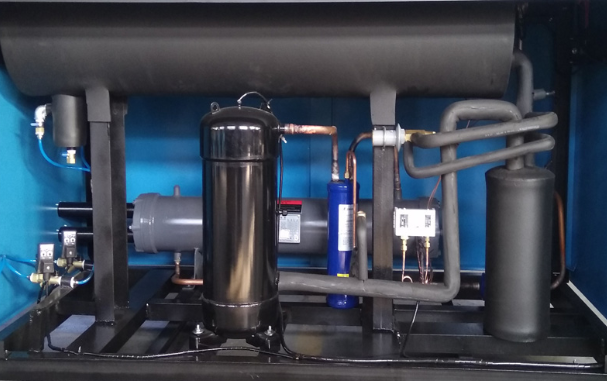
Inside a Luoyou refrigerated dryer. Cooling the compressed air condenses water vapor so a separator can collect the droplets.
The water starts as humidity in the air entering the compressor. Compression concentrates the vapor and heats the air. As the hot discharge cools in the aftercooler, some vapor condenses into droplets.
A separator catches the droplets, and a drain discharges them. The air leaving the separator can still be nearly saturated. Run that air through a colder tool hose and more water can form, even when the upstream drain works perfectly.
In a refrigerated dryer, compressed air and refrigerant flow through separate passages in a heat exchanger. The refrigerant absorbs heat through the metal wall. Follow the compressed air through four steps.
Precool. Incoming air gives up heat to cold, dry air on its way out. That reduces the load on the refrigeration circuit.
Chill. The refrigerant evaporates, drawing heat from the compressed air. As the air cools past its dew point, water vapor condenses.
Drain. A separator collects the droplets. An automatic drain discharges the water before the air leaves the dryer.
Reheat. The outgoing air picks up heat from the inlet air. It can feel warm at the outlet and still have a low dew point because the condensed water has already drained away.
A typical refrigerated dryer can deliver a pressure dew point near +3 °C (+37 °F) under rated conditions. Conventional units keep their coldest passages above freezing to prevent ice from blocking the airflow.
A twin-tower dryer directs wet air through one bed of porous desiccant beads. Water molecules cling to the surfaces inside the pores, a process called adsorption. While that tower delivers dry air, the other releases the water it collected.
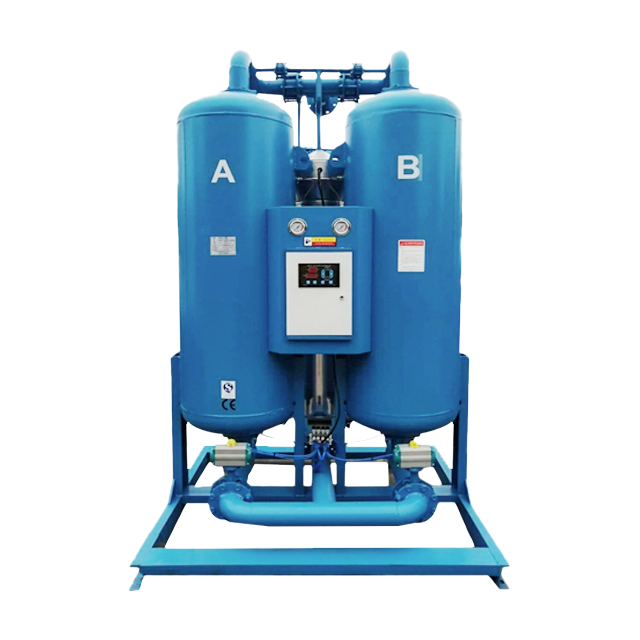
The A and B labels identify the two desiccant beds. One tower supplies dry air while the other regenerates.
One drying cycle in a heat-assisted twin-tower dryer | ||
Cycle stage | Tower A | Tower B |
|---|---|---|
Drying and regeneration | Dries the main airflow at line pressure. | Depressurizes. Heated purge air carries moisture out through the exhaust. |
Preparing to switch | Continues supplying dry air to the plant. | Cools, then returns to line pressure. |
After switchover | Goes offline for regeneration. | Takes over the main airflow. |
Luoyou’s microthermal regeneration adsorption dryer draws some dry air from the outlet and warms it in an external heater for the purge. Once the water has been driven off, unheated purge air cools the bed.
A heatless dryer regenerates its bed with dry air expanded to low pressure. Both designs can serve subzero duties. A −40 °C (−40 °F) pressure dew point requires a model rated for that duty.
A membrane dryer splits the air into two streams. The hollow fiber walls allow water vapor to pass through more readily than the main components of air.
A lengthwise view of one fiber. The dashed arrows trace water vapor crossing the wall into the sweep stream.
Product air flows inside the fibers. Compressed air loses water vapor through the fiber walls. The air that continues along the fibers exits the module and supplies the instrument or tool.
Sweep air flows outside the fibers. Some dried air expands to a lower pressure and sweeps the escaped vapor out through a vent. This keeps the water vapor pressure lower outside, so moisture continues to move outward.
The compressor supplies both streams. When sizing a module for an instrument, check the delivered outlet flow at your operating inlet pressure and required outlet dew point.
The pressure dew point is the temperature at which water starts to condense as compressed air cools at a given pressure. Compare it with the coldest air temperature in the pipe. Use a dew point measured at, or converted to, the pressure in that pipe.
Suppose the dryer delivers a +3 °C pressure dew point and two branches run at the same line pressure.
Indoor branch at +15 °C. The air stays above its dew point. No new liquid forms from the remaining vapor.
Loading-bay branch at −5 °C. The air crosses its +3 °C dew point before it reaches freezing. Water can condense inside the pipe and then turn to ice.
For an exposed line, choose a dew point below its coldest expected temperature, allowing for operating variation. Luoyou’s range of compressed air dryers includes refrigerated units for above-freezing duties and adsorption units for lower dew points.
A coalescing filter collects liquid droplets and helps protect a desiccant bed or membrane from oil and liquid water. Water vapor passes through the filter, so a dryer is still needed when the application calls for a lower dew point.
Warmer, nearly saturated inlet air carries more water vapor per unit of dry air. A hot compressor room also makes it harder for an air-cooled refrigerated dryer to reject heat. Compare inlet temperature, room temperature, pressure, and peak flow with the dryer’s ratings.
Start with the coldest pipe and the moisture limit of the equipment it serves. For a model recommendation, give Luoyou your required pressure dew point, peak delivered airflow, minimum line pressure, and highest inlet and ambient temperatures. If the dryer uses purge air, ask how much airflow remains available to the plant.


