
- Home
- Products
- Hot
- About Us
- Services
- Industry
- Contact
Views: 0 Author: Site Editor Publish Time: 2026-08-24 Origin: Site


A blaring high dew point alarm signals immediate danger for your production line. When visible moisture enters your air lines, your drying system has failed to meet its specified Pressure Dew Point (PDP). We know a standard refrigerated dryer is designed to maintain a PDP of roughly 38°F to 39°F (3°C to 4°C). Anything higher introduces massive condensation risks downstream. Moisture ruins pneumatic tools. It spoils paint finishes and halts automated packaging lines. You need a fast, accurate diagnosis to stop the bleeding and protect your equipment. Our objective is to outline how to systematically isolate the root cause. You will learn to determine whether the issue is environmental, a mechanical failure, or a sizing mismatch. We also provide a practical framework for deciding between basic maintenance and full equipment replacement. Finding the exact problem path prevents wasted maintenance hours and protects your operations.
Business framing is crucial before opening any equipment panels. Misdiagnosing the problem leads to unnecessary equipment purchases. It also causes prolonged production downtime. Facility managers often see water in the pipes and assume the refrigeration circuit is dead. They rush to buy replacement parts. You must define the exact failure mode first to protect your capital budget.
A true high dew point means the refrigeration circuit is actively failing. It fails to chill the compressed air sufficiently. Water vapor remains suspended in the air stream. It travels through your piping network safely as a gas. However, as it travels downstream, the ambient factory air cools the pipes. The vapor then condenses into destructive liquid water at the point of use.
A false high dew point presents identical symptoms but has a different cause. The dryer cools the air perfectly. However, the liquid water is not being ejected. This is known as water carryover. It often stems from a stuck, clogged, or completely failed auto-drain valve. Bulk liquid water bypasses the internal separator. It enters the main air network. This event triggers moisture alarms despite a functioning refrigeration circuit.
Before disassembling the dryer, focus on monitor verification. Verify that the dew point monitor sensor is functioning properly. Sensor probes routinely get fouled by compressor oil. They also drift out of calibration over time. Clean and verify the sensor. This simple check prevents you from tearing down a perfectly healthy system.
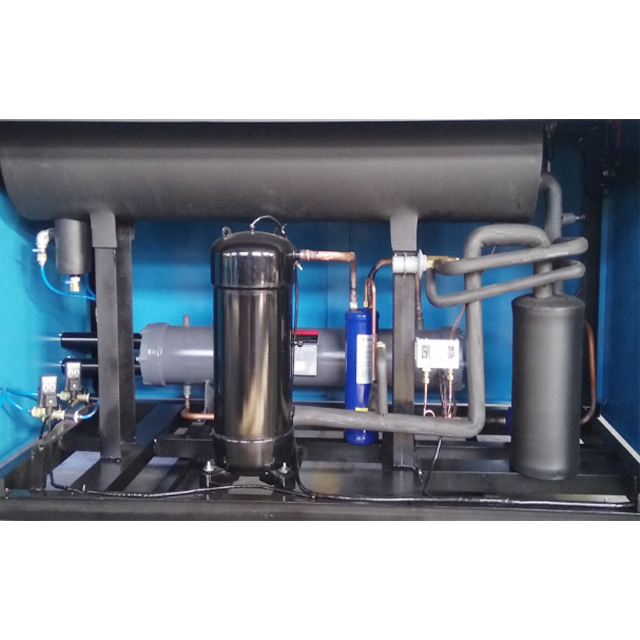
Refrigerated dryers are incredibly sensitive to their surrounding environment. Most issues actually originate outside the dryer casing. You must evaluate the air compressor and the room itself.
High inlet air temperature places a massive load on the dryer. Refrigerated dryers are rated for specific inlet temperatures. Most handle a maximum of 100°F (38°C). If the upstream air compressor runs abnormally hot, the dryer suffers. A failed compressor aftercooler sends scorching air downstream. The dryer becomes thermally overloaded immediately. It simply lacks the capacity to shed the excess heat.
Elevated ambient temperature is another silent killer of compressed air equipment. The dryer condenser must reject internal heat into the surrounding room. High ambient temperature severely degrades cooling efficiency. Poorly ventilated compressor rooms bake the equipment during summer months. The system struggles to condense the refrigerant gas. You must ensure proper ventilation or install exhaust ducting to remove heat.
Airflow overload is a frequent operational issue. Facility expansion pushes more volume through your existing pipes. Adding new pneumatic equipment pushes more compressed air volume (CFM) through the dryer than it is rated to handle. Air moves too fast for effective heat exchange. The moisture never condenses out of the fast-moving air. This overload inevitably creates a refrigerated air dryer high dew point.
When environmental factors are ruled out, you must inspect the internal mechanical components. The refrigeration circuit is complex. It requires precise pressures and temperatures to function correctly.
Refrigerant leaks are a primary cause of failure. A loss of refrigerant gas immediately reduces cooling capacity. The compressor works harder but produces less chilling effect. Inspect all internal copper piping joints. Look closely for dark oil spots. Oil travels alongside the refrigerant gas. An oil spot usually marks a microscopic pinhole leak.
Condenser issues restrict essential heat transfer. Dust and debris clog the aluminum condenser fins rapidly in industrial settings. They act as an insulating blanket. This debris prevents heat transfer into the ambient air. Clean the fins regularly using low-pressure compressed air. Furthermore, a failed condenser fan motor will cause the refrigerant system to trip on high pressure. The heat cannot escape, forcing the safety switches to activate.
Evaporator or heat exchanger freezing creates severe air blockages. A faulty Hot Gas Bypass Valve (HGBV) can cause the system to over-cool. This freezes the condensed water inside the heat exchanger. The solid ice blocks compressed airflow. Eventually, this causes a massive dew point spike as the system bypasses the air or thaws rapidly.
Compressor failure represents a catastrophic breakdown. The internal refrigeration compressor can fail mechanically or electrically. Seized internal bearings or burned electrical windings result in a total dryer cooling fault. You must shut the unit down immediately to prevent further electrical damage or system contamination.
Maintenance teams need actionable evaluation logic. Guessing replaces expensive parts unnecessarily. Following a structured approach isolates the root cause quickly. Proper air dryer troubleshooting requires patience and basic diagnostic tools.
Table 1: Common Dew Point Symptoms and Initial Diagnostics
| Observed Symptom | Probable Root Cause | Initial Diagnostic Action |
|---|---|---|
| Water in lines, compressor running, cold air outlet | Failed auto-drain valve (Water Carryover) | Press manual drain test button. Inspect drain lines. |
| High dew point alarm, hot room, fan running | Elevated ambient temperature or clogged fins | Clean condenser fins. Improve room ventilation. |
| Compressor short-cycling, ice on copper pipes | Faulty Hot Gas Bypass Valve (HGBV) | Call HVAC technician to adjust or replace HGBV. |
| Zero cooling, oil spots on piping joints | Refrigerant gas leak | Perform electronic leak detection. Repair and recharge. |
Equipment failures force difficult financial decisions. You must weigh the immediate repair costs against long-term reliability. We recommend evaluating several dimensions before approving major overhauls.
Evaluate the cost of downtime versus the cost of capital. Calculate the hourly cost of pneumatic tool wear. Factor in product spoilage, such as ruined paint or contaminated food packaging. Add your internal maintenance labor hours. Weigh this total against the outright price of a new dryer. Frequently, a new unit pays for itself by eliminating production stops.
Consider the age and refrigerant compliance of the unit. Older units utilizing R-22 or earlier phase-out refrigerants are increasingly expensive to service. Finding replacement gas is difficult and costly. A major refrigerant leak on an older unit is a strong replacement indicator. Continuing to patch obsolete equipment drains maintenance budgets rapidly.
Scalability is a critical factor for growing facilities. If the current dryer is consistently running at 100% capacity due to facility growth, investing in repair yields diminishing returns. Upgrading to a larger, variable-speed (VSD) refrigerated dryer offers better long-term ROI. VSD units provide superior energy efficiency by matching cooling output to actual air demand.
Apply simple shortlisting logic. If troubleshooting points to a clogged drain or a dirty condenser, execute in-house maintenance immediately. These are inexpensive fixes. However, if symptoms point to a seized refrigerant compressor or a cracked internal heat exchanger, begin sourcing a replacement unit. Major component failures on aging machines rarely justify the repair expense.
A high dew point compromises facility operations and damages downstream equipment. However, identifying whether the root cause is ambient, mechanical, or capacity-related simplifies your path forward. Stop guessing and start measuring. Focus on isolating environmental factors before dismantling the refrigeration circuit. Always verify your drains and sensors first.
We advise readers to conduct the basic troubleshooting checklist provided above immediately. Check your drains, read your gauges, and clean your condensers. If the system continues to trigger alarms or operates outside ISO 8573-1 standards, take decisive action. Promptly schedule a professional compressed air audit. Request a quote for a properly sized replacement dryer to protect your production line permanently.
A: Compressing air concentrates moisture significantly. This means PDP is always higher than the atmospheric dew point. Air dryers are specifically rated based on PDP. This metric reflects the actual moisture condensation conditions inside your pressurized piping system.
A: Transient afternoon spikes usually link to peak ambient temperatures. The afternoon sun bakes the compressor room. This thermally overloads the dryer condenser. Additionally, afternoon shifts often push peak compressed air demand beyond the dryer’s rated CFM capacity.
A: No. Refrigerated dryers have strict physical limits. Lowering the temperature further causes condensed liquid water to freeze inside the heat exchanger. This ice blocks airflow completely. You must switch to a desiccant dryer for sub-freezing dew point requirements.


