
- Home
- Products
- Hot
- About Us
- Services
- Industry
- Contact
Views: 0 Author: Site Editor Publish Time: 2026-09-04 Origin: Site


Pharmaceutical manufacturing operates under incredibly high stakes. A single incident involving hydrocarbon or moisture contamination carries severe consequences. You risk ruined product batches, FDA warning letters, or devastating recalls. Historically, plant facilities relied on general purity standards. Today, global regulators demand strict, verifiable compliance for production lines. It is no longer acceptable to merely filter out impurities. We must ensure absolute purity directly at the compression source. The industry requires flawless execution. This guide provides a clear evaluation framework. You will learn how to shortlist a reliable pharmaceutical oil free air compressor. We base this evaluation on strict compliance requirements and specific application scales. We will help you design a holistic setup. It will fit your unique production needs perfectly.
Quality control forms the absolute backbone of any medical manufacturing operation. The ISO 8573-1 Class 0 standard defines the pinnacle of air purity. It mandates zero added oil during the entire compression process. Class 1 certification technically allows minute amounts of oil vapor. However, Class 1 setups rely heavily on complex inline filters. Filters eventually degrade, saturate, or fail entirely. Class 0 guarantees 100% pure pharmaceutical compressed air from the very start. You never have to worry about sudden filter failure.
Understanding contact risks helps determine your exact purity needs. We categorize these into direct and indirect contact scenarios.
Many facilities fall for the filtered micro-oil fallacy. They attempt to use standard oil-injected compressors. They pair them with extensive inline filtration networks. This approach introduces massive operational risks. You face frequent filter saturation and sudden contamination breakthroughs. Oil vapor easily bypasses saturated filter media under pressure. Once oil enters the piping, it coats internal surfaces permanently. You cannot easily clean contaminated distribution lines. The risk of ruining an entire production batch remains too high.
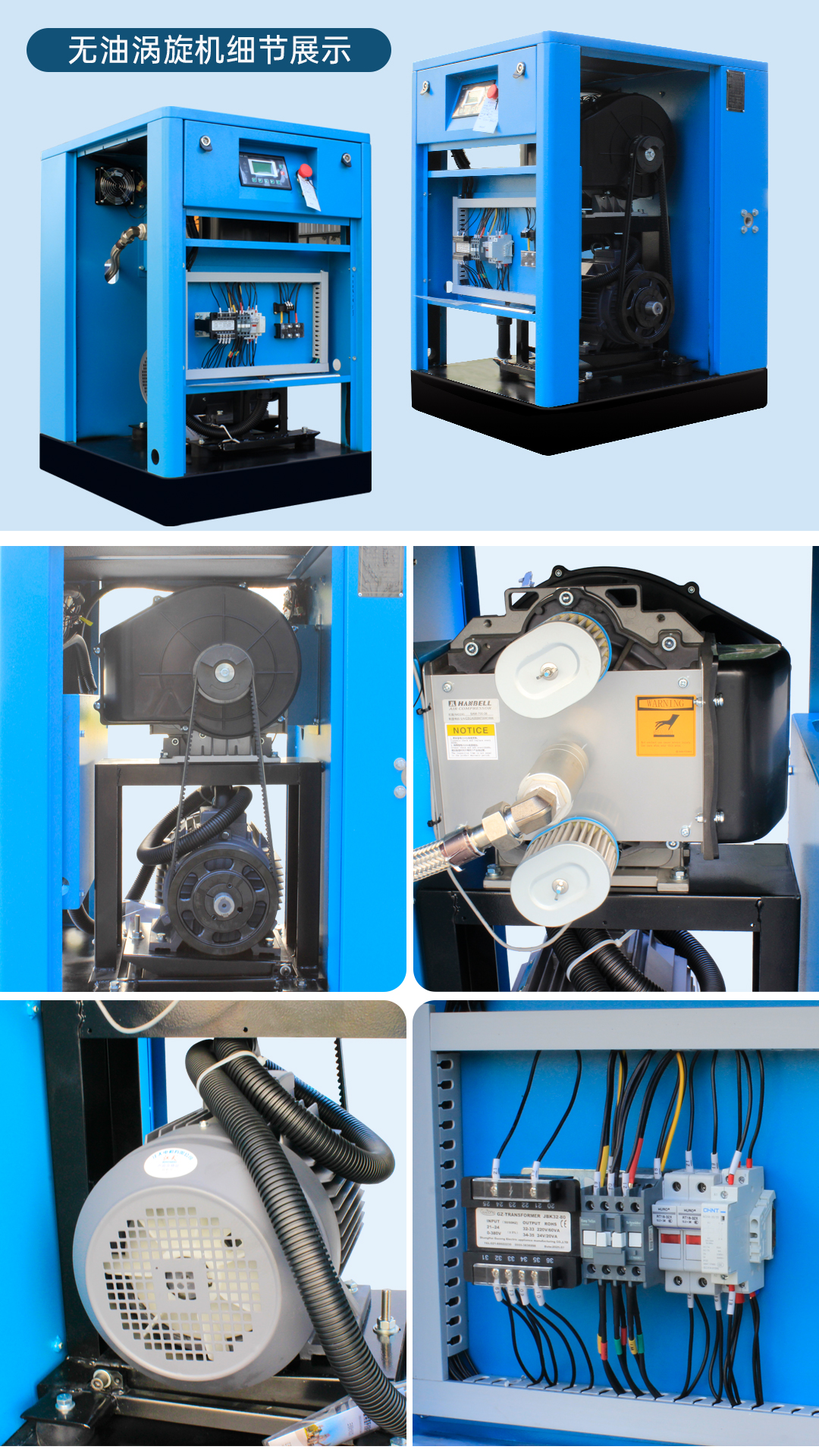
Choosing the right technology requires matching specific mechanical designs to your facility demands.
An oil free scroll compressor uses two interleaving spirals. One spiral remains stationary while the other orbits in a precise path. This action compresses air smoothly. It operates without metal-to-metal contact. The process requires zero internal lubrication.
These machines are best for R&D labs and cleanrooms. They serve low-demand applications perfectly. You get ultra-quiet operation and minimal maintenance requirements.
However, they have distinct physical limitations. Scroll units offer much lower flow capacities (CFM). They do not suit heavy, continuous plant-wide manufacturing. You would need too many units to meet high demands.
This design features twin rotors coated in specialized materials. Manufacturers often use Teflon or advanced polymer resins. Precise timing gears prevent the rotors from ever touching. They generate compression entirely without friction. They need absolutely no oil.
They excel in high-volume continuous production environments. Large-scale fluid bed dryers and pneumatic conveying lines depend on this robust technology. It provides relentless, steady output.
Despite their power, they generate more noise and high heat. You must integrate robust cooling infrastructure into your facility design. They demand proper ventilation.
These units use water inside the compression chamber. The water acts as a lubricant, sealant, and coolant simultaneously. It seals the gaps between internal components.
They fit facilities needing high efficiency and lower operating temperatures. They maintain strict oil-free output continuously. The internal temperatures remain remarkably low.
Their primary limitation involves stringent water quality requirements. You must supply reverse osmosis (RO) or highly purified water. Standard tap water causes rapid mineral scaling. It also promotes bacterial growth inside the chamber.
| Compressor Technology | Ideal Application | Primary Advantage | Main Limitation |
|---|---|---|---|
| Scroll Systems | Laboratories, Cleanrooms | Ultra-quiet, zero maintenance | Low flow capacity (CFM) |
| Dry Rotary Screw | High-volume production | Continuous heavy-duty output | Requires robust cooling |
| Water-Injected | Temperature-sensitive tasks | High efficiency, cool operation | Requires RO water supply |
A compressor alone cannot guarantee completely sterile conditions. You must engineer a comprehensive clean air system. Proper downstream integration ensures purity reaches the final point of use.
Moisture control is just as critical as oil elimination. Warm compressed air holds significant water vapor. As it travels through facility piping, it cools rapidly. It then condenses into liquid water. Liquid water promotes rapid microbial growth in air lines. Desiccant dryers manage this dew point effectively. Pharmaceutical guidelines often require a pressure dew point between -40°C and -70°C. This extreme dryness prevents bacterial proliferation completely. It keeps the lines perfectly sterile.
You must also implement a rigorous particulate filtration framework. Ambient intake air contains atmospheric dust and microscopic pollutants. Pipe scale can develop inside older distribution networks. Install HEPA or sterile filter staging immediately before the point of use. These final filters catch microscopic contaminants just before the air contacts your product. They serve as your last line of defense.
Distribution materials matter immensely. Do not use carbon steel or standard aluminum in cleanrooms. Ultra-dry air causes carbon steel to oxidize and flake. We strongly recommend 316L stainless steel piping. Stainless steel resists oxidation and scaling perfectly. It maintains internal cleanliness over decades of continuous use. It handles rigorous chemical cleaning cycles flawlessly.
Many facility managers overlook ambient air intake vulnerabilities. Your compressor draws in atmospheric air continuously. Poorly positioned intakes ingest exhaust fumes, high humidity, or chemical vapors. Position your intake vents far from loading docks. Keep them away from chemical exhaust flues. The quality of ambient air directly dictates downstream success. Bad intake air overworks your filtration setup.
The pharmaceutical industry requires strict equipment validation. You cannot simply plug in a machine and start producing. You must complete the Installation Qualification (IQ) and Operational Qualification (OQ) processes.
These documented processes satisfy stringent FDA compliance requirements. They provide verifiable proof of performance to auditors.
Maintenance realities vary significantly across different technologies. Scroll compressors typically require simple tip seal replacements. You can perform these quickly with minimal downtime. Dry screw air-ends require comprehensive rebuilds after thousands of hours. You must schedule these major interventions carefully. Unplanned downtime disrupts facility scheduling severely. Always map out your maintenance intervals before finalizing a purchase.
Selecting the perfect equipment requires a highly methodical approach. Follow these four steps to ensure operational success.
Assess your peak versus continuous flow requirements accurately. Oversizing your equipment leads to short-cycling. Short-cycling damages internal components prematurely. Conversely, undersizing halts production during peak demand shifts. Measure your exact CFM needs during maximum facility operation. Account for future expansion plans.
Ensure your procurement team specifies process air requirements clearly. Do not default to a medical air compressor. Medical air strictly serves human respiration in hospitals. It carries different regulatory specifications focused on carbon monoxide monitoring. Plant floor manufacturing requires specialized process air. It focuses entirely on absolute sterility and zero moisture.
Evaluate your system purely on workflow efficiency and risk mitigation. True Class 0 machines eliminate the need for complex inline filter replacements. They lower system pressure drops significantly over time. Most importantly, they guarantee zero batch-loss risk from oil contamination. Focus on these operational stability factors when comparing machine specifications. They drive true reliability.
Instruct buyers to demand verifiable documentation. Ask manufacturers for independent TÜV certification. It must prove exact ISO 8573-1 Class 0 compliance. Scrutinize the comprehensive air-end warranty terms. Reliable manufacturers stand behind their oil-free claims unequivocally. They will provide transparent testing data.
In the pharmaceutical sector, compressed air acts as a critical utility. It is just as vital as sterile water or reliable power. Any contamination compromises your entire manufacturing operation.
Selecting the correct equipment requires careful balance. You must match your precise CFM demand against the appropriate oil-free technology. You also must architect a holistic downstream drying and filtration setup. Every component must work together seamlessly to ensure safety.
We strongly encourage facility managers to take proactive action. Schedule a professional compressed air audit today. Request a comprehensive operational analysis to compare your current setup against a certified Class 0 system. Proactive evaluation prevents disastrous contamination events later. It protects your brand and your patients.
A: No. Relying on oil-injected machines paired with carbon filters introduces immense risk. Filters eventually saturate, leading to unavoidable vapor carryover. They lack reliable fail-safes. FDA guidelines strongly favor verifiable Class 0 systems. True oil-free compression eliminates contamination variables entirely at the source.
A: Medical air is strictly regulated for human respiration in hospitals and ventilators. It focuses heavily on carbon monoxide and dioxide monitoring. Pharmaceutical air serves manufacturing processes like tablet coating. It focuses strictly on achieving zero oil, ultra-low moisture, and absolute sterility.
A: Industry standards generally recommend testing air purity quarterly or bi-annually. You must test at the specific point of use. Verify the pressure dew point, particle count, and microbial limits. Always align testing schedules with your site-specific validation master plan.
A: Moisture creates a breeding ground for biological contamination. It allows bacteria and fungi to proliferate inside the facility piping system. Microbes can ruin active pharmaceutical ingredients (APIs) instantly. This contamination causes severe regulatory compliance failures and massive product loss.


