
- Home
- Products
- Hot
- About Us
- Services
- Industry
- Contact
Views: 0 Author: Site Editor Publish Time: 2025-10-23 Origin: Site


Are you using a compressor that meets your industrial needs efficiently? A two-stage screw air compressor could be the solution. These compressors use two stages of compression, offering higher efficiency, greater pressure, and longer lifespan compared to single-stage compressors. In this article, we will explore how two-stage screw air compressors work, their key benefits, and how they stack up against single-stage models.
The process begins with the intake of air into the compressor through a large piston. This piston draws the air in through an intake valve, and the air undergoes the first stage of compression. In this initial stage, the air is compressed to around 90 PSI. This moderate compression helps prepare the air for the next, more intensive phase of compression. It ensures that the air is not over-pressurized at this stage, which can lead to inefficiency and potential damage to the compressor components. The result is that the first stage effectively increases the air pressure while also preparing it for the second compression phase.
After the first stage compression, the air enters an intercooler before moving on to the second compression stage. The intercooler’s main role is to lower the temperature of the partially compressed air. This cooling process is essential for several reasons. First, it reduces the moisture levels in the air, which can otherwise lead to condensation and moisture buildup in the system. Second, it prevents the compressor from overheating, as heat can lead to inefficiency and increased wear and tear on the components. By cooling the air, the intercooler ensures that the air is in optimal condition for the next stage of compression, maximizing the efficiency and longevity of the compressor.
Once the air has been cooled, it moves on to the second stage of compression. In this phase, the air is compressed by a smaller, high-pressure piston. This second compression phase significantly increases the air pressure, typically to around 175 PSI or higher. The higher pressure achieved in this second stage makes the air suitable for use in heavy-duty applications, such as powering industrial tools, machinery, and large-scale production lines. This two-stage process, with its dual compression and cooling, ensures that the air is compressed more efficiently and with greater consistency than in a single-stage compressor.
After the second stage compression, the air is delivered to a storage tank where it is stored until needed. This storage system ensures that compressed air is available on demand for various tasks, such as operating pneumatic tools, machinery, or air-driven equipment in industrial environments. The air, now at a higher pressure and a cooler temperature, is ready to be used effectively without the risk of overheating or excessive moisture that could impair equipment performance.
One of the primary advantages of a two-stage screw air compressor is its enhanced efficiency. Due to the dual compression process and the intercooling system, two-stage compressors use less energy to compress the same amount of air compared to single-stage compressors. The first stage compresses the air moderately, and the intercooler cools the air before the second compression stage. This results in a much lower energy consumption overall, which makes two-stage compressors highly cost-effective in the long term, particularly for industries that require continuous air supply.
The ability to achieve higher pressures is another key benefit of two-stage compressors. The second stage compression allows for pressures of up to 175 PSI or more, which is essential for industrial operations that require high-powered pneumatic tools and machinery. This makes two-stage compressors ideal for heavy-duty applications like manufacturing, automotive assembly, and construction. The increased pressure not only improves performance but also provides a more reliable and consistent airflow for high-demand tasks.
The design of two-stage screw air compressors helps extend their lifespan. Because the air is compressed in two stages with an intercooling process in between, the components generate less heat compared to single-stage compressors. This reduction in heat generation helps prevent overheating, which can cause premature wear and tear on the compressor parts. As a result, two-stage compressors tend to last longer, require less frequent maintenance, and perform more reliably over time.
Two-stage compressors are built to handle continuous operation, making them highly reliable for industrial environments that require a constant supply of compressed air. Whether it’s a manufacturing plant or a large-scale automotive assembly line, these compressors can run for extended periods without compromising performance. Their ability to operate consistently under heavy-duty conditions makes them indispensable in industries where downtime can be costly.
In industrial settings, two-stage screw air compressors are essential for powering a wide range of pneumatic tools, from drills and wrenches to sanders and grinders. These compressors also supply air to material handling systems and assembly lines, ensuring that production processes remain efficient and uninterrupted. For example, in a factory, the compressor might power robotic arms, conveyor belts, or automated machines, all of which require consistent and high-pressure air.
In the food and beverage industry, two-stage compressors play a crucial role in various stages of production. They are used in bottling, packaging, and processing lines, where high-pressure air is needed to power equipment that fills bottles, seals caps, and labels containers. These compressors also help maintain the quality and safety of the products by reducing moisture levels in the air, which could otherwise affect the packaging and sealing process.
The automotive and aerospace industries rely on two-stage screw air compressors for tasks such as vehicle assembly, component finishing, and aircraft manufacturing. These compressors power air tools used for assembly and maintenance, such as impact wrenches, pneumatic drills, and paint sprayers. In aerospace manufacturing, where precision and high performance are critical, two-stage compressors help ensure that components are machined and assembled with the utmost accuracy.
In sectors like construction, mining, and military equipment manufacturing, two-stage screw air compressors are often required to provide the high-pressure air needed to power heavy-duty tools and machinery. These industries rely on compressors that can operate continuously and maintain consistent pressure levels, making two-stage compressors the perfect choice for such applications.
Industry/Use Case | Typical Applications |
Industrial and Manufacturing | Powering pneumatic tools, assembly lines, material handling systems |
Food and Beverage | Bottling, packaging, sealing, labeling containers |
Automotive and Aerospace | Vehicle assembly, aircraft component finishing, machining |
Heavy-Duty and Continuous Applications | Construction, mining, military equipment operation |
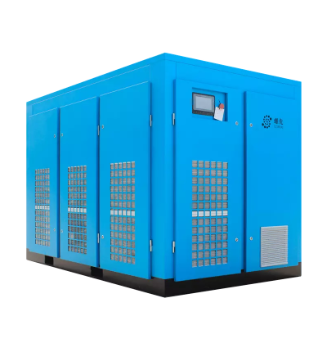
The main difference between two-stage screw air compressors and single-stage compressors is the number of compression stages. While a single-stage compressor compresses air once, a two-stage compressor compresses the air twice. This dual-stage process allows two-stage compressors to achieve higher pressures and greater efficiency, especially in demanding industrial applications. Single-stage compressors, on the other hand, are typically sufficient for lighter tasks that do not require high pressure or continuous operation.
Two-stage compressors are far more efficient than single-stage compressors, particularly when higher pressures are needed. The dual compression process, combined with the intercooling stage, helps minimize energy consumption and heat buildup. This makes two-stage screw air compressors ideal for industries that need continuous high-pressure air, such as manufacturing, automotive, and aerospace.
Although two-stage screw air compressors come with a higher initial investment compared to single-stage compressors, they provide significant savings in the long term. The energy efficiency, lower maintenance costs, and longer lifespan of two-stage compressors make them a more cost-effective solution for large-scale industrial operations. In contrast, single-stage compressors, while cheaper upfront, may incur higher operational costs due to lower efficiency and more frequent maintenance needs.
Single-stage compressors are suitable for light-duty applications where less pressure is needed, such as powering small tools and equipment. However, two-stage screw air compressors are better suited for industrial applications that require consistent, high-pressure airflow, such as in manufacturing, automotive assembly, and large-scale production lines.
Feature | Single-Stage Compressor | Two-Stage Compressor |
Compression Stages | 1 | 2 |
Maximum Pressure (PSI) | Up to 120 PSI | Up to 175 PSI or more |
Efficiency | Moderate | High, more energy-efficient |
Heat Generation | Generates more heat | Generates less heat |
Applications | Light-duty, intermittent use | Heavy-duty, continuous use |
Cost | Lower initial cost | Higher initial cost, long-term savings |
Maintenance | Simple, more frequent | Complex, but lower long-term costs |
Regular maintenance is essential to keep two-stage screw air compressors running at peak performance. Common maintenance tasks include changing the oil, replacing the air filters, and ensuring that the components are well-lubricated. Additionally, checking for air leaks and performing system cleanings can help prevent issues from arising.
The intercooler in a two-stage compressor requires regular inspection to ensure it is functioning properly. Cleaning the intercooler and checking for blockages will help maintain optimal airflow and cooling efficiency. Neglecting the intercooler can lead to overheating, reduced performance, and potential damage to the compressor.
Common problems with two-stage screw air compressors include air leaks, overheating, and pressure drop. To troubleshoot, check for leaks in the air intake and the connections, inspect the intercooler for blockages, and ensure the compressor is adequately lubricated. If any components are damaged or worn, they should be replaced promptly to prevent further damage.
Maintenance Task | Frequency | Purpose |
Oil Change | Every 500-1000 hours | Ensure proper lubrication and smooth operation |
Air Filter Replacement | Every 1000 hours | Prevent debris and contaminants from entering the system |
Intercooler Cleaning | Every 1000 hours | Ensure efficient cooling and reduce moisture buildup |
Piston and Valve Inspection | Every 1500 hours | Prevent wear and tear, ensuring effective compression |
Leak Check | Regularly (every 6 months) | Identify and repair any air leaks that reduce efficiency |
When selecting a two-stage screw air compressor, it is important to assess the air pressure (PSI) and airflow (CFM) requirements for your specific tasks. Understanding these requirements will help ensure that the compressor you choose can handle the demands of your operations, whether it's for heavy-duty machinery or industrial production lines.
Consider how often the compressor will be used. Two-stage screw air compressors are ideal for continuous use in industrial settings. However, if your operations are more intermittent, a smaller, single-stage compressor may be sufficient for your needs.
While two-stage screw air compressors may have a higher initial cost, they offer long-term savings through energy efficiency and lower maintenance requirements. By considering the total cost of ownership over the lifespan of the compressor, you can make a more informed decision about whether the investment is worthwhile for your business.
Two-stage screw air compressors provide enhanced efficiency, higher pressure, and longer operational lifespans. These features make them ideal for industrial applications that require continuous, high-pressure air. By investing in a two-stage screw air compressor, you can significantly improve operational efficiency, reduce long-term costs, and ensure reliable performance. When selecting a compressor, consider your specific air pressure, flow, and usage needs to choose the best model for your business.
For those looking for high-quality compressors, Luoyou offers reliable solutions. Their products are designed to provide superior value, especially in demanding industrial environments.
A: A two-stage screw air compressor uses two compression stages to increase air pressure, offering greater efficiency and higher performance compared to single-stage compressors.
A: In a two-stage screw air compressor, air is compressed in two stages. After the first compression, it is cooled before being compressed again to a higher pressure.
A: Two-stage screw air compressors provide enhanced energy efficiency, higher pressure output, and a longer lifespan compared to single-stage models, making them ideal for industrial use.
A: The price of a two-stage screw air compressor varies based on size and capacity but generally comes with a higher initial cost than single-stage models, offering long-term savings due to energy efficiency.
A: Two-stage screw air compressors are ideal for industries requiring continuous, high-pressure air, such as manufacturing, automotive, aerospace, and food processing.
A: Regular maintenance of a two-stage screw air compressor includes oil changes, filter replacements, and intercooler cleaning to ensure optimal performance and longevity.


