
- Home
- Products
- Hot
- About Us
- Services
- Industry
- Contact
Views: 0 Author: Site Editor Publish Time: 2026-10-05 Origin: Site


Energy consumption routinely accounts for up to 80% of the total lifecycle cost of an industrial air system. You might assume a smaller motor guarantees lower utility bills. However, engineers and plant managers quickly realize nameplate horsepower is insufficient for predicting actual operational costs. Relying solely on basic motor ratings often leads to expensive procurement mistakes.
The definitive metric of efficiency is specific power. It reveals exactly how much electrical energy you consume to produce a given volume of compressed air. This standard strips away marketing claims. It allows you to evaluate actual machine performance under real-world conditions.
This guide breaks down how to read specific power data effectively. We will explore how you can use it to compare vendor quotes fairly. You will also learn how to avoid common pitfalls when evaluating an industrial screw air compressor. Mastering this concept guarantees better equipment selection and massive long-term energy savings.
We define specific power using a straightforward ratio. You divide the Total Package Input Power in kilowatts by the Free Air Delivery. We typically measure this air delivery in cubic meters per minute (m³/min) or cubic feet per minute (cfm). This calculation yields a clear performance indicator.
Think of it as the miles-per-gallon rating for your compressed air system. When you buy a vehicle, you want to know how far it travels on a single gallon of fuel. Similarly, air compressor specific power evaluates your energy economy. It tells you the exact energy price you pay for every unit of compressed air entering your plant.
Many buyers confuse motor shaft power and total package power. This confusion creates flawed comparisons. Shaft power only measures the energy consumed by the main drive motor. Total package power provides the true picture. A complete package evaluation accurately includes several hidden energy consumers:
This comprehensive metric matters deeply in heavy manufacturing. High-duty-cycle industrial operations run equipment constantly. A minor fractional improvement in your kW per m³/min rating yields massive annual cost savings. Over a typical ten-year lifespan, energy savings easily dwarf the initial purchase price of the machine.
You cannot trust every efficiency claim found in a glossy brochure. To ensure a fair comparison between brands, you must verify the testing standards. Reputable manufacturers publish data complying strictly to the ISO 1217 standard.
ISO 1217 Annex C and Annex E dictate exact testing conditions. They regulate inlet temperature, cooling water temperature, and ambient pressure during the test. When you see an ISO 1217 stamp, you know the data reflects an apples-to-apples comparison. It prevents vendors from manipulating environmental variables to artificially boost efficiency numbers.
In North America and globally, the Compressed Air and Gas Institute (CAGI) standardizes this reporting. You can request CAGI data sheets for any modern compressor. Look directly for the line item labeled "Specific Power." This single number cuts through complex technical jargon. It gives procurement teams a verifiable baseline.
Discharge pressure heavily influences specific power. You must compare compressors at the exact same pressure rating. An equipment sheet might show exceptional efficiency at 7 bar (100 psi). If you compare it to a competitor rated at 8.5 bar (125 psi), the comparison fails. Generating higher pressure inherently demands more energy. Always normalize your data before making a decision.
Testing standards allow for manufacturing tolerances. No two manufactured airends perform identically. ISO 1217 allows a specific power tolerance margin based on the machine's volume capacity. You must factor these tolerances into your real-world performance expectations.
Table: Standard ISO 1217 Volume Flow and Specific Power Tolerances
| Volume Flow Rate (m³/min) | Volume Flow Tolerance (%) | Specific Power Tolerance (%) |
|---|---|---|
| Less than 0.5 | +/- 7% | +/- 8% |
| 0.5 to 1.5 | +/- 6% | +/- 7% |
| 1.5 to 15 | +/- 5% | +/- 6% |
| Greater than 15 | +/- 4% | +/- 5% |
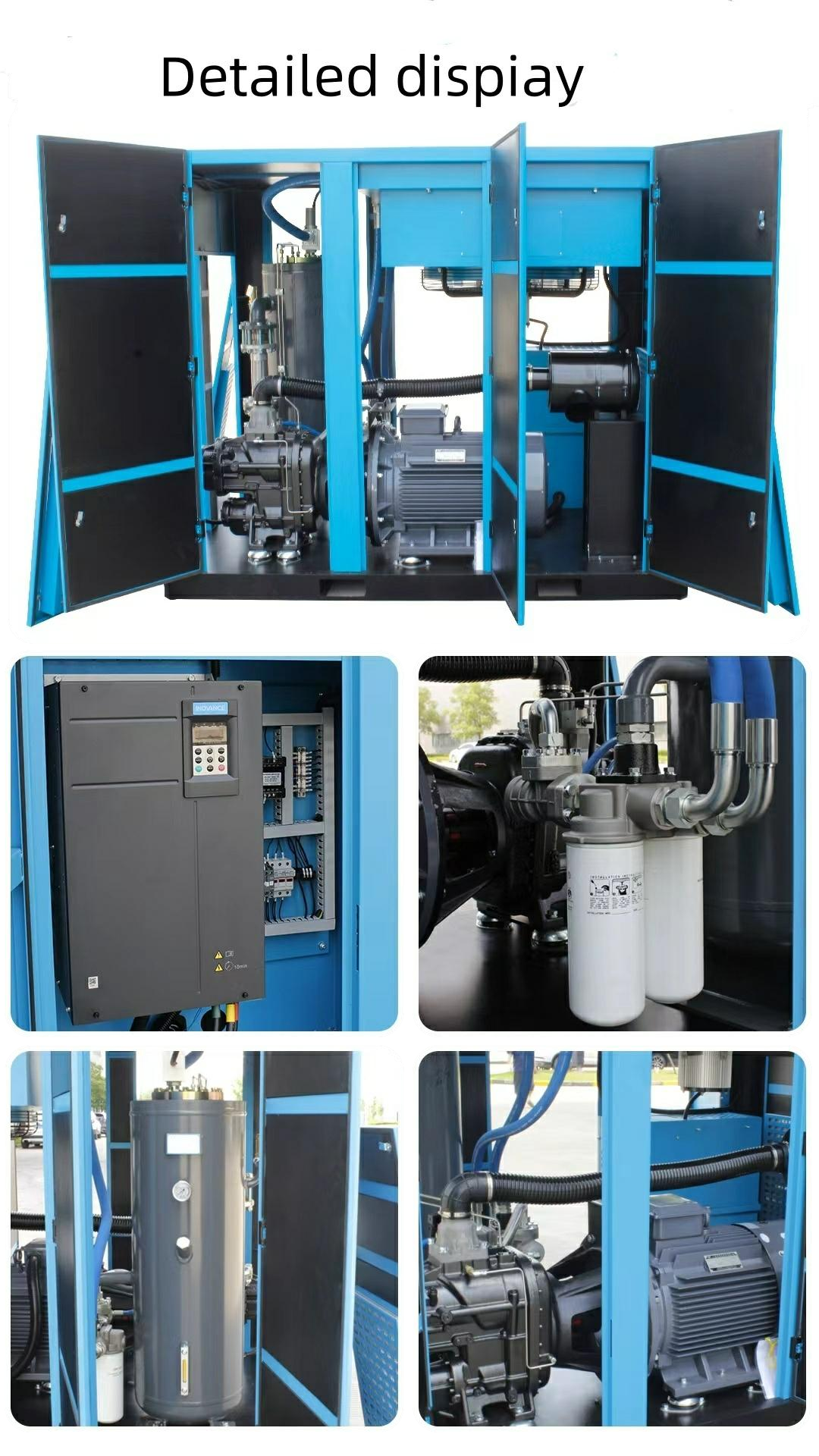
Compressor drive technology fundamentally alters how specific power behaves under different workloads. You must align the machine type to your actual factory demand. Buying the wrong drive type destroys operational efficiency.
Fixed-speed machines operate best at full throttle. At 100% load, a premium fixed-speed unit often achieves the lowest possible specific power. The motor runs at optimal designed speeds. The airend compresses air at peak mechanical efficiency. However, efficiency degrades severely when demand drops. When a fixed-speed unit unloads, it produces zero air. Yet, it continues consuming 25% to 40% of its full load electrical power. This unloaded running absolutely ruins your average kW per m³/min.
Variable Speed Drive (VSD) technology solves this partial-load problem. The VSD controller adjusts the motor speed to precisely match real-time air demand. This technology flattens the specific power curve. It maintains optimal efficiency across a broad 40% to 80% turndown range. The compressor slows down instead of unloading, eliminating wasted energy.
We recommend a strict decision framework when choosing between drive types. Your plant's unique demand profile dictates the winner.
Never install a VSD machine as a baseload unit if it runs at 100% speed continuously. VSD controllers introduce a small electrical loss (typically 2-3%). A fixed-speed unit will outperform a VSD unit if both run flat-out constantly.
Understanding specific power empowers you to calculate exact financial returns. We use a standardized math framework to determine annual operating expenses (OPEX). You only need four variables to build an accurate cost model.
Follow these distinct steps to calculate your annual savings:
Multiply these figures together. The formula looks like this: (Difference in Specific Power) × (Air Flow) × (Operating Hours) × (Electricity Cost per kWh). This calculation reveals the exact monetary value of efficiency.
You can use this OPEX data to evaluate your return on investment (ROI). Consider a scenario where a premium machine costs 15% more upfront (CAPEX). If it offers a 5% better specific power rating, the energy savings accumulate rapidly. Plants frequently achieve a complete ROI on the premium upgrade in less than 18 months.
However, implementation risks can destroy these calculated savings. An undersized piping network creates massive system pressure drops. Dirty filtration and inefficient dryers also restrict airflow. To compensate for downstream pressure drops, operators often increase the compressor's discharge pressure.
Every 1 bar (14.5 psi) of over-pressurization increases your energy consumption by roughly 7%. Investing in a highly efficient industrial screw air compressor becomes pointless if you force it to overcome poor piping design.
Procurement teams frequently fall into data traps when reviewing multiple vendor proposals. You must scrutinize the stated conditions behind every specific power claim. Overlooking subtle details leads to poor purchasing decisions.
Trap 1: Evaluating at Maximum Pressure vs. Operating Pressure
Vendors often quote the specific power at the machine's maximum rated pressure. However, your plant might operate at a lower pressure. Running a 10-bar compressor at 7-bar reduces its aerodynamic efficiency. It will consume more energy per cubic meter than a unit natively designed for 7-bar. Always ask vendors to quote performance at your exact operating pressure.
Trap 2: Ignoring "Zero-Loss" Drains and Ancillaries
Standard specific power figures generally exclude external air treatment equipment. Refrigerated dryers, desiccant towers, and inline filters introduce their own energy penalties. They also cause pressure drops. A compressor might boast a stellar kW per m³/min rating. Yet, the total system efficiency plummets if you pair it with restrictive, outdated air treatment components.
Trap 3: Degradation Over Time
Specific power data assumes a perfectly maintained, brand-new machine. Real-world efficiency degrades as components wear down. Fouled oil coolers force cooling fans to work harder. Skipped maintenance schedules restrict intake filters. Airend rotors gradually lose their tight tolerances. These factors inflate your actual kW per m³/min over a 5-to-10-year lifecycle.
We strongly recommend conducting an independent compressed air energy audit before buying new equipment. Professionals will data-log your current flow rates and power consumption for a full week. This empirical data reveals your true baseline. You can then select a replacement unit based on verified demand profiles, rather than guesswork.
Specific power stands as the ultimate arbiter of an air compressor's commercial viability. By focusing on the kW per m³/min metric, procurement and engineering teams can strip away misleading marketing claims. You gain the ability to compare raw operational efficiency across different brands accurately.
We advise making CAGI data sheets or ISO 1217 compliant documentation mandatory for all vendor shortlists. Base your final purchasing decision on the machine's performance at your facility's exact pressure and load profile. Prioritize long-term energy savings over minor savings on upfront capital expenditure. A disciplined approach to specific power ensures a reliable, highly profitable industrial air system.
A: It varies by pressure and size, but a highly efficient modern two-stage industrial screw air compressor operating at 7 bar (100 psi) typically achieves a specific power between 5.5 and 6.5 kW/(m³/min).
A: No. Standard specific power ratings (ISO 1217) apply only to the compressor package. Integrated or standalone dryers, filtration, and condensate drains require additional power calculations.
A: This usually stems from operating at partial loads (on fixed-speed machines), operating above the rated discharge pressure, or mechanical degradation (e.g., clogged separators, restricted air intakes) forcing the motor to work harder.


