
- Home
- Products
- Hot
- About Us
- Services
- Industry
- Contact
Views: 0 Author: Site Editor Publish Time: 2026-09-09 Origin: Site


Upgrading industrial air systems often forces plant managers into a tough decision. You must choose between lower upfront capital expenditure and long-term operational savings. This core buyer dilemma shapes facility budgets for decades. Compressed air generation can easily account for up to 30% of a facility's total electricity bill. Because of this massive energy draw, maximizing plant efficiency remains a board-level priority.
Business realities ultimately dictate which machinery delivers a better return on investment. While physics proves dual-stage machines are more efficient, practical factors matter just as much. Duty cycles, maintenance budgets, and capital constraints heavily influence the final purchase. In this article, you will learn how to evaluate equipment based on real-world demands. We will explore the mechanical differences driving upfront costs. You will discover exactly how to calculate true lifecycle savings for your specific manufacturing footprint.
To understand the financial disparity between equipment choices, we must first demystify the core engineering. Mechanical design directly dictates how much electrical energy you consume to produce usable air. Let us look closely at a single-stage screw compressor. The process appears brilliantly simple. Air enters the system at atmospheric pressure. The interlocking rotors trap this air and compress it to the final required pressure in one continuous step.
However, physics exacts a toll. The direct byproduct of this massive, single-step compression ratio is extreme heat. High heat generation represents wasted electrical energy. You pay the utility company for electricity, but a large portion turns into useless thermal output rather than mechanical force. This heat also degrades compressor oil faster, requiring strict maintenance.
Now consider the advanced mechanics of dual-stage compression. This design splits the mechanical workload. Air undergoes partial compression in the first stage. It then passes through a critical component called an intercooler. The intercooler drastically lowers the air temperature. Finally, the system pushes this cooler air into the second stage to reach the final pressure.
The benefit here is pure thermodynamics. Pushing cooler, denser air into the second stage requires significantly less mechanical work. It moves the entire process much closer to ideal isothermal compression. This fundamental engineering principle directly lowers your monthly power bill.
Facility managers need highly reliable metrics to evaluate equipment objectively. You cannot rely on horsepower alone. We introduce specific power as the gold standard for comparing compressor efficiency. You measure this metric in kilowatts per 100 cubic feet per minute (kW/100 cfm). Think of it as the miles-per-gallon rating for your plant air system. Lower numbers mean higher efficiency and lower utility bills.
Let us calculate the true financial return. Assume your industrial electricity rate sits at $0.10/kWh. Your facility operates a continuous cycle of 8,000 hours annually. A standard 15% reduction in this power metric translates directly to massive returns. You achieve thousands of dollars in compressor energy saving each year. Over a ten-year lifespan, this operational savings easily eclipses the initial purchase price.
Annual Operational Savings Comparison (100 HP Unit Example)
| Evaluation Metric | Single-Stage Design | Dual-Stage Design |
|---|---|---|
| Assumed Annual Operating Hours | 8,000 Hours | 8,000 Hours |
| Average Specific Power (kW/100 cfm) | 20.5 kW | 17.4 kW |
| Estimated Annual Power Cost | $78,500 | $66,725 |
| Projected Annual Savings | Baseline | $11,775 Saved |
We must outline transparent assumptions regarding these calculations. These savings only materialize if you size the machinery correctly. The equipment must operate near its rated capacity. Partial loads heavily skew these numbers. If a premium machine constantly unloads because it is oversized, efficiency plummets rapidly. You lose the financial benefits of advanced engineering when equipment idles needlessly.
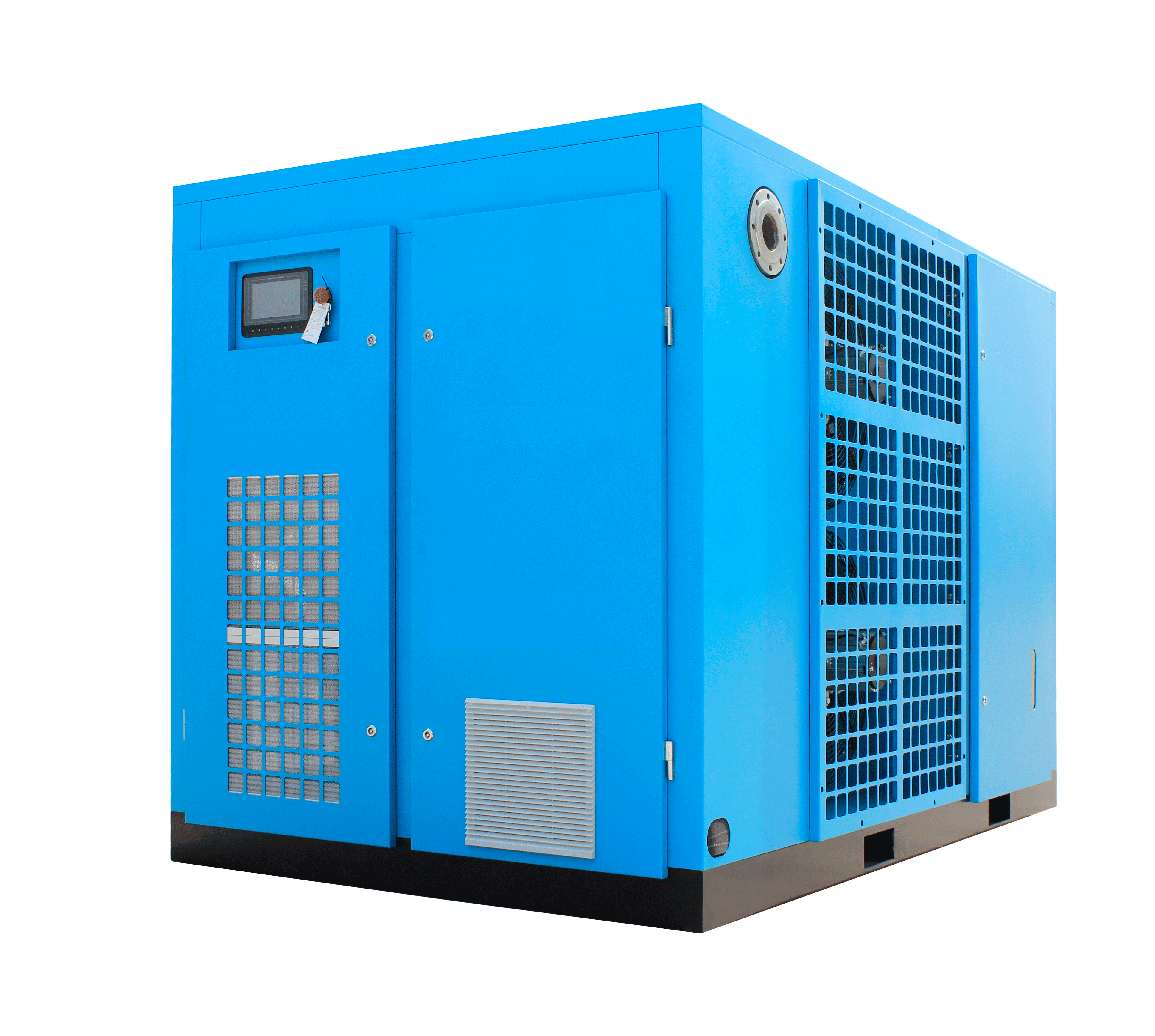
Higher upfront capital costs require solid financial justification. We can define specific operational profiles where paying the CapEx premium makes absolute sense. High duty cycles offer the best financial return. Facilities running multiple shifts, or continuous 24/7 operations, consume massive amounts of electricity. In these rigorous environments, long-term energy consumption quickly dwarfs the initial purchase price.
High volume demand also dictates this strategic choice. Plants requiring high CFM typically utilize 200 HP motors and above. Heavy manufacturing, automotive assembly, and large textile plants fall into this category. At this scale, even single-digit percentage efficiency gains yield massive dollar savings. The sheer volume of air produced multiplies your financial return exponentially.
Furthermore, do not ignore regional utility incentives. Many utility companies offer custom cash rebates for installing a highly efficient two-stage screw air compressor. They want to reduce strain on the local power grid. These cash rebates artificially shorten your ROI timeline. A hefty utility rebate can make premium equipment incredibly affordable on day one. Always consult your local energy provider before finalizing a purchase order.
We must state a balanced truth regarding industrial equipment. Advanced two-stage engineering is not a universal silver bullet. Many facilities benefit significantly more from simpler mechanical designs. Intermittent demand scenarios strongly favor single-stage units. If your plant has highly fluctuating air demands, premium efficiency might go unused. Facilities operating single shifts under 3,000 hours per year rarely consume enough power to justify the hefty upgrade.
Budget and capital constraints play a huge role in procurement. Immediate capital limits sometimes dictate your available choices. If the projected return timeline for a complex unit exceeds your facility's financial planning horizon, you should hold off. Breaking even after four or more years might not fit your current corporate strategy. In these cases, preserving initial capital takes priority.
Space limitations and footprint realities also matter greatly. Simpler units generally boast a much more compact physical footprint. This size difference becomes critical for cramped mechanical rooms. Large dual-stage assemblies require substantial floor space and adequate ventilation cooling. You must match equipment dimensions to your physical reality. Buying an efficient machine that overheats in a tiny room defeats the purpose entirely.
Post-installation realities reveal the true financial impact of your decision. We must carefully evaluate mechanical complexity versus long-term durability. Dual-stage units inherently feature more moving parts. You must manage two separate airends and complex intercooler plumbing. This added mechanical complexity can mean slightly higher routine maintenance costs over time. Technicians spend more time inspecting connections and servicing cooling components.
However, a strong counterpoint exists regarding equipment lifespan. Because the mechanical work divides into two distinct steps, the airends run much cooler. They suffer significantly less thermal degradation. This reduced stress often results in longer bearing and rotor lifespans. Heat destroys industrial bearings. By managing heat effectively, you extend the operational life of the most expensive internal components.
We must also discuss the Variable Speed Drive (VSD) variable. Integrating a VSD addresses shifting air demands beautifully. Combining a VSD with either mechanical design adds another profound layer of efficiency. It eliminates wasteful unloading cycles. But remember, VSDs introduce highly sensitive electronics into harsh plant environments. They require clean, cool power panels. You must weigh the efficiency gains against the risk of electrical failures in dusty or hot manufacturing spaces.
The choice between these two distinct technologies requires strict operational analysis. It is an exercise in lifecycle cost analysis, not just a simple mechanical preference. You must balance your initial budget against decades of power consumption. Miscalculating your plant load leads to wasted capital and inflated utility bills.
Follow this strict shortlisting logic before making a purchase:
Do not guess your operational metrics. Precision saves money. Request a formal compressed air audit from a certified systems engineer today. Let data drive your next major equipment upgrade.
A: Two-stage machines easily achieve much higher pressures. They often reach 150 to 175+ PSI with high efficiency. They handle this heavy load without overheating because the intercooler manages the thermal byproduct. Single-stage machines struggle at these higher pressures, generating excess heat and wasting substantial electrical power.
A: Yes, they generally boast a longer operational lifespan. The two-step compression process ensures lower operating temperatures. It also significantly reduces axial thrust on the internal bearings. However, this longevity strictly depends on following proper maintenance schedules and keeping the intercoolers entirely clean.
A: VSD and two-stage designs solve completely different problems. A VSD perfectly addresses variable demand efficiency. Two-stage engineering addresses base-load mechanical efficiency. For highly variable loads, a single-stage VSD might yield better overall savings than a fixed-speed two-stage unit. Consult an engineer to match technology to your specific demand curve.


