
- Home
- Products
- Hot
- About Us
- Services
- Industry
- Contact
Views: 0 Author: Site Editor Publish Time: 2026-09-08 Origin: Site


A 55kW nameplate rating tells you how much power a compressor consumes. It does not reveal how much work it actually does. For facility managers, this distinction matters greatly. Procurement engineers often evaluate equipment based on theoretical displacement. This mistake inevitably leads to undersized systems. It causes unexpected pressure drops across the plant. It creates severe production bottlenecks on the factory floor. You need a better evaluation metric. To accurately forecast your production air capacity, you must change your approach. You must anchor calculations to a different number. You should rely on free air delivery (FAD). This crucial metric represents the exact volume of usable air discharged into your network. It strips away idealized conditions. It gives you the real-world output you need. You can use it confidently to evaluate competing models. It ensures your machinery receives adequate continuous flow.
You must define FAD strictly. It is the exact volume of air drawn into the compressor and delivered directly to the plant network. Engineers measure it right at the intake conditions. They account for ambient temperature, local atmospheric pressure, and specific humidity. This rigorous measurement guarantees accuracy. It provides a real-world baseline. You cannot plan a facility around imaginary numbers.
Many buyers fall into the spec sheet trap. They confuse theoretical piston displacement with actual FAD. Theoretical displacement looks impressive on paper. Manufacturers calculate it using simple geometry. They multiply the cylinder volume by the operating speed. However, they ignore real-world physics. They overlook internal clearance volumes. They ignore valve friction and heat expansion. Relying on theoretical numbers creates a massive deficit. You risk a 10% to 15% shortfall in expected air output. Your pneumatic cylinders will respond sluggishly. Your production lines will stall.
Vendor accountability remains crucial during procurement. You must demand verified data. We rely on standard frameworks like ISO 1217. The industry uses Annex C for fixed-speed compressors. We use Annex E for variable-speed machines. These represent non-negotiable standards. They independently verify the FAD. If competing vendors refuse to provide an ISO 1217 data sheet, walk away. You should flag this omission as a critical procurement risk.
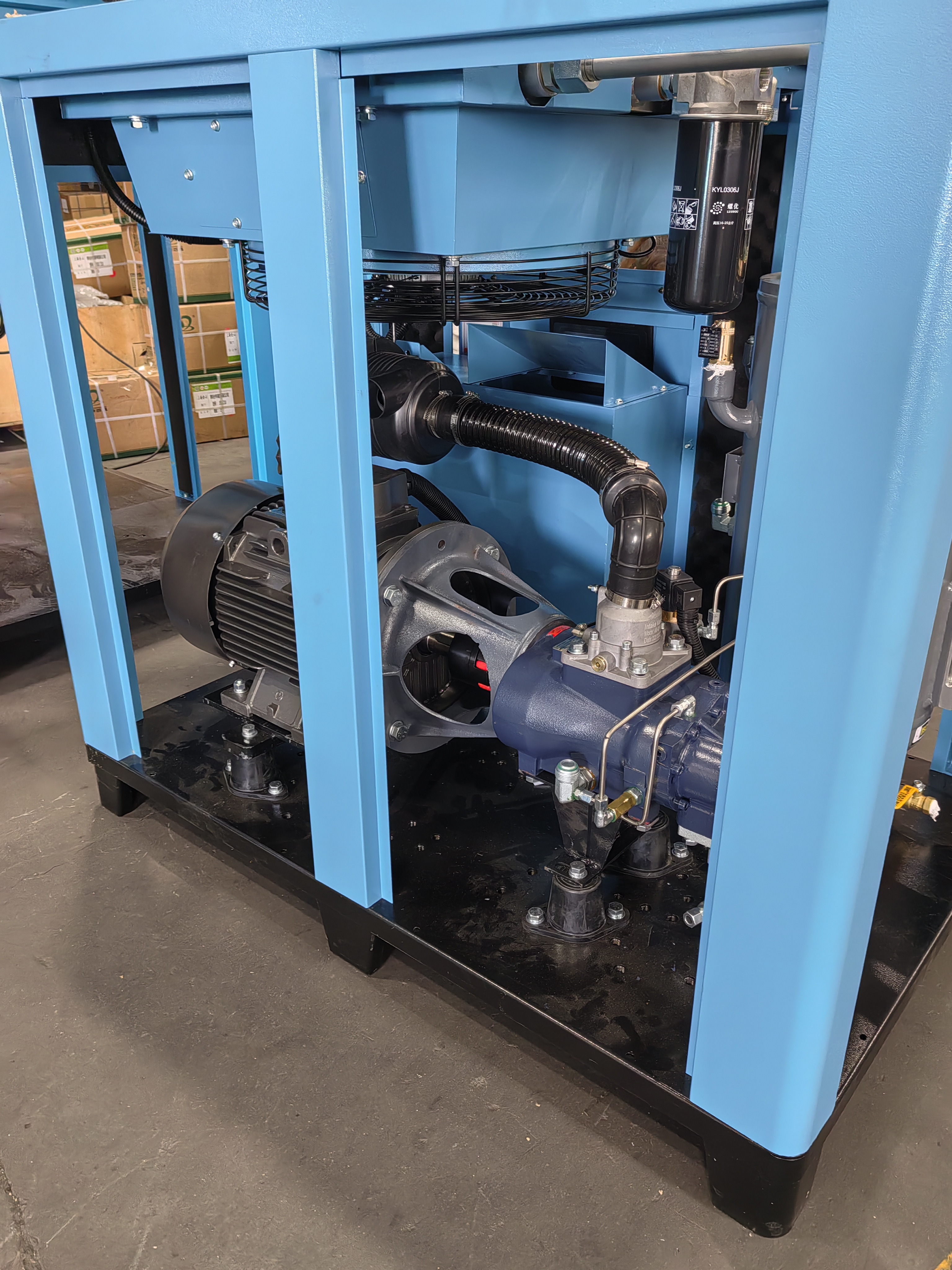
We must establish a clear performance benchmark. Modern industrial designs optimize rotor profiles for maximum efficiency. You can generally expect a quality 55kW screw air compressor FAD to yield excellent results. It typically generates approximately 10.05 m3 min airflow. This translates to roughly 355 CFM. This output assumes a standard operating pressure of 7 to 8 bar. We map this capacity directly to your factory floor below.
Heavy manufacturing demands aggressive, continuous air delivery. An output of 10.05 m3/min easily supports complex production zones. You can run multiple pneumatic torque tools simultaneously. Heavy-duty robotic arms actuate smoothly without hesitation. Industrial paint booths maintain perfect atomization. You avoid the sudden pressure drops causing defective paint finishes. The compressor easily handles these simultaneous high-flow events.
Packaging facilities require rapid, repetitive pneumatic cycles. This capacity sustains continuous blow-off nozzles across several conveyor lines. High-speed sorting gates fire accurately. Automated bagging machines cycle perfectly without experiencing pressure sags. You keep cycle times incredibly tight. You avoid unexpected machinery faults triggered by low line pressure.
You must carefully consider the pressure penalty. Certain applications require higher pressures. You might need 10 bar or even 13 bar for specialized equipment. This requirement changes your capacity. Increasing the system pressure proportionally decreases the total volume delivered. The compressor motor has finite power. Pushing air harder limits how much air it can process. You must conduct a careful audit of your absolute minimum pressure requirements. Never over-pressurize your network unnecessarily.
Buyers often encounter an alphabet soup of acronyms. You must clearly differentiate these terms. We separate Actual Cubic Feet per Minute (ACFM) from Standard Cubic Feet per Minute (SCFM). We also distinguish both from FAD. Misunderstanding these metrics leads to disastrous equipment sizing.
SCFM represents air under idealized standard conditions. Engineers typically define this as 14.5 psia, 68°F, and 0% relative humidity. This creates a dangerous sizing illusion. A machine looks incredibly capable on paper. Yet, it underperforms on a hot, humid factory floor. Real high-altitude conditions ruin standard expectations. Air density drops significantly at elevation. An SCFM rating simply ignores these vital environmental realities.
You need a rigid evaluation framework. We highly recommend using a standardized spreadsheet for shortlisting. You must force competing vendors to normalize their data. Make them convert all flow metrics to FAD at your exact site conditions. Give them your maximum summer temperature. Give them your facility elevation. This establishes a true level playing field.
Table 1: Flow Measurement Metrics Comparison| Metric | Definition | Practical Shortcoming |
|---|---|---|
| SCFM | Flow measured at standard, idealized conditions. | Ignores site temperature, humidity, and altitude constraints. |
| ACFM | Flow measured at a specific point in the system. | Varies depending on exactly where you place the meter. |
| FAD | Usable air discharged, referenced back to actual intake conditions. | None. It provides the most accurate real-world capacity baseline. |
You must accurately calculate your real demand. Do not guess. You should physically audit existing equipment consumption. Add up the requirements of every tool, cylinder, and nozzle. Compare this total to the available capacity. This step determines if a 75 hp compressor actually fits your facility profile. Use thermal mass flow meters for precision.
Always incorporate a leakage buffer. Industry standards assume a harsh reality. Even a well-maintained piping network suffers a 10% to 15% air loss. Fittings vibrate loose. Seals degrade slowly. Valves weep compressed air. You must deduct this inevitable loss from your 10.05 m3/min baseline. If your machines demand exactly 9 m3/min, your compressor will struggle to keep up. It will run constantly just to feed the leaks.
You must weigh fixed-speed against Variable Speed Drive (VSD) models. Factory demand rarely stays flat. Your consumption might fluctuate significantly below the maximum FAD. During shift changes, demand drops. A fixed-speed unit will enter an inefficient load/unload cycle. It wastes mechanical effort. A VSD model adjusts its motor speed perfectly. It matches output to the exact real-time demand.
Chart: Air Demand vs. Supply Strategy Matrix| Demand Profile | Expected Fluctuation | Recommended Compressor Type |
|---|---|---|
| Continuous Base Load | Less than 15% variance | Fixed-Speed Rotary Screw |
| Variable Shift Load | 30% to 70% variance | Variable Speed Drive (VSD) |
| Mixed Plant Demand | Highly unpredictable | VSD Unit + Fixed-Speed Backup |
Generating the air represents only the first step. You face severe post-compressor restrictions. Engineers measure FAD right at the compressor discharge valve. After this point, the air travels through various components. Inline particulate filters create friction. Refrigerated air dryers cause distinct pressure drops. Poorly sized piping networks steal usable capacity. Every restriction forces the system to work harder.
Environmental variables also drain your capacity. Elevated ambient temperatures expand the intake air. The compressor ingests fewer air molecules per revolution. High altitudes thin the air significantly. This lower air density effectively reduces the actual mass of air delivered. The machine's nameplate FAD rating remains unchanged. However, the real volume available to your tools drops considerably.
You require a strict mitigation strategy. Follow this installation checklist to protect your flow:
Buying a 55kW compressor means buying an expected volume of reliable air. You are securing FAD, not just a heavy motor. This distinction separates successful facility upgrades from operational failures. Theoretical metrics look appealing, but they cannot sustain heavy pneumatic machinery. You must base your procurement decisions on verified, real-world data.
Do not accept verbal assurances on capacity. We strongly advise buyers to demand ISO-certified performance data sheets. Verify the numbers carefully. Consider your local elevation, summer temperatures, and inevitable system leakage. Incorporate a safety margin.
Take action before issuing a final Purchase Order. We encourage you to conduct an ultrasonic leak audit on your existing network. Alternatively, request a professional compressed air flow audit. Understanding your exact baseline demand ensures your new compressor will perform flawlessly upon installation.
A: They share an inverse relationship. As discharge pressure increases from 8 bar to 10 bar, the volume of air decreases. The motor has finite power limits. It must work significantly harder to compress the air to higher pressures. This mechanical limit reduces the total volume it can process.
A: Several common real-world culprits exist. You might have internal wear increasing rotor clearances. Blocked intake filters choke the air supply. Inefficient cooling causes high operating temperatures. Alternatively, the original testing standards were inflated compared to your actual factory site conditions.
A: You should request the CAGI data sheet from the manufacturer. You can also ask for the ISO 1217 Annex C or Annex E test report. Independent labs verify these specific documents. They provide accurate performance data measured at strict, standardized intake conditions.


