
- Home
- Products
- Hot
- About Us
- Services
- Industry
- Contact
Views: 0 Author: Site Editor Publish Time: 2026-08-12 Origin: Site


Incorrectly sizing a refrigeration unit directly impacts your production uptime and system reliability. If you undersize the equipment, you invite severe moisture carryover. This moisture quickly leads to catastrophic downstream equipment failure and product spoilage. If you oversize the unit, you needlessly inflate initial capital expenditure. Oversizing also causes damaging short-cycling, which degrades internal components over time.
Many facility managers mistakenly assume dryer sizing requires a simple one-to-one match with compressor horsepower. However, accurate selection demands much more precision. You must adjust the baseline capacity against site-specific environmental conditions and utility constraints. Sizing is an engineering process, not a simple catalog lookup.
This guide breaks down the critical engineering criteria and facility requirements you need. We will explore essential correction factors, cooling water infrastructure demands, and system integration strategies. By following these steps, you can accurately specify a robust unit tailored perfectly to your operations. You will learn to navigate load-matching risks and ensure continuous, clean air delivery.
Engineers design industrial air dryers based on standardized laboratory metrics. Most manufacturers rate their equipment according to ISO 7183 standards. This standard sets a perfect baseline for equipment comparisons. It typically assumes 100°F (38°C) inlet air temperature, 100 PSIG operating pressure, and 85°F (29°C) cooling water temperature. It also assumes a 100°F ambient room temperature.
These ideal laboratory conditions rarely exist in actual manufacturing environments. Your facility might experience extreme summer heat. Your compressor might discharge air at 115°F. Your cooling tower water might spike to 90°F during peak summer months. If you buy a dryer based purely on its nameplate rating, you ignore these crucial real-world deviations. Failing to account for these variables guarantees poor performance.
Miscalculating your required capacity carries heavy operational consequences. We categorize these failures into two distinct scenarios: undersizing and oversizing. Both scenarios damage your production capabilities and equipment longevity.
Undersizing is the most common sizing mistake. When the dryer cannot handle the incoming moisture load, the heat exchanger becomes overwhelmed. The compressed air moves through the system too quickly to reach the target dew point. This failure allows liquid water to bypass the separation phases. The moisture then flows directly into your downstream piping. You will experience immediate pneumatic tool corrosion. Valves will stick and fail prematurely. In applications like paint spraying or food packaging, moisture carryover causes immediate product spoilage.
Oversizing presents a different set of mechanical problems. Purchasing a massively oversized unit wastes your capital budget. More importantly, it damages the equipment. A non-cycling dryer must maintain a constant refrigerant flow. If it only receives a small fraction of its rated air load, the internal refrigeration compressor will short-cycle. This rapid on-and-off switching stresses the motor windings. It reduces the lifespan of the refrigerant compressor. Furthermore, an oversized unit constantly consumes excessive cooling water, straining your utility infrastructure.
Proper refrigerated dryer sizing relies on empirical data and strict mathematical formulas. You cannot guess the required capacity. You must gather precise operational metrics from your compressor room.
Determining your peak compressed air flow rate is the mandatory first step. You must differentiate between ACFM (Actual Cubic Feet per Minute) and SCFM (Standard Cubic Feet per Minute). ACFM measures the air volume at your specific ambient conditions. SCFM standardizes this volume to sea level, 68°F, and 0% relative humidity. Dryer manufacturers always size their equipment based on SCFM. Sizing must utilize your absolute peak SCFM to ensure maximum moisture load handling during worst-case conditions.
Once you know your peak SCFM, you apply the standard sizing formula. This formula adjusts the generic nameplate rating to match your harsh realities.
Required Dryer Capacity = Peak SCFM / (Factor 1 × Factor 2 × Factor 3)
Manufacturers provide tables for these specific factors. The factors quantify how much your system deviates from the ISO 7183 baseline. You multiply these factors together to find your actual required capacity.
Inlet Air Temperature (Factor 1): This is the most critical variable. Hot air holds exponentially more water vapor than cold air. For every 20°F increase in air temperature, the moisture holding capacity essentially doubles. If your inlet air is 120°F instead of 100°F, your dryer must do significantly more work. The correction factor for elevated temperatures is always less than 1.0, which forces you to select a larger dryer.
Operating Pressure (Factor 2): Higher system pressure actually helps the drying process. High pressure compresses the air volume. This squeezing action forces moisture out of the air before it even reaches the dryer. If you operate at 125 PSIG instead of 100 PSIG, your dryer operates more efficiently. The correction factor here will be greater than 1.0, slightly reducing your required capacity.
Cooling Water Temperature (Factor 3): A water-cooled unit rejects internal heat into your utility water. Warmer utility water reduces the condenser's heat transfer efficiency. If your cooling water exceeds 85°F, the refrigerant cannot condense properly. This lowers the dryer's overall moisture removal rating. You must design around your highest summer water temperatures.
Below is a simplified example of how inlet temperature impacts the correction multiplier. Always consult your specific manufacturer's engineering data.
| Inlet Air Temperature (°F) | Moisture Load Multiplier | Typical Correction Factor |
|---|---|---|
| 100°F (Baseline) | 1.00x | 1.00 |
| 110°F | 1.45x | 0.74 |
| 120°F | 2.05x | 0.55 |
| 130°F | 2.85x | 0.39 |
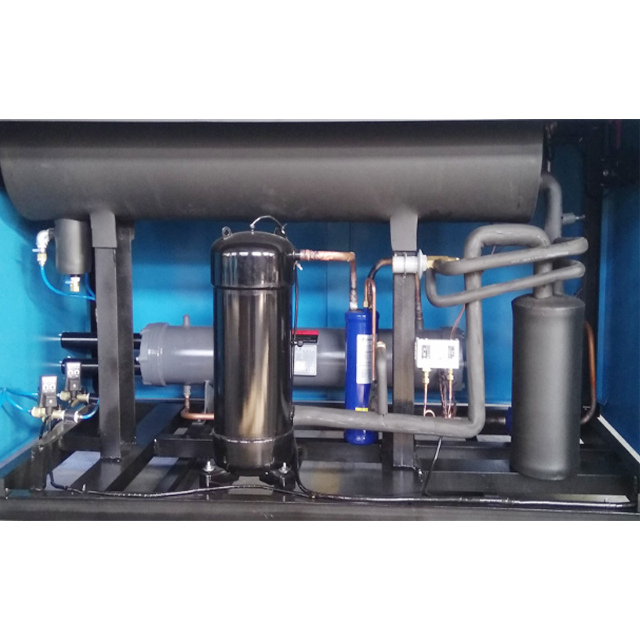
Water-cooled equipment requires a reliable, continuous supply of utility water. Before you specify a unit, you must rigorously evaluate your facility's cooling infrastructure. You cannot simply connect a hose and expect optimal performance. The water system must meet strict volume, temperature, and chemical standards.
You must calculate the required Gallons Per Minute (GPM). The dryer's heat rejection load dictates this GPM requirement. The manufacturer specifies this thermal load in BTUs per hour. Typically, you need 2 to 3 GPM for every 100 SCFM of dryer capacity, assuming standard 85°F water. If your incoming water is warmer, you must pump more GPM to reject the same amount of heat. Ensure your facility water pumps can deliver this sustained volume without starving other critical processes.
Water chemistry heavily influences dryer longevity. Industrial water systems often harbor minerals, algae, and particulate matter. These contaminants pose severe risks to the dryer's internal condenser.
You will typically encounter two types of condensers: shell-and-tube or brazed plate. Shell-and-tube designs are robust. They handle minor fouling better and allow for mechanical tube cleaning. Brazed plate condensers offer excellent heat transfer in a compact footprint. However, their narrow internal channels clog easily if water quality drops.
Consider your water source carefully. Open cooling towers introduce airborne debris and oxygen, increasing corrosion risks. They require aggressive chemical treatment programs. Closed-loop chillers provide excellent, clean water, drastically reducing condenser maintenance. Municipal water is clean but often prohibitively expensive for continuous flow. Always install dedicated water strainers immediately upstream of the dryer to catch large debris.
Water pushing through a condenser experiences friction. This friction creates a pressure drop, often called pressure differential or ΔP. You must verify your facility's water pump can overcome the internal pressure drop of the specific dryer model. If the pump lacks sufficient head pressure, the water flow will stall. The dryer will subsequently overheat and shut down on high-pressure safety faults. Review the engineering submittals to confirm the water pressure drop falls within your pump's capabilities.
Engineers often debate between air-cooled and water-cooled technologies. Both designs remove moisture effectively under ideal conditions. However, specific facility environments dictate a strict preference for water-cooled configurations. Understanding these parameters ensures you select the correct architecture for heavy industrial use.
Heat is the enemy of refrigeration. Air-cooled dryers rely on ambient room air to cool their condensers. If the compressor room temperature exceeds 100°F (38°C), air-cooled models struggle. The refrigerant pressure skyrockets, and the dryer safety switches trip. In these punishing environments, water-cooled technology outperforms air-cooled models completely. By utilizing 85°F utility water instead of 110°F room air, a water-cooled system maintains stable internal pressures. This makes it the definitive standard high ambient dryer solution for foundries, glass plants, and desert climates.
Many facilities place compressors in enclosed utility rooms, basements, or retrofitted boiler rooms. These spaces rarely feature adequate ventilation. Air-cooled dryers reject massive amounts of heat into the surrounding room. Without proper exhaust ducting, they create a severe "hot box" effect. The room temperature climbs rapidly, eventually suffocating both the compressors and the dryers. A water cooled air dryer solves this architectural problem. It rejects the thermal load into the closed water loop, transporting the heat entirely out of the room. This preserves the ambient temperature and protects your other machinery.
As airflow volumes increase, the physical size of air-cooled condensers becomes unmanageable. Heavy manufacturing facilities requiring >1,000 SCFM heavily favor water cooling. The technology provides superior scalability and a much smaller equipment footprint. At these large capacities, water-cooled units offer tighter dew point control and greater overall efficiency. They form the robust backbone of any serious industrial air treatment system. By centralizing the heat rejection at the main cooling tower, large plants streamline their mechanical footprints.
Selecting the correct dryer size is only part of the engineering challenge. You must also integrate the equipment properly into your broader compressed air network. Ignoring system integration creates operational bottlenecks and voids the benefits of accurate sizing.
Every component you add to an air system restricts flow. The dryer itself introduces an inherent pressure drop (ΔP). Furthermore, manufacturers mandate installing pre-filters and after-filters to protect the heat exchangers. These filters add their own restriction. You must account for the cumulative pressure drop of the entire treatment skid. If the total pressure drop reaches 10 PSI, your compressors must work significantly harder to maintain plant pressure. Always size filters generously to minimize this restriction. Monitor differential pressure gauges weekly.
A properly sized dryer removes gallons of liquid water daily. This water falls into the internal separator and must be expelled. You must ensure the specified automatic drain valves can physically handle the maximum water volume. Peak summer humidity creates massive condensate loads. If the drain valve is too small, water backs up into the heat exchanger. This floods the system and pushes water downstream. Demand zero-loss electronic drain valves. They offer superior reliability and prevent expensive compressed air leaks during discharge.
Modern plants frequently utilize Variable Speed Drive (VSD) air compressors. VSD compressors ramp their output up and down to match plant demand. This creates a highly variable air flow entering the dryer. Pairing a VSD compressor with a standard non-cycling dryer introduces risks. If the VSD drops the flow to 20% of maximum, the standard dryer might freeze the moisture internally. It continues cooling at 100% capacity despite the low load.
When operating VSD compressors, strongly evaluate cycling or thermal mass dryer configurations. These units ramp their refrigeration compressors down in sync with the air flow. They match the varying load perfectly. This prevents internal freezing and stabilizes the dew point during low-flow weekend shifts.
Accurately sizing a water-cooled refrigerated air dryer ensures decades of reliable, moisture-free production. You cannot rely on simple horsepower estimates or standard laboratory ratings. Success requires a methodical engineering approach based on your actual facility conditions.
Here are the core takeaways and actionable steps for your facility:
Your immediate next step is to conduct a localized compressed air system audit. Install data loggers to measure your true peak SCFM and inlet temperatures over a two-week period. Once you have this data, consult with a qualified application engineer. They will verify your site-specific correction factors and help you procure a perfectly matched unit.
A: Moisture will bypass the overwhelmed heat exchanger. This drastically raises the pressure dew point. Liquid water will condense in the piping and reach downstream pneumatic equipment, causing rapid rust, sticky valves, and product contamination.
A: If your utility water exceeds the manufacturer's rated design temperature (typically 85°F), the internal refrigerant cannot condense efficiently. This thermal bottleneck drastically reduces the dryer's SCFM processing capacity.
A: Yes, but strictly provided the compressor room itself is heated. You must prevent the cooling water lines, internal heat exchangers, and condensate drains from freezing solid, which would rupture the internal piping.
A: ACFM measures actual airflow at your current ambient room conditions. SCFM standardizes that flow to sea level, 68°F, and 0% relative humidity. Manufacturers size dryers based on SCFM to ensure standardized moisture load calculations.


