
- Home
- Products
- Hot
- About Us
- Services
- Industry
- Contact
Views: 0 Author: Site Editor Publish Time: 2026-07-31 Origin: Site


Compressed air serves as the "fourth utility" in modern manufacturing. It remains critical to daily production operations. However, generating it is notoriously expensive. Facility designs often face a common business problem during the blueprint stage. Undersizing your system leads to severe pressure drops and costly production halts. Conversely, oversizing wastes significant initial capital expenditure and inflates long-term energy consumption.
This guide offers a pragmatic, engineering-led framework for facility managers and procurement teams. You will learn how to accurately evaluate demand and select appropriate equipment. We will help you design a compliant, future-proof system. By following these steps, you can bridge the gap between theoretical calculations and real-world industrial performance.
You must establish a mathematically sound baseline for system requirements before evaluating any hardware. Guesswork during this phase guarantees operational inefficiencies. We need to measure industrial air demand using precise engineering principles.
Engineers often confuse volume requirements with pressure requirements. Cubic feet per minute (CFM) dictates how much work your tools can perform. Pounds per square inch (PSI) determines how hard they perform that work. You must identify the single highest pressure requirement in your plant. Isolate this specific machine. Do not elevate the entire system's pressure just to satisfy one tool. Elevating plant-wide pressure wastes massive amounts of energy. Instead, install a point-of-use pressure booster for that specific application. This keeps the main header pressure low and efficient.
Many procurement teams make a critical error here. They simply sum up all pneumatic tool maximums from OEM data sheets. This approach artificially inflates your required capacity. Tools rarely operate simultaneously at full throttle.
Follow these steps to calculate a realistic load profile:
This formula yields your true average demand. It prevents you from buying excessively large equipment.
You should chart your anticipated baseline continuous demand. Compare it against intermittent, high-volume spikes. Some machines require short bursts of massive air volume. Others need a steady, low-volume trickle. You must account for acceptable pressure bandwidths at the point of use. If a tool operates fine between 90 PSI and 100 PSI, use this bandwidth. Allowing pressure to fluctuate slightly prevents artificial demand. It stops the compressor from constantly loading and unloading.
Data means nothing if you cannot translate it into smart equipment selection. You need to match your hardware perfectly to your calculated load profile. This mitigates operational risk and ensures manufacturing stability.
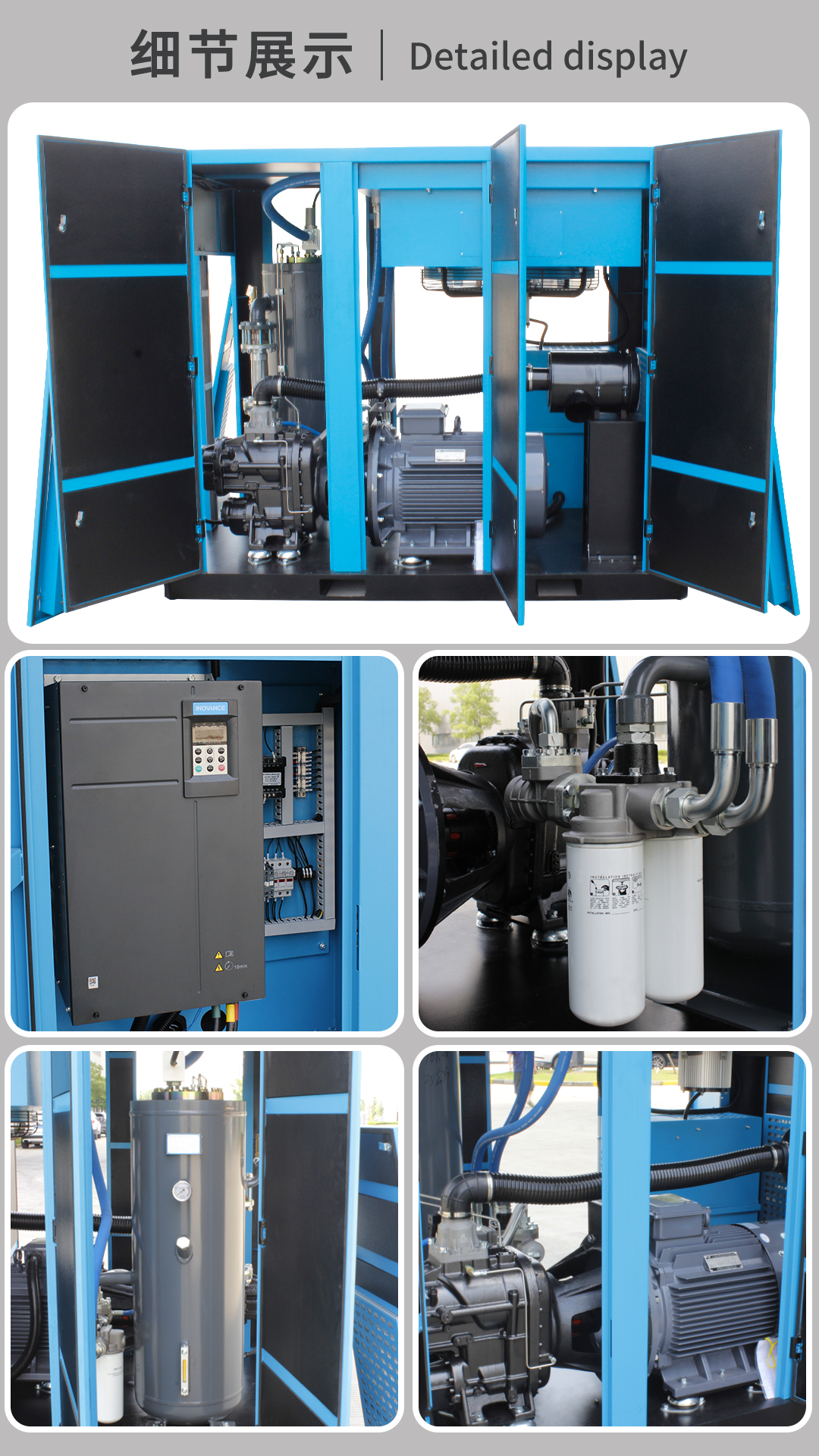
Most modern factories rely heavily on an industrial screw air compressor for their main air supply. We consider it the industry standard for continuous manufacturing operations. Reciprocating models struggle under a 100% duty cycle. They generate too much heat and require frequent cooldown periods. Screw compressors operate continuously without breaking a sweat. Their rotary mechanism provides a smooth, pulsation-free air delivery.
You must decide how your compressor's motor will operate. Fixed-speed machines run at a constant RPM. They offer the highest efficiency when operating at full load. You should use fixed-speed units for stable, unchanging base loads. They handle steady production runs perfectly.
Variable Speed Drive (VSD) units adjust their motor speed dynamically. They match output directly to fluctuating demand. You should use a VSD as a trim compressor. It handles the peaks and valleys of your air usage efficiently. A VSD prevents excessive unloading cycles. This saves massive amounts of energy during partial-load scenarios.
Compressor Drive Technology Comparison
| Technology Type | Best Application | Efficiency Peak | Key Advantage |
|---|---|---|---|
| Fixed-Speed | Stable, continuous base loads | 100% full load capacity | Lower initial purchase cost and simple maintenance |
| Variable Speed Drive (VSD) | Fluctuating, unpredictable loads | Partial load conditions (40%-80%) | Eliminates wasteful unloading cycles and voltage spikes |
Facility planners often adopt a "just in case" purchasing mindset. They buy a massive unit anticipating aggressive future growth. This is a dangerous mistake. An oversized compressor leads to short-cycling. The machine turns on, hits the pressure target immediately, and shuts off. This constant starting and stopping causes excessive wear on motor bearings. It destroys internal components prematurely. Furthermore, running a large fixed-speed unit at 30% capacity results in severe energy waste.
Never trust marketing brochures blindly. You must verify air compressor capacity using strict ISO 1217 standards. This standard measures actual Free Air Delivery (FAD) at the machine's discharge valve. It ensures vendor performance claims match real-world output. Demand ISO 1217 Annex C or E data sheets from every prospective supplier.
The compressor itself represents just one component of a broader ecosystem. Brilliant hardware fails inside poorly designed infrastructure. Effective compressor system planning requires a holistic approach to piping, storage, and treatment.
Air travels through pipes, and pipes create friction. Friction causes pressure drop. You should always design a closed-loop (ring main) system instead of dead-end lines. A ring main allows air to travel in two directions to any usage point. This cuts the velocity in half and minimizes pressure loss.
Material selection matters immensely. Traditional black iron pipes corrode internally over time. Rust flakes break off and clog pneumatic valves. The rough interior also increases friction. We strongly recommend modular aluminum piping. Aluminum remains smooth forever. It prevents contamination and keeps pressure drops close to zero. It also installs much faster than threaded iron.
Receiver tanks act as your primary defense against intermittent demand spikes. They store potential energy. When a machine suddenly demands a massive volume of air, the tank provides it. This prevents the compressor from abruptly overworking.
Raw compressed air contains water vapor, oil aerosols, and solid particulates. You must treat it before use. Refer to the ISO 8573-1 standard to determine your specific air purity class. General manufacturing might only need a refrigerated dryer (Class 4 moisture). Electronics or pharmaceuticals require a desiccant dryer (Class 1 or Class 2 moisture).
You must treat your filtration equipment as a source of intentional pressure drop. Every inline filter removes energy from the air stream. A standard filter setup might consume 3 to 5 PSI. You must calculate this loss into the compressor's required output. If the plant needs 100 PSI, and filters consume 5 PSI, the compressor must generate 105 PSI.
Your new factory will hopefully grow. Your utility design must scale gracefully alongside it. We need to provide a scalable decision framework for growing facilities.
Avoid buying one massive compressor to handle current and future needs. Instead, recommend an N+1 redundancy approach. Install three smaller units rather than one giant machine. Two machines can handle the daily load. The third serves as a backup or rotation unit.
This strategy guarantees continuous factory compressed air during routine maintenance. If one machine goes offline, production never stops. Furthermore, it allows for staggered capital expenditure. You can buy the exact capacity you need today. You can easily plug another identical module into the system in three years.
Managing multiple compressors manually is impossible. You need a central master controller. These intelligent sequencers automate the switching between base-load and trim compressors. They read the network pressure in real-time. If demand rises, they wake up the next machine. If demand falls, they shut units down.
Sequencers also equalize run hours across all machines. They prevent your lead machine from accumulating 10,000 hours while your backup sits at zero. Equalizing run hours simplifies maintenance scheduling immensely. It maximizes overall system efficiency and extends equipment lifespans.
You must plan your spatial logistics carefully. Dedicate floor space now for future footprint additions. Leave enough clearance around every machine for technicians to remove panels and replace filters safely.
Adequate ventilation remains strictly mandatory. Compressors reject immense amounts of heat. A 100 HP machine basically acts as a 100 HP space heater. You must install proper ambient temperature controls. Use intake louvers and exhaust ducting. If the room overheats, the compressor fluid degrades rapidly. High ambient temperatures directly destroy compressor efficiency and trigger thermal shutdowns.
Decision-makers need specific criteria to vet proposals accurately. Finalizing procurement requires diligence regarding safety codes and performance guarantees.
Compressed air systems operate under high pressure. They pose significant safety risks if designed poorly. Ensure all pressure vessels (receiver tanks) strictly meet ASME (American Society of Mechanical Engineers) standards. Look for the physical ASME stamp on the tank's nameplate. Never install uncertified vessels in a commercial facility.
You must also factor in local environmental regulations. Condensate drained from an oil-injected compressor contains hazardous compressor fluid. It is illegal to dump this directly into municipal sewers. You must install certified oil/water separators. These devices filter the condensate until it reaches legally compliant parts-per-million (PPM) thresholds before discharge.
Hold your vendors accountable during the bidding process. Ask them for detailed system flow simulations based on your blueprints. Demand a guaranteed specific power rating. Specific power measures how many kilowatts it takes to produce 100 CFM of air (kW/100 CFM). It serves as the true metric for compressor efficiency.
Require transparent preventative maintenance agreements. Know exactly what replacement parts cost before you sign the contract. As an actionable next step, commission a professional air demand audit. Have an independent systems engineer simulate your blueprint load profile. Do this before finalizing any equipment purchase orders.
Proper system sizing requires balancing initial constraints with long-term operational efficiency. Never guess your CFM or PSI requirements. Use factual duty cycles and utilization factors to build a realistic load profile. Adopt a modular, N+1 redundancy strategy to ensure continuous uptime during maintenance.
Do not treat compressed air planning as a simple hardware purchase. You must treat it as an integrated utility design. Piping layouts, receiver tanks, and ventilation matter just as much as the machine itself. We strongly prompt you to consult with a professional systems engineer today. Let them model your specific factory blueprint and finalize your optimal load profile.
A: Use OEM data sheets for baseline equipment consumption. Multiply that figure by the estimated minutes per hour the tool or machine will actively actuate in the planned production line. Avoid using theoretical maximums, as they lead to severe oversizing.
A: Yes. For infrequent, short-duration spikes, relying on stored air is far more cost-effective. It stabilizes the system without requiring you to size up the compressor's generation capacity, preventing unnecessary wear.
A: A well-designed compressor system planning strategy should aim for no more than a 10% total pressure drop. Measure this from the compressor discharge valve to the absolute furthest point of use in the facility.
A: It depends entirely on the industry. Food, pharma, and electronics strictly require oil-free (Class 0) air. General manufacturing typically uses oil-injected models with proper downstream filtration due to their robust reliability and easier maintenance.


