
- Home
- Products
- Hot
- About Us
- Services
- Industry
- Contact
Views: 0 Author: Site Editor Publish Time: 2026-09-10 Origin: Site


Investing in a new compressed air system demands careful planning. A 75kW PM VSD air compressor represents a major initial expense and a long-term operational commitment. You face high stakes during the selection process. Treating a variable speed machine as a simple, one-size-fits-all solution creates severe problems down the line. Facilities often suffer from chronic under-loading. Equipment experiences frequent motor cooling issues. Many operations completely miss their expected return on investment.
We designed this guide for plant engineers and procurement teams. We provide an evidence-based framework to validate system requirements. You will learn how to ensure optimal equipment sizing. This approach eliminates guesswork entirely. It secures maximum efficiency for your facility. Proper evaluation prevents expensive mistakes. Decision-makers must look beyond simple horsepower ratings. They need accurate demand profiles before authorizing any purchase. You can transform factory efficiency through diligent preparation.
Engineers frequently rely on outdated habits during equipment selection. They often add a standard safety margin to their calculations. This approach creates massive inefficiencies for modern systems.
Buying a larger variable speed drive (VSD) machine "just in case" sounds logical initially. However, this strategy severely compromises system efficiency. Permanent magnet (PM) motors operate optimally within specific speed ranges. They lose efficiency rapidly when operating at the extreme low end of their frequency range. Oversized units run too slowly during normal production shifts. This low-speed operation generates insufficient heat to evaporate moisture inside the oil circuit. Water accumulates inside the lubricant reservoir. This moisture destroys bearings and leads to premature airend failure.
Initial purchase price matters, but it represents a small fraction of overall expenditures. Energy consumption accounts for roughly 70-80% of lifetime operating expenses. Incorrect sizing completely nullifies the theoretical energy savings promised by permanent magnet technology. You might pay a premium for high-efficiency equipment. If you size it poorly, it consumes just as much power as older fixed-speed models. Every investment calculation must prioritize long-term energy consumption over the initial capital outlay.
You can identify a correctly sized system easily. It runs between 40% and 80% of its rated capacity during normal daily production. This specific operational window provides several benefits. It maximizes the aerodynamic efficiency of the twin screws. It leaves adequate room for unexpected peak demand spikes. The unit never drops into inefficient idling states. Proper sizing keeps the motor temperatures stable and the oil moisture-free.
Precision sizing requires accurate data collection. You must abandon assumptions and measure actual factory conditions.
Many buyers confuse theoretical displacement with actual delivery. Displacement merely measures the physical geometry of the compressor rotors. Free Air Delivery (FAD) measures the actual usable air exiting the machine. FAD accounts for internal leaks, temperature changes, and inlet restrictions. You must always use FAD values (measured in m³/min or CFM) for your calculations. Relying on displacement figures guarantees an undersized system.
Actionable Step: Conduct a comprehensive compressed air audit. Use professional data loggers over a complete 7-day production cycle. This timeframe captures weekend shifts, cleaning cycles, and peak production hours. Analyze this data to identify your exact minimum, average, and peak flow rates.
Pressure directly controls your energy bills. Many facilities operate at unnecessarily high pressures to compensate for bad piping. Over-pressurization destroys financial returns quickly. Every single bar (14.5 psi) of excess pressure increases energy consumption by approximately 7%. You must eliminate artificial pressure demands before sizing new equipment.
You must differentiate between equipment ratings and point-of-use requirements. Your factory tools might need 6 bar to operate efficiently. An equipment label might show a higher rating. You must factor in natural pressure drops across the distribution network. Friction occurs inside pipes, inline filters, and refrigerated dryers. A typical system loses about 0.5 to 1 bar between the compressor room and the factory floor. Calculate these drops accurately to select the lowest possible generation pressure.
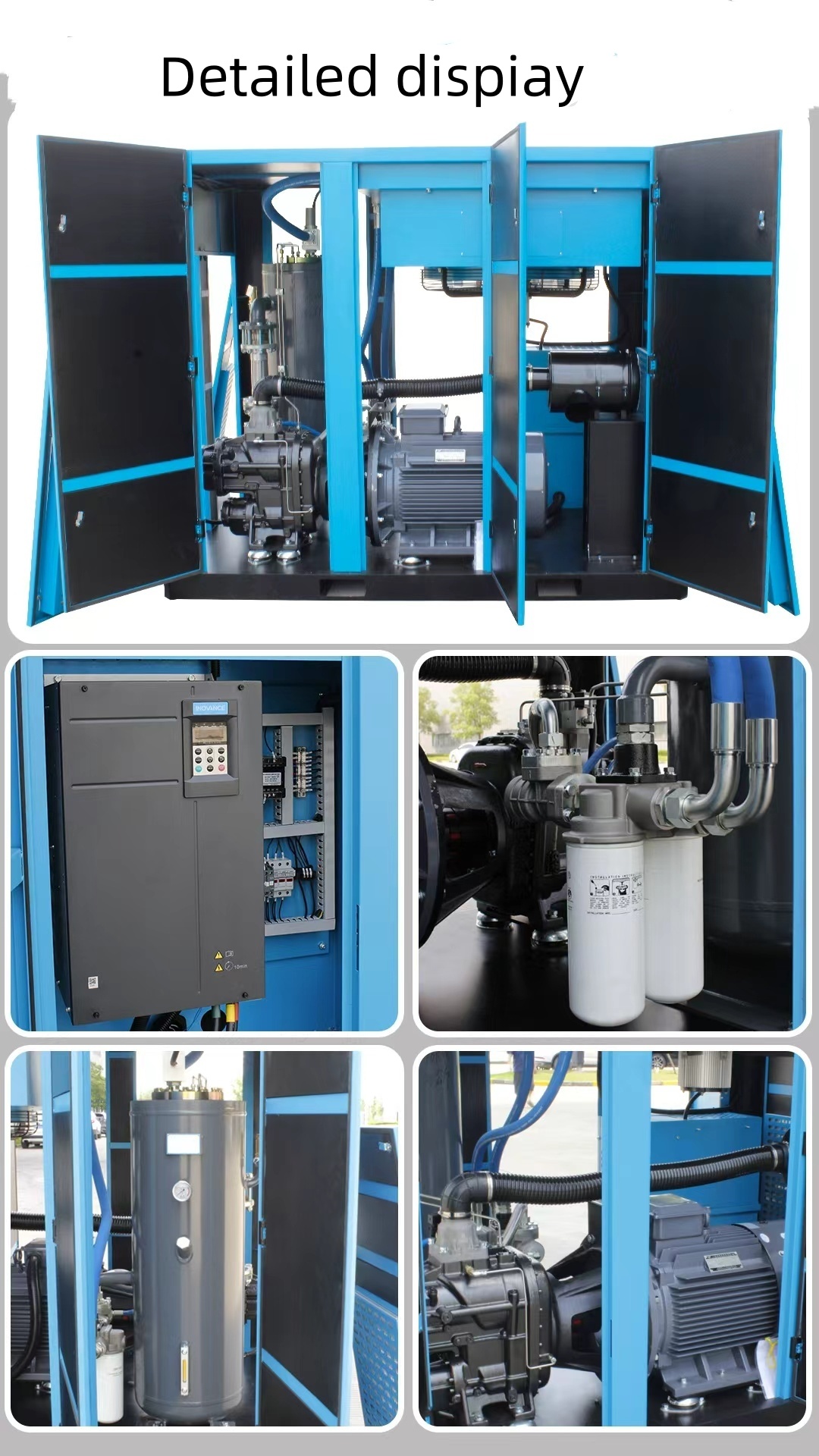
Variable speed technology offers incredible flexibility, but it possesses hard physical limits. Ignoring these limits causes catastrophic mechanical failures.
Every VSD machine features an operational bandwidth called the turndown ratio. This represents the safe speed range for the electric motor and airend. Most manufacturers specify a turndown range between 25% and 100% of maximum capacity. The machine cannot simply slow down to 5% capacity. The motor requires a minimum rotational speed to pull cooling air across its copper windings. The oil pump also needs minimum RPMs to maintain hydraulic lubrication pressure.
A single-compressor setup presents hidden dangers during low-demand periods. Imagine a facility where off-shift demand drops below the machine's minimum turndown threshold. The machine cannot slow down any further. It must stop completely to avoid over-pressurizing the pipework. Moments later, pressure drops, and the machine starts again. The unit cycles on and off repeatedly. This start-stop behavior defeats the entire purpose of a VSD system. It causes severe mechanical wear on contactors and drive components.
You can prevent the turndown trap through smart system design. Do not force one large machine to handle tiny air leaks at night.
Once you understand your demand profile, you must choose between single-stage and two-stage compression technologies.
Single-stage models utilize one airend to compress air from atmospheric pressure to final system pressure. They represent the industry standard for most general applications.
Two-stage models divide the compression workload across two separate airends in a series. This division dramatically changes the thermodynamic profile of the machine.
Comparison: Single-Stage vs. Two-Stage Equipment
| Feature | Single-Stage VSD | Two-Stage VSD |
|---|---|---|
| Initial Capital Cost | Lower | Higher (approx. 20-30% premium) |
| Maintenance Complexity | Simple (one airend) | Moderate (two airends, complex piping) |
| Specific Energy Efficiency | Standard baseline | Excellent (10-15% better than single-stage) |
| Ideal Operating Profile | 8-16 hours per day | Continuous 24/7 operation |
Selecting the right machine solves only half the problem. You must integrate it properly into your existing facility infrastructure.
Variable frequency drives contain sensitive electronics. You must verify your facility's power quality before installation. PM motors and inverters react poorly to voltage fluctuations. They are highly sensitive to harmonic distortion on your electrical grid. Dirty power causes nuisance fault trips and damages sensitive inverter capacitors. We recommend installing line reactors or harmonic filters if your facility shares power with heavy welding or induction melting equipment.
Air compressors convert a massive amount of electrical energy directly into heat. A 75kW system generates substantial thermal output during normal operation. You cannot simply place the machine in a closed room and close the door. The ambient temperature will rise rapidly, causing the inverter to trigger thermal overload faults. Detail the exact requirements for proper ducting. Ensure the room has adequate cooling airflow. Extract the hot exhaust air directly outside the building whenever possible.
Engineers often make critical errors when sizing air treatment equipment. Downstream components include air receivers, refrigerated or desiccant dryers, and inline coalescing filters. You must ensure they are sized for the absolute maximum flow of the equipment, never the average flow. If you size a dryer for average flow, a sudden demand peak will overwhelm it. High-velocity air pushes water past the dryer heat exchanger. Moisture travels directly into your production equipment, causing catastrophic rust and product spoilage.
Procurement teams receive varying claims from different manufacturers. You need a structured method to evaluate quotes objectively.
Sales brochures often feature aggressive marketing language. Do not accept generic energy-saving claims like "Saves up to 40%." Demand hard engineering data. Require every manufacturer to provide a CAGI (Compressed Air and Gas Institute) data sheet. If a CAGI sheet is unavailable, request an equivalent certified performance document. Look closely at the specific power metric. This metric shows the kilowatts required to produce 100 CFM of air at various load profiles. Lower specific power numbers guarantee better electrical efficiency.
Look past the metal canopy and scrutinize internal components. Check the origins and thermal ratings of the PM motor. Verify the VFD component specifications. Insist on high environmental protection ratings. IP66-rated inverters resist dust and moisture far better than standard IP20 models. Ask about the specific cooling methods used for the permanent magnet motor. Liquid-cooled or independently fan-cooled motors maintain better internal temperatures than shaft-driven fan designs.
A good machine requires excellent local support. Evaluate the fine print on airend and inverter warranties carefully. Some warranties require expensive mandatory oil sampling programs. Others void coverage if ambient temperatures exceed specific limits. Verify local technician response times. A ten-year warranty holds zero value if the nearest qualified service technician lives three days away from your facility.
Sizing this equipment correctly requires discipline and precise data. You must move past simple nameplate horsepower comparisons. Successful integration demands auditing your actual flow and pressure profiles thoroughly. You must respect the strict operational limits of variable frequency drives to prevent mechanical failures. Proper evaluation transforms a heavy capital expense into a reliable, highly efficient utility for your factory.
We strongly recommend initiating a formal compressed air demand audit immediately. Deploy data loggers before signing any purchase orders. Request specific performance curves and certified data sheets from your shortlisted vendors. These proactive steps guarantee you purchase the right technology for your specific production environment.
A: Yes, they share the same equivalent power rating. However, if your fixed-speed unit runs constantly fully loaded, a VSD might not offer significant savings. VSDs excel when demand fluctuates.
A: The compressor will operate in a start/stop or load/unload cycle, which increases wear on components, risks oil temperature dropping below the dew point (causing water in the oil), and reduces energy efficiency.
A: While VSDs require smaller tanks than fixed-speed units, a standard baseline is 1 to 2 gallons per CFM of maximum capacity to stabilize pressure signals to the inverter and handle sudden demand spikes.


