
- Home
- Products
- Hot
- About Us
- Services
- Industry
- Contact
Views: 0 Author: Site Editor Publish Time: 2026-09-06 Origin: Site


Selecting the right air pressure is rarely about buying maximum capacity just in case. Engineering teams often face a complex dilemma when trying to achieve true precision in their operations. Over-specifying equipment creates an illusion of safety while continuously draining operational resources.
Defaulting to a higher pressure creates massive energy waste across the entire facility. Conversely, under-sizing causes critical pneumatic equipment failure and forces frustrating production downtime on the floor. Finding the exact balance dictates your overall operational efficiency and equipment lifespan.
You must carefully audit actual point-of-use requirements before finalizing any equipment upgrades. We will explore how to calculate system pressure drops accurately across your current pipework. Ultimately, this approach guides you to set the optimal working parameters based on verifiable facility data rather than pure guesswork.
Many operators fall victim to the "more is better" fallacy when upgrading equipment. They mistakenly buy 13 bar compressors for standard 8 bar applications. They do this acting as a safety net against potential pressure drops. This strategy seems logical on the surface. However, it ignores basic thermodynamic principles. Generating unnecessary pressure severely penalizes your operational efficiency.
The energy penalty for this mistake is steep and unavoidable. Industry standards dictate a rigid rule for compressed air generation. Every 1 bar of unnecessary pressure increases your energy consumption by roughly 7%. You pay this premium every minute the machine runs. A system running at 10 bar instead of 8 bar wastes nearly 14% more energy. This penalty compounds rapidly over thousands of annual operating hours.
Over-pressurization also creates significant artificial demand throughout your facility. Running a system at 10 bar forces unregulated tools to consume significantly more air volume. Standard blow-off nozzles will release excess air needlessly. Existing pipe leaks will also expel air at a much faster rate. You end up paying to compress air only to lose it instantly to the atmosphere.
You cannot select the right machine without understanding your actual plant air demand. You must conduct a thorough audit of your facility. Guesswork often leads to oversized or undersized equipment. Follow these structured steps to determine your true requirements.
Start by identifying the equipment requiring the highest minimum operating pressure. Walk the production floor and read the manufacturer tags on every machine. You must differentiate between continuous demand and intermittent demand. Assembly line tools represent continuous demand. Air cylinders or pulse-jet dust collectors represent intermittent demand. Record these baseline figures carefully.
Air loses energy as it travels from the compressor room to the production floor. You must account for standard air treatment equipment. Filters and refrigerated dryers typically create a 0.3 to 0.5 bar pressure drop. Moisture separators add further resistance.
Next, factor in the friction loss from your piping layout. Engineers often refer to this as the "dirty pipe" reality. Pipe diameter, total length, and elbow joints all restrict airflow. Older galvanized pipes with internal corrosion create severe friction. You must calculate these losses to understand what reaches the end user.
Standard Treatment Component Pressure Drops
| Component Type | Expected Pressure Drop (Bar) |
|---|---|
| Particulate Pre-Filter | 0.1 - 0.2 |
| Coalescing Oil Filter | 0.2 - 0.3 |
| Refrigerated Air Dryer | 0.2 - 0.4 |
| Desiccant Air Dryer | 0.3 - 0.5 |
You can now calculate your exact target compressor working pressure. Use this simple yet effective formula:
The resulting number represents the exact discharge pressure your new compressor must generate. Any pressure above this calculated figure represents pure waste.
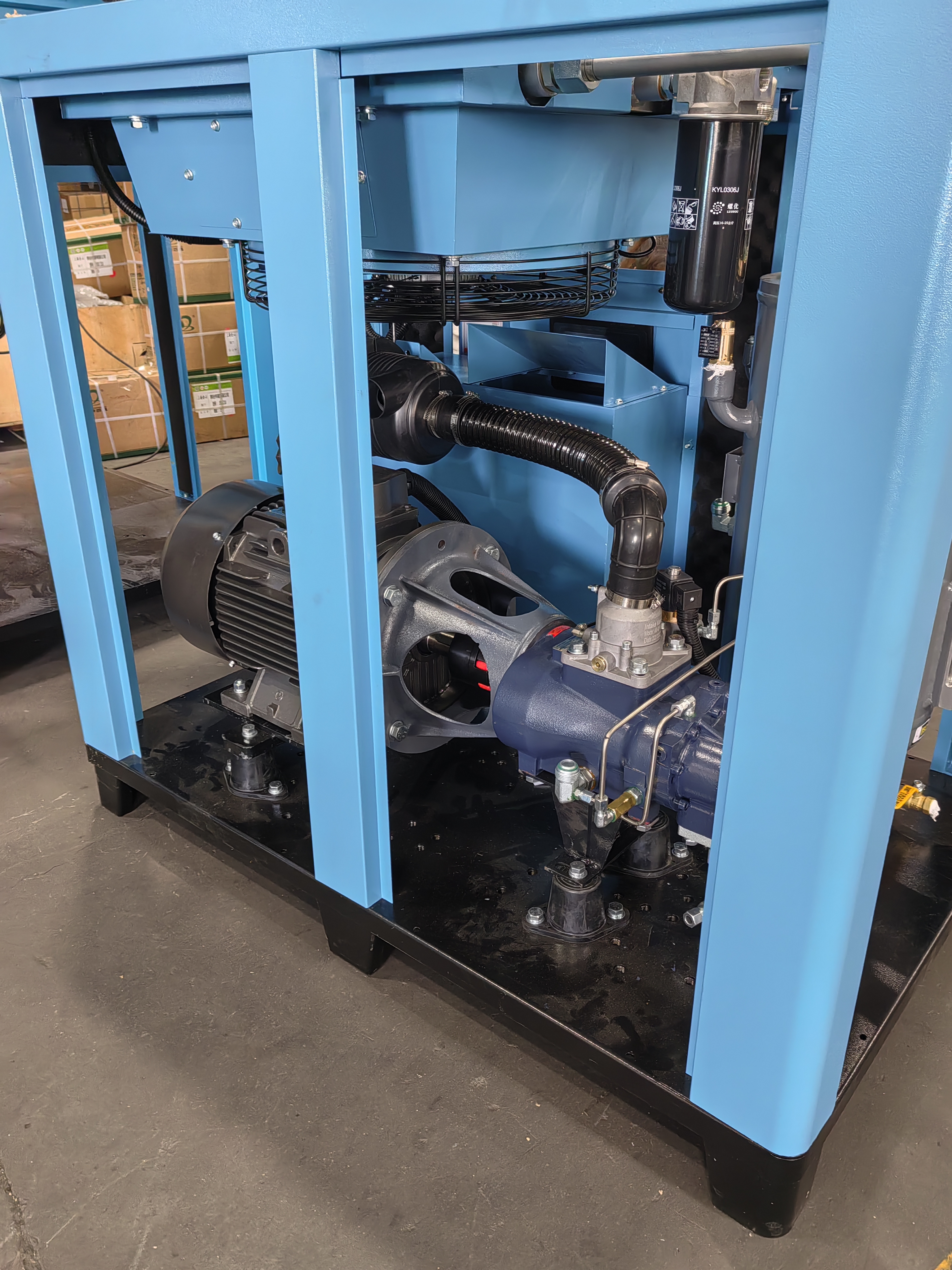
An 8 10 13 bar screw air compressor comes in various configurations tailored to specific tasks. Understanding the distinct applications for each pressure rating ensures optimal performance.
Most industrial facilities operate perfectly well within the 8 bar range. This configuration maximizes your Free Air Delivery (FAD) volume. It offers the absolute best energy efficiency for typical applications.
Sometimes standard pressure cannot overcome poor infrastructure. A 10 bar system pushes air harder to compensate for significant network resistance. It serves as a necessary compromise for complex plant layouts.
Only a small fraction of industrial processes truly require 13 bar. Generating this pressure demands significant energy and specialized infrastructure. You strictly sacrifice total air volume to achieve this high force.
Physics dictates a strict rule regarding compressed air generation. Motor power remains finite. If you increase the system pressure, you must decrease the generated volume. You cannot have both without upgrading to a much larger motor.
Let us examine a standard 55kW screw compressor. The performance trade-off becomes immediately clear when viewing the FAD specifications across different pressure ratings.
FAD Volume Output Based on Pressure (55kW Motor)
| Target Pressure | Expected Delivery (m³/min) | Volume Loss vs Baseline |
|---|---|---|
| 8 bar | 10.0 to 10.5 | Baseline (0%) |
| 10 bar | 8.5 to 9.0 | ~ 15% Loss |
| 13 bar | 7.0 to 7.5 | ~ 30% Loss |
The buying lesson here is critical for facility managers. Buying a 13 bar unit for an 8 bar plant means you are losing roughly 30% of your potential air volume. You pay for a 55kW motor but only receive the volumetric output of a much smaller machine. This severe volume reduction might force you to purchase a second compressor just to meet your baseline flow requirements.
Proper pressure selection requires strategic thinking. You must decide between system-wide pressure increases and localized upgrades. This decision framework prevents massive capital waste.
Consider a scenario where only one laser cutter needs 13 bar. The rest of your plant operates perfectly at 8 bar. Do not buy a 13 bar primary compressor for the entire facility. This forces 95% of your plant to operate inefficiently. Instead, buy a highly efficient 8 bar primary compressor. Then, install a specialized high-pressure booster exclusively for the laser cutter. This localized approach isolates high-pressure demands and optimizes overall plant efficiency.
Upgrading to higher pressures introduces several facility risks. You must proactively manage these factors before commissioning new equipment.
Do not base your purchase order on historical assumptions. We highly recommend conducting a week-long data-logging audit. Install electronic flow meters and pressure transducers across key distribution points. This hardware maps your precise peak flow and minimum pressure requirements over a full production cycle. Data reveals the truth.
Finalizing your operational parameters is a delicate balancing act. You must provide adequate point-of-use force while protecting overall system efficiency. Blindly selecting the highest available pressure damages your infrastructure and wastes electricity daily.
We strongly recommend choosing the lowest possible pressure rating. Ensure it reliably serves your most demanding equipment only after factoring in unavoidable system pressure drops. Localize high-pressure demands with boosters whenever possible.
Take action today to optimize your pneumatic infrastructure. Schedule a professional compressed air system audit immediately. Contact an experienced sales engineer to map out your exact FAD requirements and eliminate guesswork from your next installation.
A: Yes, but it operates less efficiently than a dedicated 8 bar airend. The internal gearing, rotor profile, and motor are strictly optimized for high pressure. Running it at low pressure wastes your initial capital expenditure and ultimately compromises optimal specific power performance.
A: This is almost certainly a distribution problem, not a compressor problem. Undersized piping, severely clogged inline filters, or excessive pipe elbows cause severe friction. These elements create massive pressure drops long before the air actually reaches your pneumatic tool.
A: VSD technology excels at matching flow volume variations efficiently as plant demand fluctuates. However, the system still needs to be sized for the correct peak pressure rating first. A VSD cannot compensate for a system that fundamentally lacks the necessary target pressure.


