
- Home
- Products
- Hot
- About Us
- Services
- Industry
- Contact
Views: 0 Author: Site Editor Publish Time: 2026-08-31 Origin: Site


Purchasing an industrial compressor represents a high-stakes capital decision. Demand for ISO 8573-1 Class 0 clean air continues to rise across strict manufacturing sectors. However, many buyers hesitate on water-lubricated systems. You might feel uncertain about long-term upkeep.
Facility managers must map out exact long-term expenses. Standard oil-injected systems feature predictable service routines. They can be messy, but they are well understood. Does removing the oil simplify this process? Or do you just trade oil changes for complex water treatment?
This guide strips away marketing claims. We detail exact operational realities and maintenance schedules. You will understand specific site requirements. We provide the evidence-based facts you need for a confident procurement decision.
You must first understand a fundamental engineering shift. In a traditional machine, oil seals rotor clearances, absorbs heat, and lubricates bearings. In a water lubricated screw air compressor, purified water performs these three exact functions. Engineers completely eliminate hydrocarbons from the compression chamber. This guarantees absolute air purity.
This mechanical shift creates powerful design advantages. It directly impacts your long-term operating budgets. You will notice fewer moving parts. You also eliminate several traditional failure points.
However, you must accept a crucial trade-off. The system relies heavily on built-in water filtration and Reverse Osmosis (RO) units. If you neglect these filters, mineral buildup occurs quickly. Catastrophic scaling can lock the rotors. Consistent water purification remains your highest priority.
What will your maintenance team actually do? How often will they do it? Evaluating the daily reality of an oil free water lubricated compressor requires looking at preventive tasks. Reactive maintenance leads to expensive downtime. You must follow strict schedules.
Your team will shift their focus. They stop managing oil viscosity. They start managing water purity and airflow restrictions. Airborne dust creates severe problems if it enters the water loop. Dust mixes into an abrasive sludge. This sludge damages internal components.
| Service Interval | Required Maintenance Actions | Primary Objective |
|---|---|---|
| Daily / Weekly | Verify RO water supply. Check tank levels. Monitor automated drain valves. Check intake filter pressure drops. | Ensure basic operational readiness. Prevent sudden water starvation. |
| Quarterly (2,000 - 4,000 Hours) | Replace air intake filters. Inspect and swap water filter elements. Test water conductivity. | Block airborne abrasives. Verify RO membrane health. Stop mineral scaling. |
| Annually (8,000 Hours) | Perform full system flush. Replace RO membrane. Inspect non-return and minimum pressure valves. Lubricate motor bearings. | Reset system baselines. Prevent long-term bacterial or mineral fouling. |
These intervals represent a baseline. Dirty environments require faster intake filter changes. Hard municipal water degrades RO membranes faster. You must adapt this schedule to your specific facility conditions.
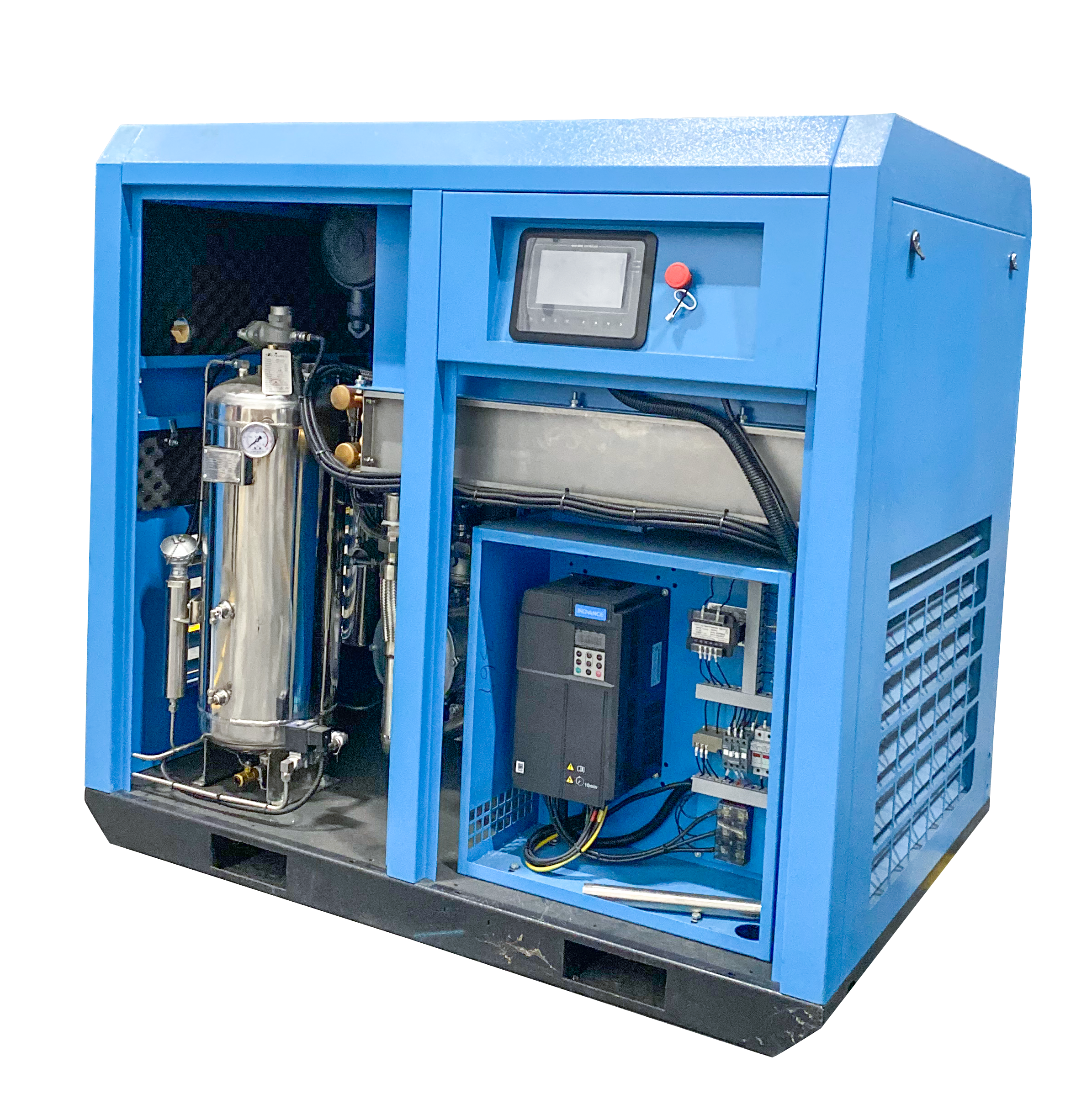
The water lubricated airend represents the most expensive component inside your machine. Evaluating its durability remains critical for procurement. Traditional cast-iron airends would rust immediately. Therefore, manufacturers use highly specialized materials.
Rotors typically feature polymer-ceramic composites. Some use advanced stainless steel or bronze alloys. These materials naturally resist corrosion. They provide excellent longevity when treated correctly. However, specific failure modes still exist.
When you maintain pristine water quality, rebuild expectations look excellent. A properly managed unit often extends beyond 40,000 hours before requiring a rebuild. This rivals or beats traditional dry screw systems. The lower operating temperature heavily protects the internal bearings and seals.
You must determine which oil-free technology makes the most financial sense. We look at a typical 10-year lifecycle. You need to compare both initial capital expenditure (CapEx) and long-term operating expenditure (OpEx).
Water-lubricated machines typically boast a lower initial purchase price. A two-stage oil free screw compressor (dry type) requires two distinct compression chambers. It needs complex timing gears. Water-lubricated units only require a single compression stage. This cuts manufacturing complexity and lowers your entry cost.
Operating expenditures also favor water sealing in many scenarios. Water provides better volumetric efficiency at lower RPMs than dry screws. You often see 10-15% energy savings. Energy consumption represents the largest lifetime expense for any compressor.
Consumables cost much less over time. Water filters and RO membranes remain inexpensive. Dry screws require specialized synthetic gearbox oils. They also need proprietary rotor coatings. These coatings degrade over time and reduce efficiency.
Finally, consider maintenance downtime. Routine services on water-lubricated systems take mere hours. Your internal team can perform most tasks. Conversely, dry-screw airend replacements require specialized factory technicians. You face prolonged downtime and massive labor invoices during a dry screw rebuild.
Hidden infrastructure upgrades often surprise new buyers. You must budget for these requirements before installation. Risk mitigation starts during the facility planning phase.
First, evaluate your water supply infrastructure. Does your facility have a reliable municipal water feed? You must connect this feed directly to the compressor’s RO unit. Low water pressure will trigger machine faults. You might need booster pumps.
Next, respect strict climate control constraints. You cannot place these machines in unheated outdoor enclosures. Cold climates present a massive risk. Your compressor room must stay above freezing at all times. Experts recommend keeping the ambient temperature above 5°C (41°F). This prevents catastrophic water expansion inside the piping and rotors.
Finally, review drainage compliance. The machine produces pure, oil-free condensate. However, local municipal codes might still dictate specific drainage routing. Industrial discharge often requires dedicated drains. Always check your local Environmental Protection Agency guidelines before routing condensate directly into storm sewers.
A water-lubricated system serves as an exceptional choice for demanding industries. Facilities in Food & Beverage, Pharmaceuticals, and Electronics require strict Class 0 air. These units help you avoid high initial costs. They also prevent the complex, expensive rebuilds associated with dry screw alternatives.
Your maintenance strategy simply shifts. You focus entirely on air intake quality and water purity. If you maintain the RO system, the machine delivers incredible longevity.
Before requesting a quote, conduct a thorough facility audit. Confirm your ambient temperature stability. Test your municipal water supply quality. Ask your distributor to calculate lifecycle energy and consumable expenses based on your specific duty cycle.
A: Most modern industrial units include an onboard Reverse Osmosis (RO) system. You only need to supply standard tap water. The machine purifies this municipal water automatically before injecting it into the compression chamber.
A: Freezing causes internal water to expand. This expansion can crack the airend housing and rupture internal piping. This leads to a total, catastrophic system failure. You must install these units inside temperature-controlled environments.
A: While consumable costs for filters and RO membranes exist, they remain relatively low. You save significantly on oil disposal, separator replacements, and environmental compliance. This makes the overall maintenance budget highly competitive.


