
- Home
- Products
- Hot
- About Us
- Services
- Industry
- Contact
Views: 0 Author: Site Editor Publish Time: 2026-08-25 Origin: Site


Textile manufacturing heavily relies on compressed air to maintain continuous operations. Modern processes like air-jet weaving, spinning, and texturizing consume massive amounts of energy daily. Often, this utility accounts for up to 70% of a mill’s total electricity cost.
Unfortunately, many facilities still use standard 7–8 bar (100–115 psi) compressors. They then step the pressure down for equipment needing only 2–5 bar. This common practice wastes incredible amounts of power. The physics of compression dictates heavy losses during this reduction.
Transitioning to a purpose-built low pressure screw air compressor directly solves this inefficiency. Selecting the perfect unit requires careful planning and engineering insight. You must align precise flow rates, strict air purity standards, and modern drive technologies. We will explore objective criteria to optimize your production lines. You will learn exactly how to evaluate machine capabilities and secure long-term efficiency.
Standard industrial systems push air at high pressures for generalized manufacturing tasks. However, textile machinery operates differently. Air-jet looms and texturizing machines require lower pressure but higher volume. Every 1 bar (14.5 psi) of over-pressurization adds about 7% to your energy bill. Generating 8 bar only to regulate it down wastes massive capital. You pay for compression energy you never actually use on the factory floor.
Many plant managers rely on Pressure Reducing Valves (PRVs) to manage excessive pressure. This approach creates a phenomenon called artificial demand. When you force high-pressure air through a restrictor, the system volume artificially increases. The network works much harder to maintain steady flow. Leaks across the facility also bleed faster at higher pressures. This compounding waste drains facility budgets quietly but rapidly.
A correctly specified textile air compressor delivers high-volume flow right at the required 2–5 bar. It eliminates aggressive pressure drops entirely. You match generation directly to consumption. This targeted approach stabilizes loom operation instantly. Consistent insertion pressure improves fabric quality and slashes monthly utility bills. Facilities adopting dedicated low-pressure units often see immediate operational stability.
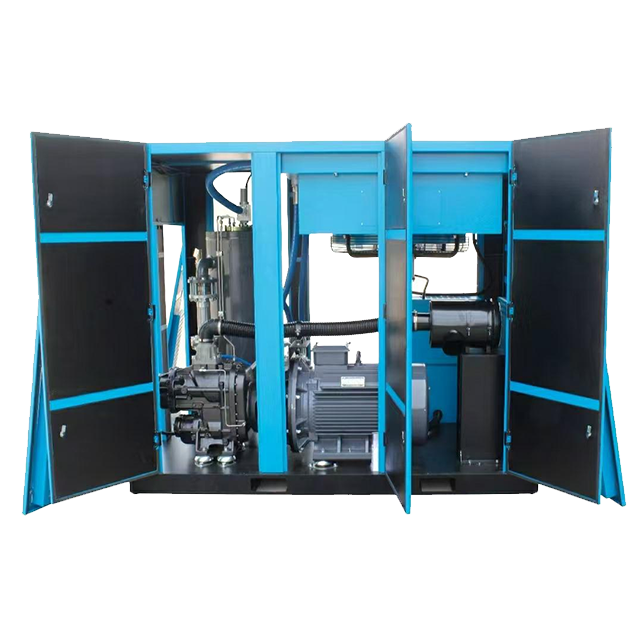
You must accurately calculate the simultaneous peak demand of your air-jet looms. Free Air Delivery (FAD) measures the actual usable volume delivered to the network. Calculate how many looms operate simultaneously during peak shifts. Add the pneumatic demands of spinning frames and packaging lines.
Always factor in a 10–15% safety buffer. This buffer handles future capacity expansion and acceptable minor system leakage. However, avoid wild oversizing. Oversizing leads to inefficient partial-load operation. Machines running far below their rated capacity waste significant power. Accurate flow profiling prevents these costly sizing errors.
Oil carryover creates massive financial risk for textile producers. Trace oil amounts stain delicate fabrics instantly. Oil also clogs sensitive loom nozzles over time. Product rejection rates spike when contamination occurs.
ISO 8573-1 Class 0 certification guarantees 100% oil-free air. This standard is non-negotiable for modern weaving mills. Simply filtering lubricated output remains far too risky. Inline filters degrade over time and require constant monitoring. A single filter failure ruins entire production batches. True Class 0 machines protect your end product entirely and eliminate filter replacement costs.
Specific Energy Consumption (SEC) measures actual machine efficiency objectively. You compare kW/m³/min or kW/100 CFM. Review compressor specifications at your actual operating pressure. Do not trust best-case baseline numbers alone.
A machine might show excellent SEC at 8 bar. Its performance at 3 bar could drop significantly if not purpose-built. Always request performance curves matching your exact mill conditions. Compare these curves side-by-side during procurement. SEC dictates your monthly power bill, making it the most vital metric for long-term savings.
Fixed-speed units run inefficiently off-load. Textile production cycles fluctuate constantly throughout the week. Looms stop frequently for warp changes. Maintenance teams shut down spinning frames temporarily.
During these lulls, fixed-speed machines keep spinning at full speed. They vent excess air or idle while drawing heavy electrical current. This unloaded running power drains facility budgets silently. Over a year, idling compressors consume thousands of dollars in wasted electricity. Standard induction motors also draw massive energy spikes during initial startup.
A PM rotary screw compressor matches motor speed to demand dynamically. If facility demand drops 30%, motor speed drops exactly 30%. The inverter adjusts frequency continuously to maintain steady pressure.
We acknowledge these systems carry a higher initial capital cost. However, variable production cycles yield a strong ROI rapidly. Most textile mills see full payback within 12–24 months. PM technology eliminates unloaded running power completely. It also reduces starting current peaks, protecting your electrical grid. Motor life extends considerably due to reduced mechanical stress.
| Operating Characteristic | Traditional Fixed-Speed Motor | Permanent Magnet (PM) VSD Motor |
|---|---|---|
| Demand Matching | Uses load/unload cycles; vents excess air. | Adjusts RPM dynamically to match actual demand. |
| Unloaded Energy Waste | High (draws 20-40% power while idling). | Virtually eliminated (stops or slows down). |
| Starting Current | Massive spikes (up to 6x full load current). | Soft start technology; no massive power spikes. |
| Pressure Stability | Fluctuates within a wide pressure band. | Maintains strict, steady pressure (within 0.1 bar). |
Textile mills present extremely harsh operating environments. High ambient temperatures challenge standard cooling systems daily. Heavy airborne lint and dust clog standard filters rapidly. Overheating causes premature mechanical failure and unexpected downtime.
You must specify oversized coolers for your equipment. Install heavy-duty pre-filtration panels on all air intakes. Demand robust IP55 or IP66 enclosed motors from your supplier. These protective features prevent dust ingress effectively. They guarantee reliable 24/7 operation despite challenging atmospheric conditions. Proper cooling also ensures optimal efficiency during peak summer months.
Delivering low pressure compressed air requires careful planning and infrastructure upgrades. Low-pressure systems push higher volumes of air. They require much larger diameter piping to maintain velocity.
Standard high-pressure pipes cause unacceptable friction. Pressure drops occur across the facility before reaching the looms. Weaving machines at the far end of the line suffer from air starvation. Outline a complete piping infrastructure audit before plugging in new equipment. Upgrading main headers ensures smooth delivery. Smooth delivery maximizes the efficiency gains of your new machine.
Selecting the best vendor requires objective evaluation and strict technical verification. You must look past marketing brochures and analyze real-world performance data. Follow a structured approach to finalize your procurement decision. Use these logical steps to secure the right equipment for your mill:
Specifying dedicated low-pressure equipment is a critical engineering decision. It directly impacts your overall cost-per-meter of fabric. Generating high pressure only to regulate it down destroys facility profit margins. You must align flow rates, pressure levels, and purity standards carefully.
Do not replace an aging machine using like-for-like sizing. Always audit your current actual demand first. Evaluate modern PM variable speed technology to capture off-load energy waste. The initial capital investment pays for itself rapidly through slashed utility bills.
We encourage you to request a comprehensive system audit today. Consult a specialized systems engineer to calculate your projected energy savings. Proper specification guarantees superior fabric quality and massive, sustainable cost reductions for your mill.
A: Generating high pressure only to reduce it later wastes massive amounts of energy. Every 1 bar of over-compression wastes roughly 7% of your electricity. A dedicated low-pressure machine eliminates this physical waste entirely, directly lowering production costs.
A: ROI depends heavily on local energy rates. However, textile mills operating 24/7 usually see payback within 12 to 24 months. The massive energy density of compressed air makes variable-speed efficiency upgrades highly lucrative.
A: Filters inevitably fail and degrade over time. A single oil carry-over event ruins a production batch. Oil also damages sensitive pneumatic loom valves. True Class 0 machines provide the safest long-term choice for product integrity.


