
- Home
- Products
- Hot
- About Us
- Services
- Industry
- Contact
Views: 0 Author: Site Editor Publish Time: 2026-08-10 Origin: Site


Many industrial facilities face a harsh operational reality during peak summer months. Standard pneumatic equipment specifications often look perfect on paper. However, they frequently fail when confronted with sweltering, unventilated compressor rooms. When ambient temperatures exceed standard limits of 100°F (38°C), it completely compromises the equipment's refrigerant cycle. This thermal overload leads directly to moisture blow-through in your facility piping.
This moisture causes degraded end-product quality, ruined paint finishes, and premature pneumatic tool failure in sectors like metal fabrication and automotive manufacturing. You cannot simply install standard equipment in extreme conditions and expect reliable performance. The physical environment will rapidly overwhelm the internal cooling components.
This guide provides a rigorous technical evaluation framework. We will help you navigate these hot-weather challenges effectively. We will show you how to properly size, select, and specify equipment built to handle severe thermal loads. You will learn to evaluate different cooling methods and apply necessary mathematical correction factors. Ultimately, you will ensure your system maintains moisture-free air without sacrificing long-term mechanical reliability.
Industry standards define baseline performance for very specific reasons. The CAGI (Compressed Air and Gas Institute) ADF 100 standard establishes uniform equipment ratings. It assumes a 100°F ambient temperature, a 100°F inlet temperature, and 100 PSIG operating pressure. Standard compressed air treatment equipment uses these specific baselines. You must understand these hard limits before installing equipment in a hot room.
When rooms get hotter, the thermodynamic problem compounds quickly. A 10°F increase in ambient temperature does more than lower the condenser's mechanical efficiency. It exponentially increases the moisture-holding capacity of the incoming compressed air. Hotter air carries significantly more water vapor. For example, incoming air at 110°F holds nearly double the moisture of air at 90°F. This forces the internal refrigeration components to work much harder to hit the required dew point.
Pushing a standard unit past its thermal limits triggers predictable and costly failure modes. The refrigerant compressor suffers severe thermal overload. The system experiences high-pressure trips and shuts down entirely to protect itself. Eventually, you lose the crucial ISO 8573.1 Class 4 pressure dew point. This class requires a strict 38°F (3°C) dew point. Once lost, liquid water passes freely into your production lines. This water corrodes internal piping, destroys sensitive pneumatic valves, and ruins automated machinery.
Selecting the right cooling mechanism dictates your success in extreme environments. Facilities must evaluate their available utility infrastructure before purchasing any new equipment. You must match the technology to your physical building constraints.
Air-cooled systems use ambient room air to reject internal heat. A fan draws this air across a specially designed finned condenser. While installation remains simple, they face severe physical limitations in hot environments.
They remain highly vulnerable to localized micro-climates in poorly ventilated spaces. Efficiency drops sharply as the room temperature approaches the refrigerant's condensing temperature. Once the room gets too hot, heat transfer stops entirely.
A water cooled air dryer offers a robust, industrial-grade solution. It utilizes a shell-and-tube or plate heat exchanger instead of a fan. It uses facility water, like chilled water or a cooling tower loop, to reject heat.
This design brings major operational advantages. It completely isolates cooling efficiency from the ambient room temperature. The room can hit 115°F, and the unit will still perform perfectly. It also allows for a much smaller physical footprint since it lacks massive cooling fans.
However, it requires specific facility prerequisites. You need existing, reliable cooling water infrastructure. The water needs proper chemical treatment to prevent scaling inside the heat exchanger. You also need flow regulation valves to maintain stable water pressures and routine maintenance schedules to clean internal strainers.
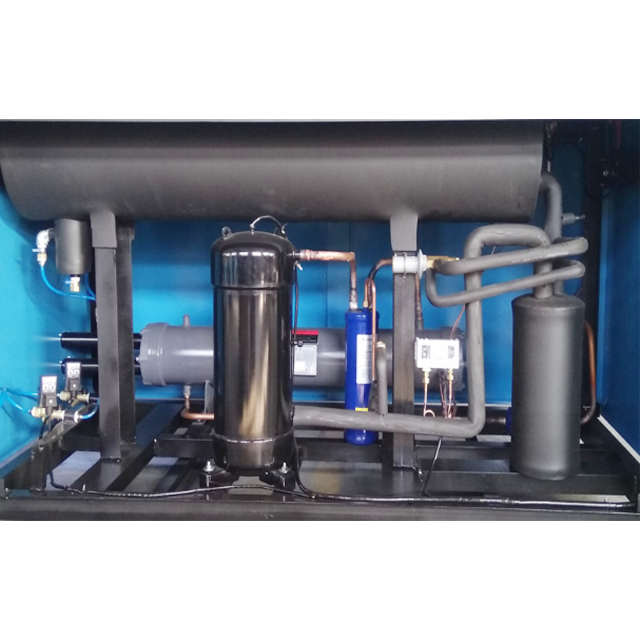
Proper refrigerated dryer selection relies heavily on applied mathematics. Never buy based purely on the "Nameplate CFM" printed on marketing brochures. Nameplate capacity becomes completely invalid the moment ambient conditions exceed 100°F.
You must apply mathematical correction factors, known as derating, to find the true capacity. You multiply the baseline capacity by these specific fractions to find real-world performance under stress.
To calculate your actual capacity requirement, use this standard engineering formula:
Required Capacity = Peak System Flow / (Ambient Factor × Inlet Factor × Pressure Factor)
Let us look at a practical calculation. If your compressor outputs 500 CFM, and your combined correction factor is 0.65 due to high heat, you cannot buy a 500 CFM unit. You calculate 500 / 0.65. You actually need a unit rated for 770 CFM to survive those conditions and maintain a stable dew point.
| Ambient Temperature | Ambient Factor | Inlet Temperature | Inlet Factor |
|---|---|---|---|
| 100°F (38°C) | 1.00 | 100°F (38°C) | 1.00 |
| 105°F (41°C) | 0.97 | 105°F (41°C) | 0.91 |
| 110°F (43°C) | 0.94 | 110°F (43°C) | 0.82 |
| 115°F (46°C) | 0.89 | 115°F (46°C) | 0.75 |
| 120°F (49°C) | 0.85 | 120°F (49°C) | 0.68 |
You must assess different control types during summer months. Variable Speed Drive (VSD) or thermal mass cycling dryers normally save significant electrical energy. However, consider what happens when extreme heat forces the unit to run at 100% load continuously.
In sustained peak summer conditions, the energy-saving ROI of a cycling unit drops rapidly. It stays on maximum power just to keep up with the heat load. A non-cycling unit might offer better simplicity and durability under constant maximum load. Choose based on your year-round temperature profile, not just your peak summer data.
Even a perfectly sized mathematical model will fail if physical installation conditions are poor. You must prepare the physical space to handle increased thermal extraction.
You must actively remove rejected heat from the compressor room. A high ambient air dryer exhausts massive amounts of thermal energy. If you lack proper ducting, this exhaust creates a dangerous thermal feedback loop.
The room continually heats up until the equipment trips on high-pressure safety faults. Ducting the hot exhaust air outside is an absolute necessity. Ensure your ducting fans can overcome the static pressure of the louvers to push the hot air completely out of the building.
Condenser fins in hot industrial areas demand frequent cleaning. Dust acts as an highly effective thermal insulator. It traps heat inside the coils and destroys cooling efficiency.
You must stipulate a three-foot minimum clearance around all ventilation panels. This ensures proper fresh airflow. It also allows maintenance technicians easy access for routine power-washing or blow-downs.
High ambient heat means extracting significantly more liquid water from the air stream. Standard mechanical timer drains often choke under this dramatically increased volume. They either fail to open long enough or get physically stuck due to debris.
Specify the need for zero-loss electronic capacitance drains. These drains easily scale for higher liquid volumes. They only open when water is present, preventing the costly waste of valuable compressed air.
Transitioning from technical evaluation to actual procurement requires a highly structured approach. Follow these logical steps to ensure a successful, reliable deployment.
Successful operation in extreme heat demands applied thermodynamics and rigorous capacity sizing. It goes far beyond simple brand selection or buying the cheapest unit on the market. You must respect the physical limits of standard refrigeration cycles.
To move forward effectively, take these action-oriented steps:
A: Standard units generally have a hard limit of 110°F (43°C). Operating continuously above this threshold triggers high-pressure safety faults. The refrigerant compressor overheats, and internal safety switches shut the system down. This mechanism prevents catastrophic mechanical failure but halts your production entirely.
A: Oversizing helps compensate for capacity loss via mathematical derating. However, it does not solve the physical heat problem. The internal components must still survive the extreme environmental temperatures. If the room exceeds the design limits of the refrigerant compressor, even heavily oversized standard units will fail.
A: These units are fundamentally different from models built for high ambient heat. High inlet dryers feature built-in aftercoolers designed to accept extremely hot air (often 180°F+) directly from piston compressors. High ambient units specifically focus on rejecting internal heat into a hot room.
A: There is a direct mathematical correlation between condenser efficiency and your final dew point. High room temperatures reduce the condenser's ability to reject heat. This causes the evaporator temperature to become unstable and rise. Moisture remains as vapor, resulting in a severe pressure dew point spike.


