
- Home
- Products
- Hot
- About Us
- Services
- Industry
- Contact
Views: 0 Author: Site Editor Publish Time: 2026-03-16 Origin: Site


Scroll compressors are widely used for their reliability and efficiency in numerous industrial applications. While traditional scroll compressors rely on oil to lubricate the moving components, some applications require compressors that produce clean, oil-free air. This is crucial for industries such as food processing, medical applications, and electronics manufacturing, where even the slightest oil contamination can compromise product quality or safety.
Understanding how oil-free scroll compressors work and their benefits can help businesses make informed decisions about which type of compressor is best suited for their needs. In this article, we will break down how oil-free scroll compressors operate, explore their advantages, and discuss their applications and challenges.
A scroll compressor uses two interleaving spiral-shaped scrolls to compress air or gas. One scroll is fixed, while the other orbits around it. As the orbiting scroll moves, it traps the air between the two scrolls and compresses it progressively as it moves toward the center. This unique design creates a smooth, continuous compression process that results in quieter and more efficient operation compared to other types of compressors.
Unlike piston compressors, which work in cycles, scroll compressors provide continuous compression with no pulsing or vibration. The smooth operation makes them ideal for applications that require consistent and reliable airflow.
A scroll compressor consists of the following key components:
Scrolls: The primary moving components. One scroll is stationary, while the other orbits around it, compressing the air.
Motor: The motor powers the orbiting scroll, causing it to move and compress air.
Discharge Port: Once the air is compressed, it is expelled through the discharge port.
Suction Port: Air is drawn into the compressor through the suction port.
Lubrication System: In oil-injected compressors, this system distributes oil to lubricate and cool the internal components. However, oil-free compressors do not require lubrication in the compression chamber.
In traditional scroll compressors, oil is injected into the compression chamber to lubricate the moving parts, such as the rotors. The oil serves several functions, including reducing friction between the rotors, cooling the components, and sealing the gaps between the scrolls to improve efficiency. The lubrication also helps prevent wear and tear, extending the compressor’s lifespan.
However, the presence of oil in the compressed air can be problematic for industries where even the smallest traces of oil can contaminate products or processes. As a result, there has been growing interest in developing oil-free scroll compressors that do not rely on oil lubrication.
While oil injection can be problematic for certain applications, it also offers several advantages:
Improved Efficiency: Oil reduces friction between the scrolls, improving the compressor’s overall efficiency.
Cooling: The oil helps to dissipate heat generated during the compression process, preventing overheating.
Extended Lifespan: Regular lubrication helps to reduce wear and tear on internal components, leading to a longer operational lifespan.
Sealing: Oil acts as a sealant between the scrolls, preventing air leakage and improving compression efficiency.
Oil-free scroll compressors operate on the same basic principle as traditional scroll compressors, but with a significant difference: they do not use oil for lubrication or sealing. Instead, oil-free scroll compressors rely on high-precision engineering, tight tolerances, and advanced sealing systems to ensure that air is compressed without contamination.
In oil-free designs, the scrolls are made with special coatings or materials that reduce friction without the need for oil. Additionally, these compressors use advanced bearings and seals that are designed to operate efficiently without the lubricating properties of oil. The result is clean, dry compressed air with no risk of oil contamination.
The design of oil-free scroll compressors is more complex than oil-injected models due to the need for advanced materials and precision engineering. Key design considerations include:
Seal Technology: Oil-free compressors use high-quality seals that prevent air leakage and ensure smooth operation.
Materials: Special coatings and materials are used to reduce friction and wear between the scrolls, which would otherwise require lubrication.
Cooling Systems: Oil-free compressors often have enhanced cooling mechanisms to prevent overheating, as there is no oil to carry away heat.
These design features make oil-free scroll compressors suitable for applications that require extremely clean air.
One of the primary advantages of oil-free scroll compressors is their ability to produce clean, contaminant-free air. Since there is no oil in the compression chamber, there is no risk of oil contamination in the compressed air. This makes oil-free scroll compressors ideal for industries that require high-purity air, such as the food and beverage industry, pharmaceuticals, and medical applications.
Oil-free compressors are also more environmentally friendly because they eliminate the need for oil, which can be harmful if not disposed of properly. Oil-free scroll compressors do not require regular oil changes, reducing the amount of oil waste generated. This makes them a more sustainable option for businesses looking to reduce their environmental footprint.
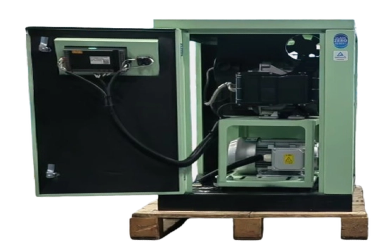
Oil-free scroll compressors are used in industries where the presence of oil in the compressed air could pose serious risks. Some of the primary industries that require oil-free air include:
Food and Beverage: Oil-free compressors are used in food processing and packaging applications where clean, contaminant-free air is essential for maintaining product quality and meeting regulatory standards.
Medical and Pharmaceutical: In medical applications, oil-free compressors provide air for respiratory equipment, breathing apparatus, and medical gas systems. Any trace of oil could compromise patient safety, making oil-free compressors the only viable option.
Electronics and Semiconductor: Oil-free compressors are critical in manufacturing processes for electronics and semiconductors, where even small amounts of oil could damage sensitive equipment or contaminate products.
In healthcare settings, oil-free scroll compressors are used in medical air systems, laboratory equipment, and equipment for anesthesia delivery. Similarly, in the food industry, oil-free compressors are used in applications such as food processing, packaging, and refrigeration. The oil-free operation ensures that the air used does not come into contact with food products or pharmaceuticals, thereby preserving product integrity and safety.
While oil-free scroll compressors offer many benefits, they also come with certain challenges. One of the main drawbacks is their higher initial cost. Due to the advanced technology and materials required to create an oil-free design, these compressors are generally more expensive than oil-injected models.
Additionally, oil-free compressors require more frequent maintenance to ensure that the seals, bearings, and other components are functioning properly. The need for precise engineering and specialized parts means that repair and replacement can be more costly compared to oil-injected compressors.
Oil-free scroll compressors, while highly efficient in many applications, may not always match the performance of oil-injected compressors in terms of energy efficiency. The absence of oil means that friction between the components can be higher, leading to slight decreases in efficiency. Furthermore, oil-free compressors may have limitations when it comes to handling higher pressure levels or larger volumes of air compared to their oil-injected counterparts.
Oil-free compressors generally have lower efficiency due to the design and higher friction without oil lubrication. The absence of oil increases internal friction, slightly reducing their overall energy efficiency compared to oil-injected models.
Oil-free compressors are more sensitive to temperature changes and may require advanced cooling systems to maintain efficiency. Without oil to absorb and dissipate heat, oil-free compressors often need specialized cooling mechanisms to prevent overheating.
While there’s no need for oil changes, oil-free compressors still require regular checks on seals, filters, and other critical components to ensure optimal performance. These compressors may also require more frequent maintenance of the sealing system to avoid air leaks and ensure continuous, oil-free operation.
Oil-free scroll compressors tend to be more expensive due to their complex design and advanced materials. However, they offer long-term cost savings in terms of reduced maintenance and cleaner air. The higher upfront cost is often balanced by fewer maintenance requirements and the ability to avoid the cost of oil management.
Oil-free scroll compressors provide a clean, environmentally friendly solution for industries that require contamination-free compressed air. These compressors are ideal for applications in food processing, healthcare, pharmaceuticals, and electronics, where the presence of oil could compromise safety and product quality. However, while oil-free scroll compressors offer several benefits, they come with higher upfront costs and more complex maintenance requirements. The precision engineering and advanced materials used in oil-free compressors also contribute to the increased initial investment.
Understanding the design and benefits of oil-free scroll compressors can help businesses make an informed decision about the best type of compressor for their specific needs. Whether you prioritize clean air, environmental impact, or long-term savings, oil-free scroll compressors are a viable option for industries where purity and reliability are paramount. As the demand for clean and sustainable air solutions grows, these compressors are becoming an essential part of industries focused on quality and safety.


