
- Home
- Products
- Hot
- About Us
- Services
- Industry
- Contact
Views: 0 Author: Site Editor Publish Time: 2026-03-05 Origin: Site


Fixed-speed air compressors have been a staple in various industries for years due to their simplicity, reliability, and lower initial cost. However, the question arises whether these compressors are less energy efficient compared to their variable-speed counterparts. In this article, we will explore the working principle of fixed-speed compressors, how they compare with variable-speed compressors in terms of energy efficiency, and when they are best used.
A fixed-speed air compressor is a type of compressor that operates at a constant speed, meaning the motor runs at a set RPM (revolutions per minute) whenever the compressor is on. These compressors work by drawing in ambient air and using mechanical energy to compress it into a smaller volume. The compressed air is then stored or used as needed.
The fixed speed design means that the compressor will continue to run at the same speed regardless of the demand for compressed air. If the system requires less air than the compressor is capable of producing, the compressor will still consume the same amount of energy, leading to potential inefficiency.
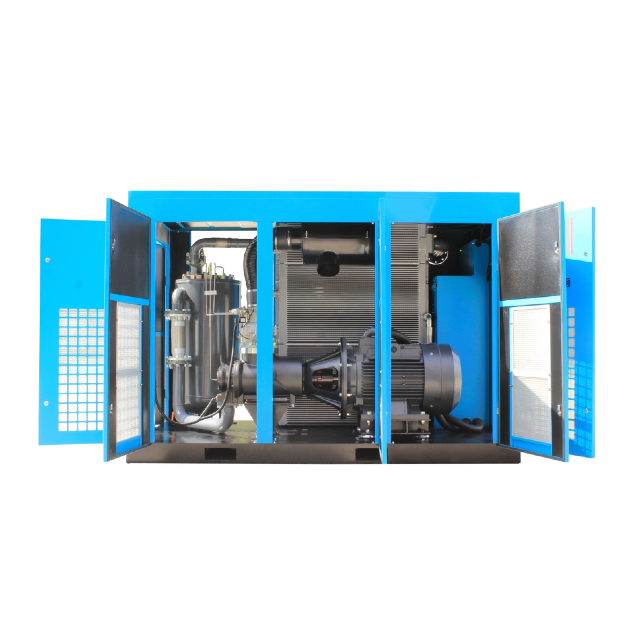
Fixed-speed compressors have a straightforward design and operate with a few core components:
Motor: The motor powers the compressor, operating at a constant speed. It is typically a direct-drive motor, which provides efficient transmission of energy to the compressor’s rotors.
Compressor Unit: The compressor unit houses the rotating parts (like screws or pistons, depending on the type) that perform the compression of air. The air is drawn in, compressed, and expelled continuously.
Air Intake Valve: The air intake valve allows the compressor to draw in air, which is then compressed.
Discharge Valve: Once air is compressed, the discharge valve releases the pressurized air into the system or storage tanks.
Cooling System: The compressor unit often comes with a cooling system (air or water-cooled) to prevent overheating during continuous operation.
One of the defining characteristics of fixed-speed compressors is that they run at full capacity all the time they are operating. This means that the motor runs at a constant speed, regardless of whether the system requires a full load of compressed air or only a fraction of it.
For example, if the demand for compressed air drops, a fixed-speed compressor will still run at the same speed, consuming the same amount of energy. This leads to a situation where the compressor is working harder than necessary, resulting in wasted energy and reduced efficiency.
In applications where air demand is consistent and predictable, fixed-speed compressors can be a suitable choice, as they can maintain a steady supply of compressed air. However, in environments where air demand fluctuates throughout the day or year, fixed-speed compressors may not be the most efficient option. As air demand fluctuates, the fixed-speed compressor cannot adjust to meet those changes, leading to periods where the compressor operates inefficiently.
Variable-speed compressors, on the other hand, adjust their motor speed to match the air demand, ensuring that energy consumption is optimized.
Variable-speed compressors (VSDs) are designed to adjust the motor speed depending on the demand for compressed air. When demand is low, the motor speed reduces, resulting in lower energy consumption. Conversely, when demand increases, the motor speed increases accordingly. This adaptability makes VSDs much more energy-efficient in environments with fluctuating air demand.
Fixed-speed compressors, by contrast, operate at a constant speed, consuming the same amount of energy regardless of the air demand. In industries with high and fluctuating air consumption, fixed-speed compressors tend to be less efficient compared to variable-speed compressors because they are not able to scale their output according to actual needs.
Compressor Type | Energy Efficiency | Operation Mode | Cost of Ownership | Maintenance |
Fixed-Speed | Less efficient (constant energy consumption) | Always operates at full speed | Lower initial cost, higher operational cost | Moderate (requires regular checks) |
Variable-Speed | More efficient (adjusts speed based on demand) | Adjusts motor speed based on demand | Higher initial cost, lower operational cost | Lower maintenance, long-term savings |
When a fixed-speed compressor operates under full load (when there is a high demand for compressed air), it operates efficiently in terms of its capacity. However, when air demand decreases (part load conditions), the compressor still runs at full speed, which means it consumes more energy than required. This situation leads to inefficiency, particularly in operations where the air demand is not constant.
Variable-speed compressors, on the other hand, have the ability to adjust their output according to the demand, which leads to higher energy efficiency under part-load conditions. Therefore, if your facility experiences significant fluctuations in air demand, investing in a variable-speed compressor could result in substantial energy savings.
The energy efficiency of a fixed-speed compressor is heavily influenced by the operating conditions. When the compressor operates under heavy loads consistently, the energy consumption might be justifiable. However, if the air demand is inconsistent or fluctuating, the fixed-speed compressor will struggle to operate efficiently, leading to unnecessary energy consumption.
Environmental conditions such as temperature and humidity also impact compressor efficiency. Fixed-speed compressors typically perform best in stable conditions, and significant changes in external factors can further degrade efficiency.
Proper maintenance is essential for ensuring the energy efficiency of fixed-speed compressors. Over time, components such as filters, belts, and valves can become clogged or worn out, which increases friction and reduces the efficiency of the compressor. Regular maintenance, such as changing the oil, replacing filters, and cleaning the system, can help keep the compressor running smoothly and reduce energy consumption.
However, even with regular maintenance, fixed-speed compressors are less flexible than variable-speed models. They cannot adjust to changes in demand or operating conditions, which makes them less energy-efficient in certain settings.
One of the main advantages of fixed-speed compressors is their simplicity. They are easy to install, operate, and maintain. Since fixed-speed compressors are built with fewer moving parts compared to more complex systems, they are less prone to mechanical failure and typically have lower initial costs.
For businesses with consistent, predictable air demand, fixed-speed compressors can be a cost-effective choice. Their initial purchase price is generally lower than that of variable-speed compressors, making them an attractive option for companies with limited budgets.
The primary disadvantage of fixed-speed compressors is their energy inefficiency in fluctuating demand scenarios. Since they run at full capacity regardless of demand, they tend to waste energy, which can increase operational costs over time. Additionally, since these compressors do not adjust to temperature changes or variations in demand, they may overheat, leading to the need for frequent maintenance and potential breakdowns.
Moreover, in applications where air demand is unpredictable, fixed-speed compressors can result in periods of overproduction and underproduction, causing inefficiencies and unnecessary energy consumption.
Fixed-speed compressors are ideal for applications where air demand is constant and predictable. Industries that require a steady, reliable supply of compressed air, such as large manufacturing facilities, may benefit from fixed-speed compressors. They are also well-suited for applications where initial cost savings are a priority and energy efficiency is not the main concern.
For businesses with high and fluctuating air demand, fixed-speed compressors may not be the best choice. However, for operations with minimal fluctuation in air demand, the cost-effectiveness of fixed-speed compressors could make them a viable option. When making a decision, it’s essential to weigh the long-term energy costs against the initial purchase price of the compressor.
Even though fixed-speed compressors are less energy-efficient than variable-speed models, businesses can adopt practices to improve their performance. Installing energy-efficient components like high-efficiency motors, regularly maintaining the system, and optimizing the system for lower load conditions can help reduce energy waste.
If a fixed-speed compressor is still the best option for your business, consider upgrading components such as variable intake valves or aftercoolers. These upgrades can help reduce energy consumption by optimizing the compressor’s performance based on actual demand.
Yes, fixed-speed compressors run at full capacity whenever they are on, which can lead to energy inefficiency during lower demand.
Environmental factors like temperature, humidity, and pressure can influence how efficiently a fixed-speed compressor operates.
Yes, proper maintenance, regular checks, and the use of efficiency-enhancing components like variable intake valves can improve energy consumption.
If air demand fluctuates significantly, switching to a variable-speed compressor can provide significant energy savings by adjusting motor speed to match demand.
In conclusion, while fixed-speed compressors are cost-effective and reliable, they tend to be less energy-efficient compared to variable-speed compressors, particularly in applications with fluctuating air demand. By understanding the advantages and disadvantages of fixed-speed compressors, businesses can make an informed decision about whether to invest in them based on their operational needs and budget. For environments with consistent demand, fixed-speed compressors can be an excellent choice, but for fluctuating demand, a variable-speed compressor may provide significant long-term energy savings.


