
- Home
- Products
- Hot
- About Us
- Services
- Industry
- Contact
Views: 0 Author: Site Editor Publish Time: 2026-10-21 Origin: Site


Sizing and selecting a compressed air dryer remains a high-stakes engineering decision. You face real consequences if you get it wrong. Undersizing leads to downstream moisture damage in your sensitive pneumatic tools. Oversizing drives up capital expenditures and lifetime energy costs unnecessarily. Relying strictly on compressor horsepower guarantees specification errors. Relying only on nameplate capacity causes similar problems. You cannot ignore environmental variables during the design phase.
We provide facility managers and engineers with an evidence-based framework. You will learn to evaluate dryers based on precise dew point targets. We will show you how to calculate true flow capacity accurately. We focus on real-world conditions rather than ideal laboratory numbers. Environmental heat and system pressure drastically alter dryer performance. By the end of this guide, you can specify equipment with complete confidence. You will secure clean, dry air for your facility.
You must understand the difference between atmospheric dew point and pressure dew point. Atmospheric dew point measures when water condenses in ambient air. Pressure dew point (PDP) measures condensation inside pressurized pipes. We rely only on PDP for system design. Compression forces moisture particles closer together. This raises the temperature where condensation begins. You must understand this distinction clearly. It prevents catastrophic moisture carryover in your piping network.
Targeting the correct compressed air dryer dew point requires industry standards. We align our specifications with ISO 8573-1. This international standard categorizes compressed air quality into distinct classes. Each class defines a maximum allowable moisture limit. You must map your required PDP directly to these established classes.
Table: ISO 8573-1 Moisture Classes and Pressure Dew Point Targets
| ISO 8573-1 Class | Pressure Dew Point (°F) | Pressure Dew Point (°C) | Typical Application |
|---|---|---|---|
| Class 1 | -94°F | -70°C | Semiconductor manufacturing, pharmaceuticals |
| Class 2 | -40°F | -40°C | Outdoor piping in winter, food and beverage |
| Class 3 | -4°F | -20°C | Specialty powder coating, precision instruments |
| Class 4 | 38°F | 3°C | General manufacturing, indoor pneumatic tools |
| Class 5 | 45°F | 7°C | Basic shop air, rough industrial processes |
We recommend matching the dew point strictly to your most sensitive equipment. You apply a specific decision lens here. Do not specify Class 1 or 2 if Class 4 prevents condensation. You only need to drop the dew point below your lowest ambient temperature. Specifying a lower dew point than necessary introduces massive implementation risks. It exponentially increases your energy consumption. It also inflates your hardware costs drastically. You end up paying for air quality you do not actually need.
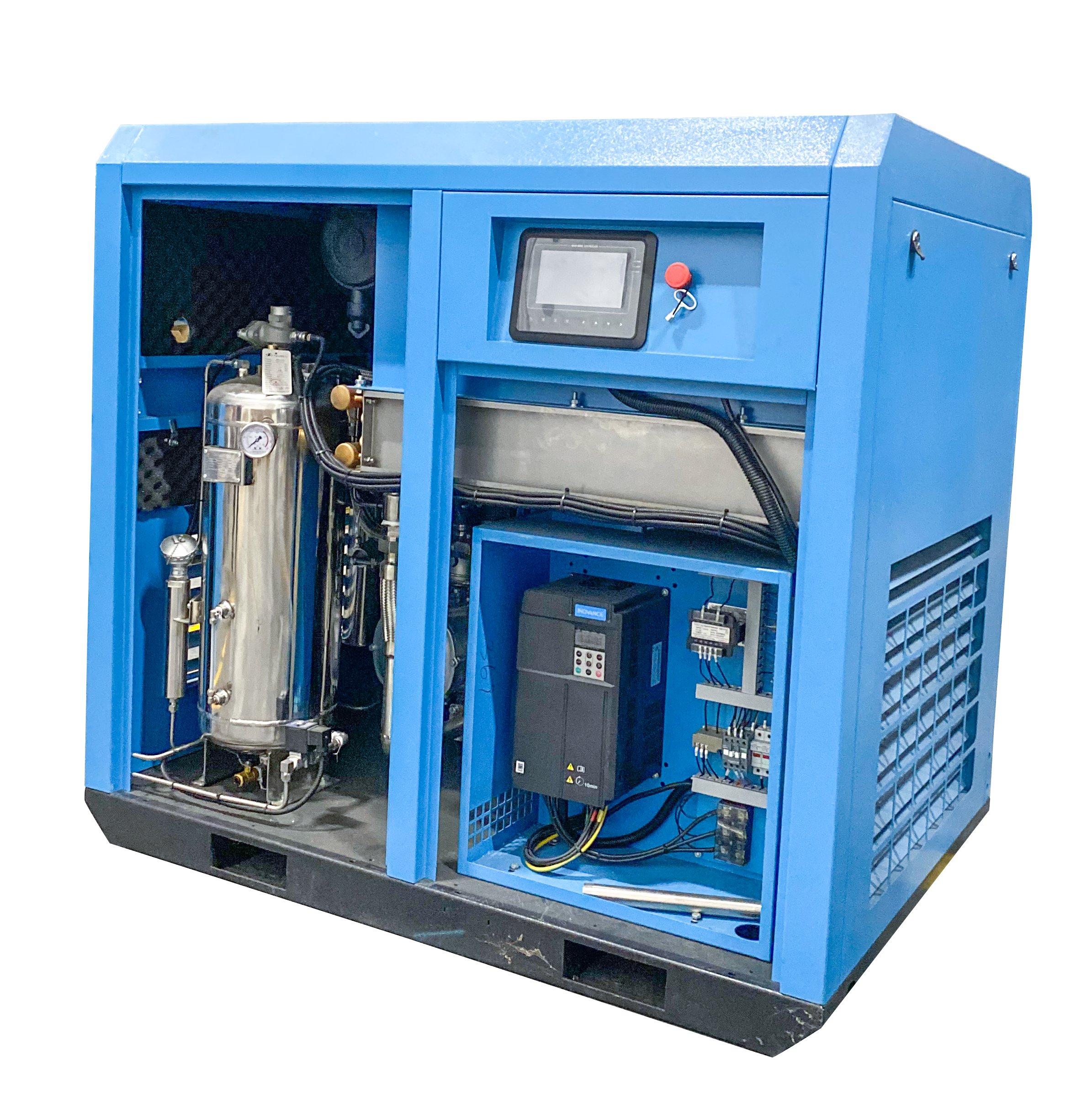
You have three primary technology paths for removing moisture. Each technology achieves different ISO moisture classes. We evaluate them based on capabilities and operational trade-offs.
Most industrial facilities rely on a refrigerated dryer for standard operations. These units deliver a PDP of 38°F to 39°F. They cool the incoming air using standard refrigerant circuits. This causes the suspended water vapor to condense into liquid. An automatic drain then removes this liquid from the system. They remain the best choice for general manufacturing. We specify them for indoor piping and standard pneumatic tools.
You can choose between two main variants. Non-cycling models offer a lower initial cost. They run continuously regardless of air demand. Cycling or Variable Speed Drive (VSD) models cost more upfront. However, they scale their energy use directly to your air demand. They turn off their compressors during low-flow periods. This saves substantial energy over the equipment lifecycle.
Critical applications require desiccant technology. These units deliver ultra-low dew points ranging from -40°F to -100°F. They push wet air through twin towers filled with desiccant beads. The beads adsorb the moisture directly from the air stream. We consider them essential for outdoor piping in freezing climates. Electronics manufacturing, food packaging, and pharmaceuticals also mandate this technology.
You face significant operational trade-offs here. Desiccant beads eventually become saturated. The system must dry them out for reuse. Heatless models use a portion of dried compressed air for this purge process. They often waste up to 15% of your total compressor capacity. Heated models reduce this purge air loss. They use external electrical heaters or blower systems instead. This requires higher initial investments but saves compressed air.
Some facilities face complex moisture challenges. A combined air dryer offers a unique solution. This hybrid technology integrates refrigerated cooling with a desiccant rotor or tower. The refrigerated section removes the bulk of the moisture first. The desiccant section then polishes the air to achieve sub-zero dew points.
We use a specific decision lens for these units. They are ideal for facilities requiring seasonal dew point flexibility. You can run the refrigerated section alone during summer. You can engage the desiccant section during winter to prevent frozen pipes. They also reduce the heavy purge air requirements found in standard desiccant models. This dramatically improves system efficiency over time.
You cannot trust nameplate flow ratings blindly. Manufacturers rate their equipment based on standard testing conditions. The Compressed Air and Gas Institute (CAGI) defines this baseline. Standard conditions assume 100 PSIG system pressure. They assume 100°F inlet air temperature. They also assume 100°F ambient room temperature. Your compressor room rarely matches these exact conditions perfectly.
Actual sizing requires mandatory adjustments. You must apply correction factors to calculate true capacity. We evaluate three critical variables.
We use a standard sizing equation to find the required capacity. You must calculate this before soliciting vendor quotes.
The Sizing Equation:
Actual CFM Required = (Maximum Compressor CFM) ÷ (Inlet Temp Factor × Ambient Temp Factor × Pressure Factor)
Consider the implementation reality. Failing to apply these correction factors causes massive problems. High-heat environments overwhelm undersized units quickly. A poorly ventilated compressor room drives ambient temperatures up. The dryer loses its cooling efficiency immediately. The dew point spikes. Downstream water carryover begins. We find uncorrected sizing to be the leading cause of wet air in industrial plants.
Evaluating dryers requires looking past the purchase price. You must weigh the initial capital cost against continuous operation costs. We analyze several critical implementation risks.
You must calculate the lifetime energy footprint. A basic non-cycling unit costs less today. However, it consumes maximum power continuously. A cycling refrigerated unit costs more upfront. A heated blower-purge desiccant unit also requires high capital expenditure. Yet, these advanced units often pay for themselves quickly. They reduce energy loads dramatically during partial production shifts. You usually see full payback via energy savings within 18 to 24 months.
Every dryer introduces a pressure drop into your system. The air must navigate heat exchangers, valves, and desiccant beds. This friction typically consumes 2 to 5 PSI.
This drop creates a severe operational impact. Your compressor must work harder to overcome this resistance. Elevating compressor discharge pressure increases power consumption significantly. You must evaluate the internal aerodynamics of shortlisted models carefully. Demand low pressure drop designs. Require your vendors to guarantee maximum pressure drop limits across the dryer and its filters.
You cannot ignore scheduled maintenance. Pre-filters and post-filters require regular element changes. These filters protect the internal components from oil and dust. Saturated filters cause pressure drops to spike.
Desiccant models introduce heavy maintenance cycles. The desiccant beads degrade over time. Oil vapor and abrasive dust destroy their adsorption capability. You must factor in the cost of desiccant bed replacements. We typically schedule these replacements every three to five years. You must also account for the associated production downtime during this service.
We developed a clear framework for selecting the right equipment. You can finalize your specification by following these exact steps.
True sizing requires marrying precise PDP targets with mathematically corrected flow capacities. You cannot rely on guesswork. We established that uncorrected nameplate data leads to downstream moisture failures. You must evaluate environmental heat and pressure drops accurately. You must select technologies based strictly on ISO 8573-1 requirements.
We encourage you to take the next step. Contact an applications engineer today for a complete system audit. Request a custom sizing calculation based on your facility extremes. Ask for a comparative quote evaluating non-cycling versus cycling technologies. Protect your pneumatic assets by engineering your air treatment correctly from day one.
A: PDP is the temperature at which moisture condenses under pressure inside your pipes. Atmospheric dew point occurs at standard atmospheric pressure. Compression forces water molecules closer together. This means PDP is always higher than atmospheric dew point. PDP remains the critical metric for system design.
A: No, you cannot use them if ambient temperatures drop below freezing (32°F / 0°C). Refrigerated systems cannot achieve a sub-zero PDP. The remaining moisture will freeze and block your pipes. You require a desiccant or hybrid system for these cold environments.
A: Industry best practice targets a maximum pressure drop of 3 to 5 PSIG. This measurement includes the dryer and its associated pre-filters and post-filters. Anything higher indicates an undersized system or severely saturated filter elements. High pressure drops force your compressor to consume excess energy.
A: Yes, if facility expansion is planned within one to two years. However, if you choose a non-cycling unit, oversizing wastes massive amounts of energy. In growth scenarios, we recommend a VSD or cycling unit. These models scale their energy use to match varying airflow loads efficiently.


