
- Home
- Products
- Hot
- About Us
- Services
- Industry
- Contact
Views: 0 Author: Site Editor Publish Time: 2026-08-11 Origin: Site


Factory managers face a persistent engineering dilemma every day. You must choose the perfect moisture level for your system. Over-specifying this target wastes immense energy. Under-specifying it destroys expensive equipment. Excess moisture leads directly to pneumatic failure. Product contamination and rapid pipe corrosion quickly follow. We see these exact failures disrupt both general manufacturing and precision processing facilities.
You need an evidence-based specification for compressed air dew point. Finding this sweet spot ensures smooth daily operations. It directly balances your long-term operational reliability against steep equipment and energy costs. We will show you exactly how to establish the right moisture parameters. You will learn to map your exact process requirements against international standards.
We will also explore the critical risks of guessing your targets wrong. By the end, you can confidently protect your pneumatic assets. You will prevent massive energy waste across your facility.
Managing compressed air moisture is a critical daily task. If you guess your targets blindly, you invite massive operational risks. We constantly see manufacturing facilities suffer from two severe extremes. They either under-specify or over-specify their exact moisture limits.
Leaving too much water in your lines causes immediate physical damage. Liquid water acts as a harsh solvent. It actively washes away essential lubrication inside delicate pneumatic valves. This triggers premature wear and unexpected tool failure on the factory floor. You will also see aggressive rust and scale buildup across your aging piping grids. Particulates flake off the inner metal walls. They travel downstream rapidly and clog expensive filters. Furthermore, outdoor airlines face severe physical threats during winter months. Trapped water freezes solid inside the exposed pipes. This ice block halts airflow entirely. It can even rupture the metal pipes under pressure.
Many engineers assume drier air is always better air. This false assumption wastes immense capital. You might spend heavily on oversized desiccant systems unnecessarily. Desiccant towers require massive purge air flows. They use this extremely dry air to regenerate the wet beads continuously. This purge waste often consumes 15% to 20% of your total compressor capacity. You pay massive electrical bills for compressed air you never actually use. A standard refrigerated unit would often suffice perfectly for basic manufacturing needs.
You must achieve the highest acceptable PDP for your specific process. This specific target guarantees zero liquid water forms anywhere. You must identify the absolute coldest point in your distribution system. Hitting this exact mark ensures complete system safety. It concurrently conserves maximum operational energy by avoiding unnecessary over-drying.
You cannot manage what you cannot measure accurately. Measuring factory air quality requires strictly standardized metrics. Pressure Dew Point (PDP) serves as the only reliable metric for pressurized lines. Relative humidity fails completely in compressed systems. When you compress ambient air, you dramatically decrease its volume. This physical change forces water vapor molecules much closer together. They condense into liquid water much faster. PDP tells you the exact temperature where this condensation happens under your current dynamic system pressure.
Industry leaders globally rely heavily on the ISO 8573-1 standard. It provides a crystal-clear framework for precise moisture control. You map your specific application to one of these primary classes.
Below is a clear reference chart outlining these standard moisture classes:
| ISO 8573-1 Class | Maximum PDP (°C) | Maximum PDP (°F) | Typical Application |
|---|---|---|---|
| Class 1 | -70°C | -94°F | Semiconductors, High-tech Pharma |
| Class 2 | -40°C | -40°F | Instrument Air, Powder Conveying |
| Class 3 | -20°C | -4°F | Specialty Outdoor Pneumatics |
| Class 4 | +3°C | +38°F | General Plant Air, Shop Tools |
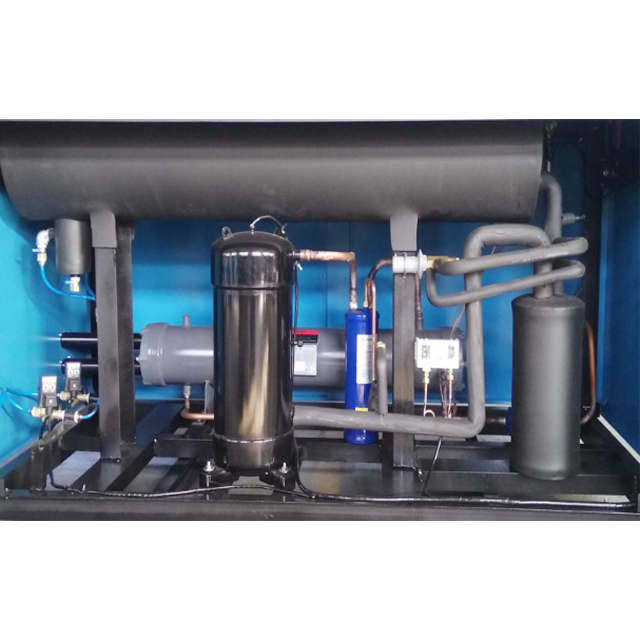
Your specified air dryer dew point dictates your equipment choices. You must select the right drying technology from the start. It must match your required ISO class reliably over years of continuous operation.
A standard refrigerated air dryer represents the absolute workhorse of modern manufacturing. These units reliably hit a +38°F (+3°C) PDP day after day. They use a standard internal refrigeration circuit. They chill the incoming hot air, forcing water vapor to drop out as liquid. A mechanical moisture separator then removes this liquid safely. They fit perfectly into general manufacturing environments. They work best where ambient pipe temperatures never drop below freezing.
Verdict: They offer the absolute lowest capital and operational costs. Make them your default choice. Only upgrade your technology if specific process requirements demand exceptionally drier air.
Some applications cannot tolerate any moisture at all. Desiccant systems provide highly capable solutions. They easily achieve a -40°F to -100°F PDP. They use beds of activated alumina or silica gel beads. These specialized beads adsorb water vapor directly from the airstream. They act as the best fit for uninsulated outdoor piping in freezing climates. They also protect precision pneumatics and direct-contact food packaging applications.
Evaluation Note: Always evaluate the severe associated energy penalty. Factor in the extremely high cost of purge air used in heatless models. Compare this daily energy waste against the higher initial capital cost of heated or blower-purge models.
You must evaluate your plant layout very carefully. Should you dry the entire plant to -40°F? Usually, the answer is no. We highly recommend using a centralized refrigerated system first. It handles the general plant air cheaply and effectively. You can then install specific point-of-use membrane or desiccant dryers. Place these smaller units strictly on the specific critical lines needing Class 2 air. This strategic split saves enormous amounts of electricity annually.
Even perfect specifications fail during poor physical implementation. We frequently see systems miss their specific targets completely. This happens due to overlooked environmental factors and poor daily maintenance.
Many engineers fail to account for hidden cold spots. Uninsulated outdoor piping poses a massive operational hazard. A cold warehouse ceiling during winter causes unexpected internal condensation. A simple rule of thumb works best here. Specify a PDP at least 20°F (11°C) below the absolute lowest ambient temperature your piping will ever experience. This critical safety margin prevents unpredictable weather drops from ruining your products.
You face major operational risks if you rely on uncalibrated hygrometers. Sensor drift happens naturally over time due to trace contaminants. Routine calibration of your dew point transmitters remains absolutely critical. It guarantees strict standard compliance and helps actively manage your energy usage. Without highly accurate sensors, your dryer might fail silently. You will only discover the expensive failure when water pours directly out of your pneumatic tools.
Sudden flow spikes easily destroy delicate moisture control. Exceeding the rated CFM of your air dryer causes rapid moisture breakthrough. The air moves too quickly across the internal heat exchanger. It might rush too fast through the active desiccant bed. This causes a sudden, highly dangerous spike in your system's moisture levels. You must size your dryer precisely for peak flow, not average flow.
We developed a straightforward, logical path for your facility assessment. Follow these exact steps to finalize your precise facility limits.
Avoid rushing this critical evaluation process. A rigorous initial assessment directly prevents massive future production shutdowns.
Standardizing on the right target remains vital for your facility. It perfectly balances operational safety against daily energy efficiency. Always avoid lazy "one-size-fits-all" generalizations. They inevitably lead to wasted money or severely broken tools.
Do not leave your plant vulnerable to hidden moisture damage. We strongly recommend scheduling a comprehensive compressed air system audit today. Consult directly with a qualified application engineer. They will evaluate your current moisture levels thoroughly. They will ensure your equipment sizing perfectly matches your daily production reality.
A: PDP accounts for the concentration of moisture under pressure. When air expands to atmospheric pressure, its dew point drops significantly. Standardizing on PDP is required for accurate system sizing, as it reflects the exact state of air inside your working pipes.
A: No. Because they use a refrigerant circuit to chill the air, they cannot drop below freezing (32°F / 0°C). If they did, the internal heat exchanger would freeze solid. They max out around +38°F (+3°C).
A: Continuous monitoring via an in-line transmitter is the modern standard for critical applications. It allows for immediate bypass or shutdown if the dryer fails. For baseline health, comprehensive system audits should be conducted annually.


