
- Home
- Products
- Hot
- About Us
- Services
- Industry
- Contact
Views: 0 Author: Site Editor Publish Time: 2026-08-26 Origin: Site


An oil-free scroll compressor operates exceptionally quietly by design. Engineers build these machines to deliver clean air without the deafening roar of traditional piston units. Therefore, sudden noise indicates immediate mechanical friction or system imbalance. You cannot afford to ignore these acoustic warnings.
We must frame abnormal noise not just as a nuisance. It serves as a leading indicator of impending air-end failure. Ignoring it risks unplanned downtime. Furthermore, it severely compromises air purity in critical applications like medical facilities, laboratories, and food and beverage processing. When internal components grind, they shed particles directly into your air stream.
This guide serves as a definitive resource for maintenance professionals. We will help you identify the root cause of the noise. You will learn how to assess the operational risk accurately. Finally, we provide a framework to help you make an evidence-based decision on whether to repair or replace the failing unit.
Acoustic signatures provide the fastest diagnostic tool for maintenance teams. You can categorize specific sounds to narrow down the mechanical fault quickly. When diagnosing scroll compressor abnormal noise, listen closely to the machine during different operational phases.
A deep grinding or howling sound points directly to classic bearing noise. Oil-free bearings operate in harsh environments. Manufacturers permanently grease and seal them at the factory. They cannot receive fresh lubrication during routine maintenance. Thermal breakdown degrades this grease over time. Once the grease fails, the bearings reach the end of their lifecycle. This results in destructive metal-on-metal contact.
Common Mistake: Technicians often assume they can regrease these bearings. You cannot. Attempting to force grease into a sealed scroll bearing destroys the seal and guarantees failure.
Rattling indicates internal component looseness. In scroll units, this specific sound usually means worn tip seals or a damaged anti-rotation mechanism. The orbiting scroll relies on the anti-rotation device to maintain its precise eccentric path. When this mechanism wears down, the scrolls clash against each other. You hear this as a distinct, rapid clattering sound.
Electrical issues often mask themselves as mechanical problems. A loud hum or buzz right at startup suggests electrical faults. The motor struggles to turn the pump. Phase imbalance, voltage drops, or a failing contactor prevent smooth engagement. The magnetic fields in the motor fight each other. This creates a low-frequency buzzing. Always check your voltage across all three phases before tearing down the pump.
High-pitched squealing rarely originates from the compressor pump itself. Instead, look at external driving components. Slipping drive belts cause intense squealing in belt-driven models. Failing cooling fans also produce this sound. The belt slips over the pulley when tension drops, glazing the rubber and amplifying the squeal.
Best Practice: Use a laser alignment tool and a sonic tension meter when replacing belts. Proper tension eliminates squealing and protects the airend bearings from side-load stress.
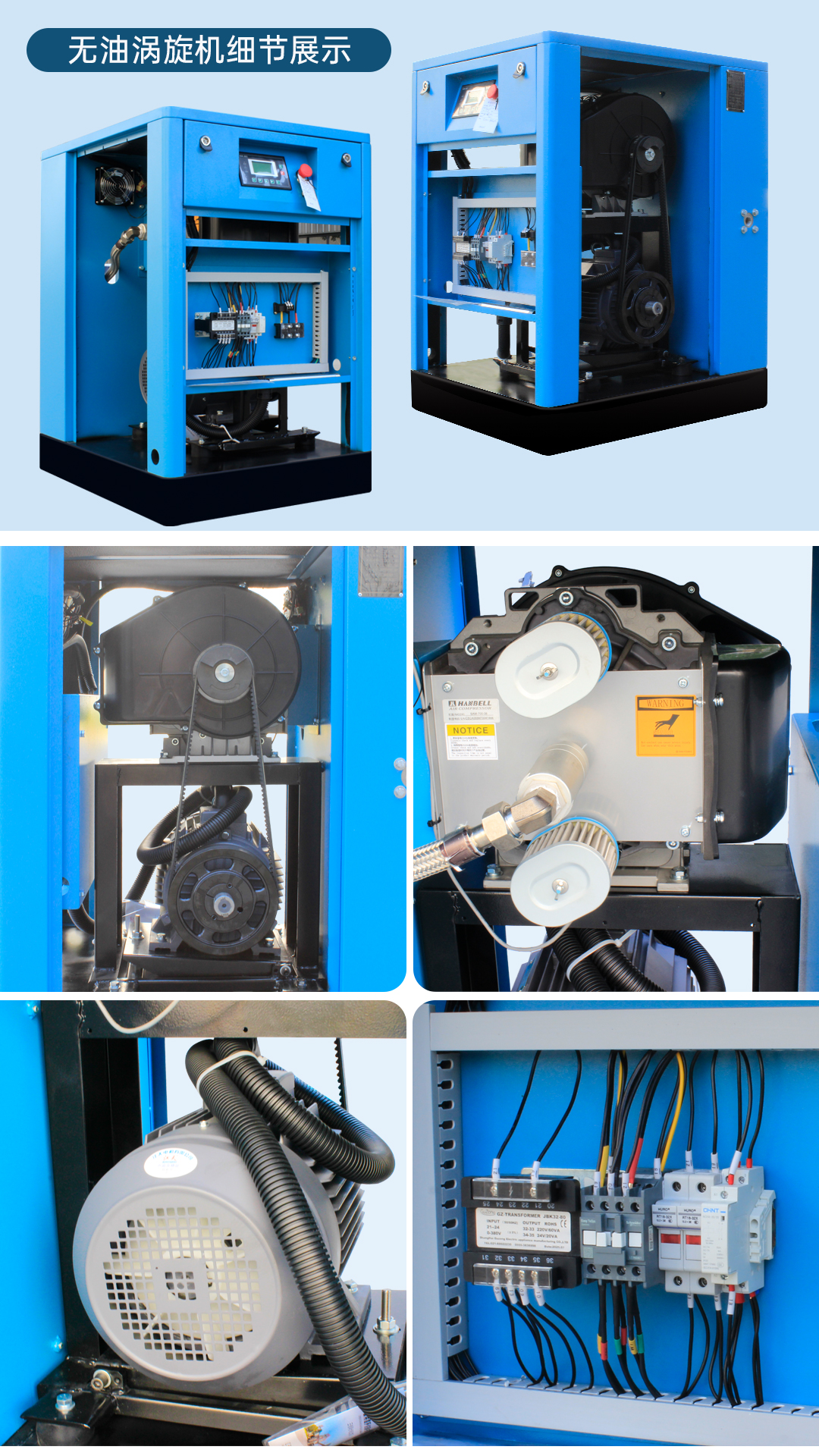
Scroll compressors rely on unique anatomy. They use two spiral-shaped elements—one fixed and one orbiting. They compress air by trapping it in decreasing crescent-shaped pockets. This design requires incredibly tight tolerances. Mechanical failures here drastically impact performance.
Engineers fit PTFE or Teflon tip seals to the edges of the scroll elements. These seals close the micro-gaps between the fixed and orbiting scrolls. They wear down naturally over 5,000 to 10,000 hours of operation. Excessive wear allows compressed air to bypass back into the intake zone. The compressor then over-speeds to meet the facility's air demand. This generates excess heat and subsequent abnormal noise. Ignoring routine seal replacement guarantees a catastrophic failure.
Failed inlet filtration introduces catastrophic risks. When the compressor ingests airborne particulates, these contaminants enter the compression chamber. Dust and debris act like sandpaper. They scar the orbiting and fixed scrolls. Severe scroll element wear fundamentally alters the spiral geometry. Once the scroll profiles suffer deep gouges, the pump loses its ability to build pressure efficiently.
Oil-free scroll units have strict duty cycle limits. Operating above the rated duty cycle causes extreme internal temperatures. The metal scroll elements undergo thermal expansion. They grow larger than their design specifications allow. This expansion bridges the necessary micro-gaps between the scrolls. The expanding metal causes physical clashing. The fixed and orbiting scrolls grind against each other, creating intense noise and shedding metal shavings directly into the air stream.
Environmental factors frequently simulate or cause internal damage. You must evaluate the installation environment. External forces routinely compromise even the best-engineered machines.
Compressors generate natural operating frequencies. Rubber isolation mounts absorb these vibrations. Over time, these mounts degrade, harden, and crack. Degraded isolation mounts transmit normal operating frequencies directly into the metal chassis. The chassis acts like a speaker box, amplifying the sound. This creates destructive compressor vibration. Unchecked vibration loosens internal fasteners and fractures copper piping.
Three-phase scroll compressors must rotate in one specific direction. Facility power upgrades or main breaker replacements often flip the electrical phases. Running a scroll compressor backward—even briefly—causes severe damage. The unit will not build pressure. Instead, it creates an immediate, violent rattling sound. Reverse rotation permanently damages the scroll sets and the anti-rotation mechanism within seconds.
What to watch out for: Always install a phase monitor relay on three-phase units. This inexpensive device prevents the motor from starting if it detects incorrect phase sequence.
Air-cooled scroll compressors demand massive amounts of ambient air. Installing a unit in a small, unventilated closet initiates a deadly causal loop. Blocked cooling air leads directly to high internal temperatures. These elevated temperatures cause the grease in the sealed bearings to liquefy and leak out. Dry bearings then fail prematurely, generating intense howling noises.
Maintenance and procurement heads need a clear decision-stage framework. When a machine screams, panic often leads to poor purchasing decisions. Follow a systematic approach for effective oil-free compressor troubleshooting.
You must perform a safe, step-by-step diagnostic checklist. Follow these numbered steps to isolate the fault accurately:
Not all noises require a complete system overhaul. Use the matrix below to guide your budget allocations.
Table 1: Troubleshooting and Action Matrix
| Component Fault | Diagnostic Symptom | Recommended Action | Viability |
|---|---|---|---|
| Drive Belts | High-pitched squealing on startup | Repair / Replace Belts | High success rate, low cost |
| Cooling Fans | Squealing or rattling near the exhaust | Repair / Replace Fan Assembly | High success rate, low cost |
| Isolation Mounts | Chassis rattling, excessive vibration | Replace Rubber Mounts | High success rate, low cost |
| Scroll Element / Tip Seals | Internal clattering, loss of pressure | Replace Airend Pump | Factory replacement required |
| Internal Bearings | Deep grinding or howling | Replace Airend Pump | Factory replacement required |
Clarify the industry reality regarding the airend. Rebuilding oil-free scroll airends in the field is rarely viable. These units require specialized factory tooling to achieve micron-level alignment. Field overhauls usually fail within a few hundred hours. Always opt for a factory-certified replacement pump.
You must evaluate the secondary risks of abnormal noise. Continuing to run a noisy oil-free unit endangers your entire facility. A failing scroll compressor sheds Teflon tip seal material and metallic particulates downstream. This debris bypasses standard particle filters. It directly violates ISO 8573-1 Class 0 clean-air compliance. In medical or food environments, this contamination forces massive product recalls and puts patients at risk.
Sometimes a compressor sits beyond economic repair. When troubleshooting confirms catastrophic airend failure, you must transition to purchasing a replacement. Do not blindly order the exact same model. Evaluate why the current unit failed.
Evaluate if the current failure was caused by undersizing. Scroll compressors running constantly at 100% duty cycle suffer premature heat-related deaths. Ensure your replacement matches your facility's peak demand without exceeding the manufacturer's duty cycle limits. Some brands specify a maximum 75% duty cycle. Size the new system up if your air demand has grown since the original installation.
Modern compressor designs offer vastly superior noise mitigation. Highlight features like sound-dampening canopies and upgraded anti-vibration mounts. Point-of-use applications demand whisper-quiet operation. Look for units boasting advanced acoustic foam lining. The enclosure should direct cooling air through baffled pathways to trap sound waves inside the cabinet.
Vet vendors based on their airend replacement warranties. A robust warranty indicates manufacturer confidence in their machining tolerances. Ensure the vendor offers local service availability. Review transparent assumptions about preventative maintenance schedules. The new unit will need regular tip seal replacements to avoid the very noise problems you just diagnosed. Ask the vendor for a clear schedule of required maintenance interventions over a ten-year span.
Abnormal noise in an oil-free scroll compressor represents a definitive warning sign of mechanical friction. It is most commonly linked to failed bearings or degraded tip seals. Ignoring these acoustic warnings leads to catastrophic pump failure and downstream contamination. You must isolate the source quickly using standard diagnostic steps. Recognize that internal pump failures require factory replacement rather than field repairs.
Take actionable steps immediately. Execute a lockout/tagout of the noisy unit today. Do not wait for it to seize completely. Schedule a thorough inspection by a certified technician. If you have already isolated the noise to the internal scrolls, contact your local distributor for a new airend replacement quote to secure your facility's air supply.
A: A loud humming or buzzing at startup usually points to electrical phase issues, like a dropped phase or voltage imbalance. If you hear a loud bang or hard rattling, it could indicate liquid slugging or a failing check valve causing extreme back-pressure against the scroll elements.
A: Rarely. Field repairs on oil-free scroll pumps are highly discouraged. The scroll elements require micron-level alignment and specialized factory tooling. Rebuilding them on a workbench usually results in rapid failure. We strongly recommend factory-certified replacement pumps for guaranteed reliability.
A: Industry benchmarks for oil-free scroll units typically range between 50 and 65 dB(A), depending on the acoustic enclosure. This is comparable to a normal conversation. Any sound exceeding this baseline, especially grinding or clattering, should be considered abnormal and investigated immediately.
A: Standard OEM maintenance intervals suggest replacing tip seals every 8,000 to 10,000 operating hours. You must stress proactive replacement before noise occurs. Waiting until you hear air bypassing or metal clattering means the wear has already damaged the underlying scroll profiles.


