
- Home
- Products
- Hot
- About Us
- Services
- Industry
- Contact
Views: 0 Author: Site Editor Publish Time: 2026-07-30 Origin: Site


Industrial compressor selection carries extremely high stakes for modern manufacturing facilities. Many plant managers still rely on simple nameplate horsepower or guess their CFM requirements. This outdated guesswork usually backfires. It leads to inflated capital expenditure and disastrous operational inefficiencies. A variable speed screw air compressor serves as the definitive industry standard for handling fluctuating production shifts. Yet, sizing these advanced machines improperly creates major daily headaches. Oversizing the equipment completely negates the promised energy savings. Conversely, undersizing it causes severe system pressure drops during crucial peak operations. Facility engineers need a highly reliable method to align equipment capabilities with true operational usage. This comprehensive guide delivers a verifiable, engineering-backed framework. We will help you perfectly match your pneumatic system to actual facility demand. By following these steps, you will bypass common sales fluff. You will learn to size your equipment correctly and optimize your entire factory floor.
You cannot effectively manage what you do not accurately measure. Facility managers must conduct a rigorous compressed air audit before buying any new machinery. We strongly recommend running this audit for 7 to 14 days. This duration captures weekend shutdowns and weekday production peaks. Professionals utilize inline thermal mass flow meters and electrical kW loggers. These instruments map your real-world usage patterns over time. Guessing air consumption based solely on machine specifications inevitably leads to poor capital decisions. Real, timestamped data reveals your true variable air demand profile. This baseline prevents catastrophic sizing errors.
Next, you must identify peak demand versus average demand. Absolute maximum CFM dictates the absolute top end of your sizing strategy. However, your statistical average CFM matters significantly more. Your newly purchased compressor will spend roughly 80% of its operational life operating at this average level. You must optimize the system around this daily reality.
Finally, facilities must clearly distinguish between base load and trim load. A variable speed unit should exclusively act as your trim compressor. It perfectly absorbs the wildly fluctuating load throughout the day. Meanwhile, your traditional fixed-speed units efficiently handle the continuous, steady base load. This hybrid approach represents the golden standard for industrial plant design.
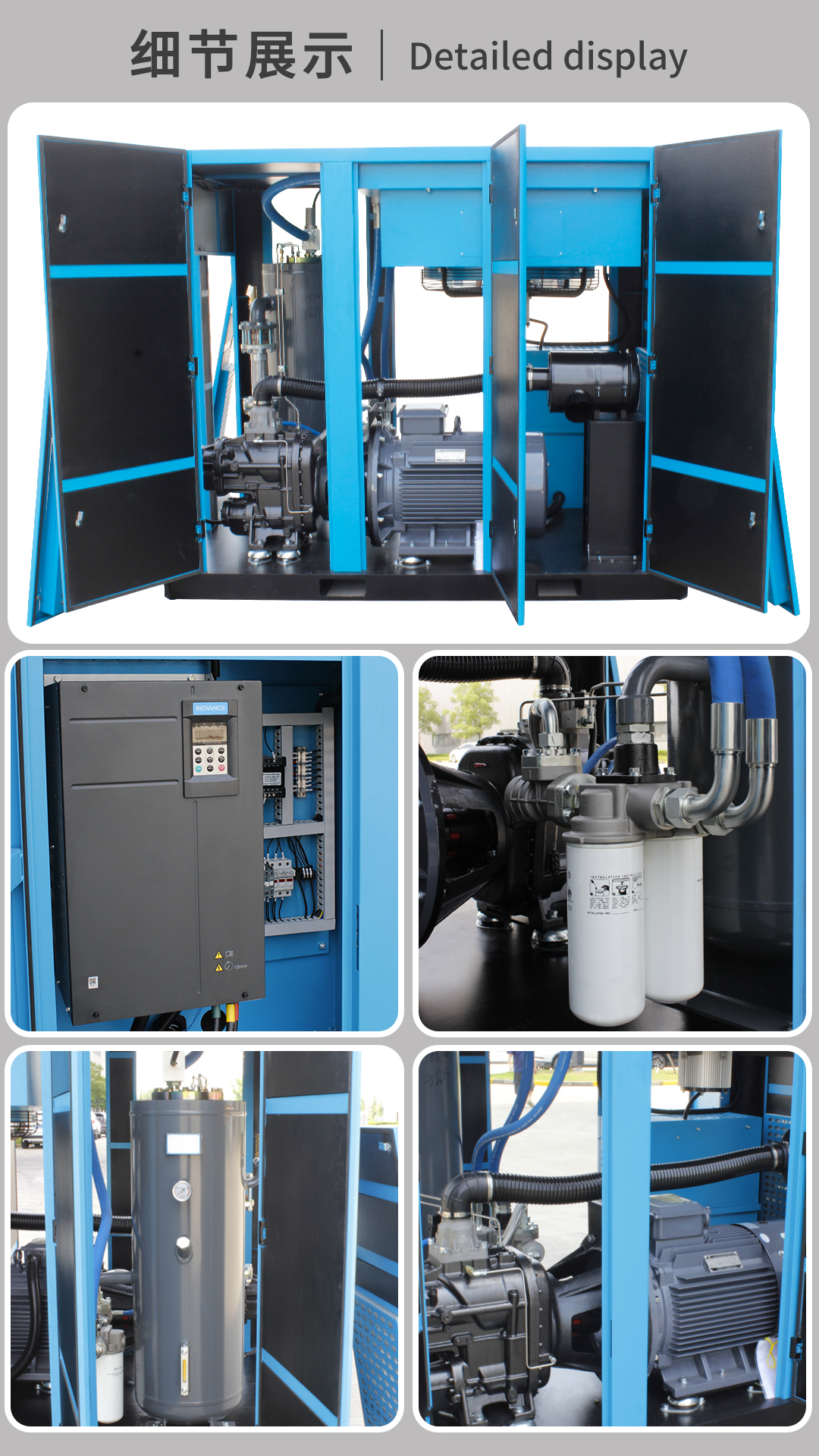
Proper VSD compressor sizing demands a highly structured methodology. You must evaluate multiple technical variables systematically. We recommend following this verified four-step engineering framework to ensure optimal long-term performance.
Choosing the specific drive technology greatly impacts your long-term reliability. Facility managers typically must choose between standard induction drives and modern permanent magnet models. Both offer variable speed capabilities, but they operate differently.
Standard induction VSDs work beautifully for predictable variable demand. They perform well when your system turndown rarely dips below 40% capacity. These units generally feature a lower initial capital expenditure. However, standard induction motors lose significant electrical efficiency at lower running speeds. This happens because they must consume electricity just to induce a magnetic field inside the stator.
Conversely, a PM screw compressor excels under highly erratic operational conditions. Multi-shift operations benefit immensely from this specific design. Permanent magnet motors utilize rare earth magnets built directly into the rotor. This eliminates the need to induce a magnetic field. Consequently, they maintain approximately 95% efficiency even at deeply reduced RPMs. They also offer a much wider functional turndown ratio.
We constructed a decision matrix to simplify your technology choice. Review these factors before finalizing your capital expenditure.
| Operational Factor | Standard Induction VSD | Permanent Magnet (PM) VSD |
|---|---|---|
| Demand Fluctuation Severity | Moderate and highly predictable | Highly erratic and multi-shift |
| Safe Turndown Limit | 40% to 50% capacity | 20% to 30% capacity |
| Low-RPM Efficiency | Drops noticeably below 50% RPM | Maintains ~95% efficiency throughout |
| Initial Capital Cost | Noticeably Lower | Noticeably Higher |
You should upgrade to PM technology when your local electricity costs run exceptionally high. It also makes sense if your facility experiences severe, unpredictable flow fluctuations throughout the working week.
Many industrial facilities make catastrophic errors during equipment selection. These mistakes lead to expensive production downtime and shattered machinery. You must thoroughly understand these field realities to protect your investment.
Running an oversized variable speed drive too slowly creates a dangerous mechanical reality. Operating below the manufacturer's minimum turndown ratio physically starves the airend of crucial lubricating oil. Twin rotary screws require constant oil injection for both sealing and cooling. This lack of fluid flow leads to rapid localized overheating. Eventually, it causes premature and catastrophic bearing failure. Excessive condensation also builds up inside the oil reservoir when the machine runs too cold.
Heavy industrial motors require adequate airflow to survive continuous daily operation. VSD motors running at prolonged low frequencies struggle to self-cool. This happens frequently if the motor relies entirely on a traditional shaft-mounted fan. At low speeds, the fan simply cannot move enough ambient cooling air across the cooling fins. Modern, purpose-built systems bypass this critical issue by utilizing independent, fixed-speed electric cooling fans.
Facility engineers frequently debate this specific topic on online industry forums. Many incorrectly assume they can simply bolt a VFD onto an existing fixed-speed compressor. Retrofitting an aftermarket drive onto an older unit rarely yields actual VSD performance. Furthermore, doing so almost always voids the original manufacturer warranty. Older standard induction motors suffer from intense harmonic distortion. They experience rapid thermal breakdown when paired with aftermarket pulse-width modulation drives. You need purpose-built hardware for safe, reliable variable speed operation.
Smart industrial compressor selection requires looking far beyond the initial sticker price. By evaluating operational efficiency and specific vendor guarantees, facilities ensure reliable long-term performance. Do not accept generic sales brochures when asking for equipment bids. You must demand verifiable engineering data.
Matching the exact right size to the right operational demand yields impressive financial returns. Most properly scoped facilities observe an average return on investment spanning 12 to 24 months. You achieve this rapid payback through significantly reduced off-load running times. Traditional machines waste massive amounts of electricity spinning uselessly when unloaded. Additionally, properly sized variable drives drastically lower your peak electrical demand charges from local utility providers.
You must ask manufacturers and regional distributors highly specific engineering questions. Ensure they possess the technical competence to support your factory long-term. Use this short checklist when evaluating prospective vendors:
Successful equipment sizing remains an exercise in rigorous data analysis. It involves much more than simply matching a maximum CFM number on a generic spec sheet. You must fully understand your facility's operational rhythms to make an informed, safe choice. A well-sized system ensures stable line pressure, reduces scrap rates, and keeps maintenance teams happy.
As your critical next step, we strongly advise commissioning an ISO-compliant compressed air audit. Complete this comprehensive assessment before ever requesting formal vendor quotes. The resulting baseline data empowers you to specify exactly what your production lines require. Moving forward, encourage your purchasing team to shortlist vendors who provide guaranteed, part-load performance curves. Prioritize transparent engineering data rather than generic peak horsepower specifications. Taking these deliberate steps guarantees maximum efficiency and equipment longevity for your modern facility.
A: Yes. An oversized VSD will constantly run at its absolute minimum RPM. This extreme low-speed operation severely reduces electrical efficiency. It also causes dangerous moisture buildup in the oil system and leads to overheating due to poor lubrication flow across the airend.
A: Most standard VSDs operate safely and efficiently between 40% and 100% capacity. Modern PM screw compressors can often safely turn down to 20% or 30%. However, your core sizing strategy should always aim to keep routine, daily operation securely between 50% and 80% capacity.
A: No. Replacing every machine with variable drives wastes capital. The most efficient industrial setup usually utilizes a reliable fixed-speed compressor for continuous base-load demand. You then pair it with a properly sized VSD compressor designed specifically to handle the fluctuating variable trim load.


