
- Home
- Products
- Hot
- About Us
- Services
- Industry
- Contact
Views: 0 Author: Site Editor Publish Time: 2026-08-16 Origin: Site


Wastewater treatment and industrial aeration often account for 50% to 70% of a plant's total energy consumption. Getting the sizing right carries incredibly high stakes for facility operators. This massive energy draw demands extreme precision during the initial design phase.
Undersizing your equipment severely compromises biological processes and critical oxidation. Your system will fail to break down waste effectively. Conversely, oversizing wastes massive amounts of energy daily. It also reduces equipment lifespan through frequent cycling and highly inefficient turndown. You end up paying for capacity you never use.
This guide provides an objective, engineering-focused framework. You will learn how to specify equipment properly based on scientific principles. We balance biological demand, environmental realities, and long-term energy compliance. Following these steps ensures you optimize your entire aeration system for peak performance.
Airflow demand directly stems from the Standard Oxygen Transfer Rate (SOTR). Biological mass and chemical processes dictate this exact oxygen need. Engineers calculate the precise oxygen weight required. Bacteria absolutely need this oxygen to break down organic waste. This baseline metric drives all subsequent equipment decisions.
Baseline aeration needs remain relatively continuous. However, variable load conditions happen constantly. Think about diurnal shifts in municipal wastewater flow. Morning peaks demand maximum oxygen. Midnight lulls require far less. Industrial plants experience similar batch-processing peaks. Your equipment must adapt to these changing conditions. Fixed-speed units completely fail to provide this necessary flexibility.
Introducing oil into an aeration basin causes catastrophic failure. Oil coats the delicate biological mass. It physically suffocates the essential bacteria. It also fouls diffuser micropores permanently. Selecting an oil-free screw blower eliminates this contamination risk entirely. It protects your expensive diffusers. It maintains high oxygen transfer efficiency over the long term. Clean air ensures your biological process remains fully stable.
Process engineers always start with base oxygen requirements. They use standard conditions to calculate these needs. Standard conditions are 68°F, 14.7 psia, and 0% relative humidity. This establishes Standard Cubic Feet per Minute (SCFM). SCFM provides a universal mathematical baseline. It allows engineers to compare different system designs easily.
However, blowers do not breathe standard air. They move actual air at the intake. You must convert SCFM to Actual CFM (ACFM). ACFM defines the physical volume of air entering the machine. Accurate industrial airflow sizing depends entirely on this exact conversion. If you specify equipment using only SCFM, you will drastically undersize the unit.
Altitude changes system requirements drastically. Thinner air at higher elevations lacks oxygen density. A blower in Denver needs higher ACFM than one in Miami. It must move more volume to deliver the same mass of oxygen. Temperature and humidity also play major roles. High summer temperatures expand air volume. Moisture displaces oxygen molecules in the air stream. This severely reduces oxygen density per cubic foot.
Always specify your oil-free screw blower airflow based on worst-case summer conditions. Summer air is hot, humid, and inherently less dense. The blower must spin faster to meet identical oxygen demands. However, ensure the unit's turndown capacity handles denser winter air efficiently. Winter air requires far less volume for the exact same oxygen mass.
Table: Comparison of Standard and Actual Airflow Variables
| Variable | Standard Condition (SCFM) | Actual Condition Impact (ACFM) | Sizing Consideration |
|---|---|---|---|
| Temperature | 68°F (20°C) | Higher temps expand air volume. | Size for peak summer heat to prevent oxygen starvation. |
| Pressure | 14.7 psia (Sea Level) | Higher altitude lowers absolute pressure. | Increase ACFM capacity significantly for high-elevation sites. |
| Humidity | 0% Relative Humidity | Moisture displaces oxygen molecules. | Account for high summer humidity reducing oxygen density. |
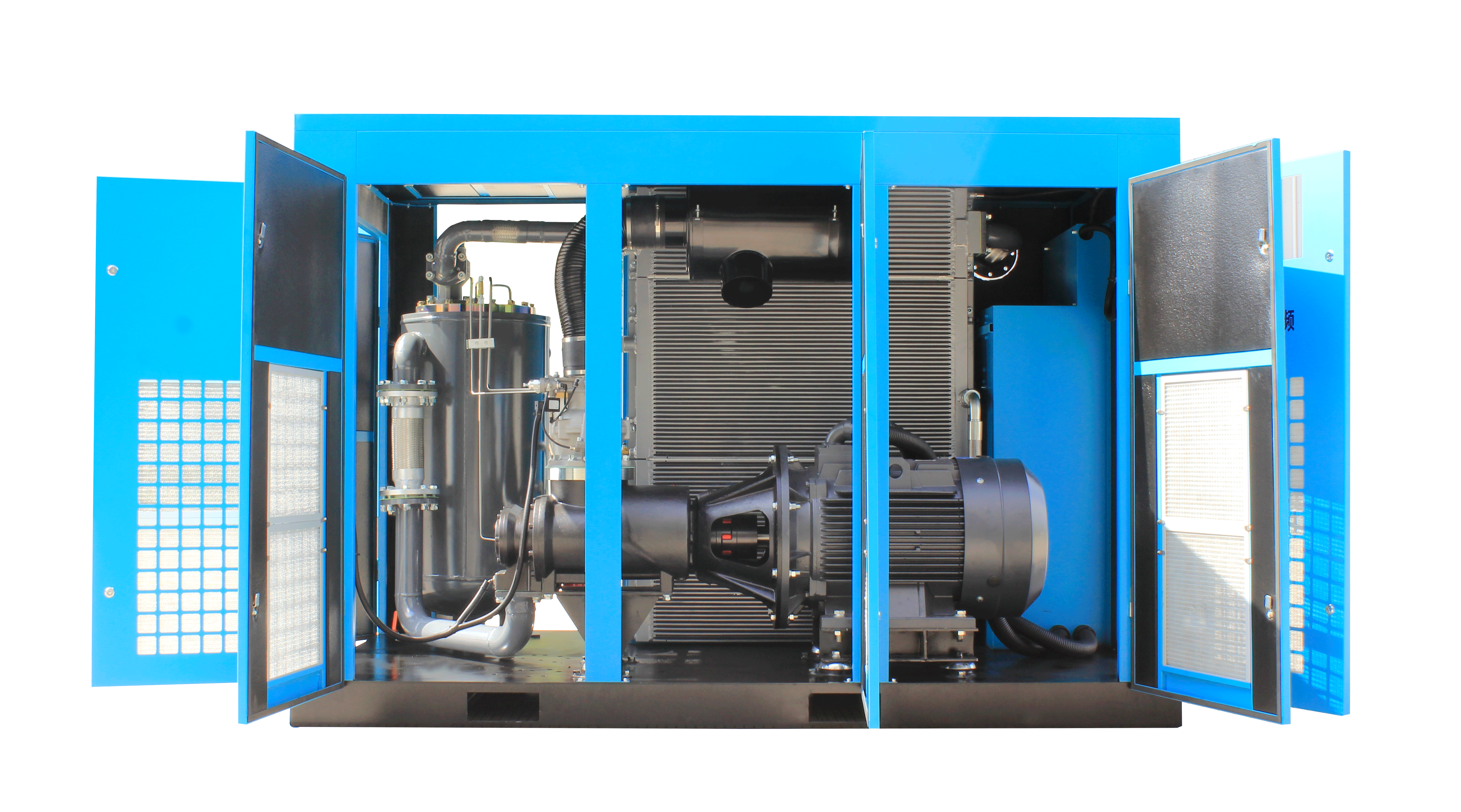
Hydrostatic head acts as your absolute baseline pressure. It is the pressure required to push air down to the diffusers. Calculate approximately 0.433 psi per foot of water depth. A tank holding 15 feet of water requires about 6.5 psi just to overcome water weight. This represents your static pressure.
Friction losses add dynamic pressure to the system. Air traveling through pipes creates friction. Elbows, long pipe runs, and check valves create significant resistance. Undersized piping artificially inflates your pressure requirements. You must size piping generously to minimize these severe friction losses.
Fine-bubble diffusers demand more pressure than coarse-bubble types. They force air through tiny micropores. Dynamic resistance also increases as diffusers age and foul. Mineral deposits and biological growth restrict the airflow over months of use. You must account for this gradual pressure increase over time.
Sum the hydrostatic head, piping friction, and diffuser loss. This vital calculation yields your precise blower discharge pressure. Never add arbitrary safety margins here. Fake margins shift the blower's operating point right off its optimal efficiency curve. The machine will fight artificial resistance constantly.
Follow these steps to calculate total system pressure accurately:
Most systems rarely operate at 100% design capacity. Typical operations hover between 50% and 80%. Plants experience massive swings in daily load. Buying equipment designed only for peak load wastes immense energy. You need machinery capable of adjusting flow dynamically.
An aeration blower equipped with a Variable Speed Drive adapts seamlessly. The VSD scales motor speed to match fluctuating ACFM demands. It slows down during midnight lulls. It speeds up during morning peaks. This dynamic adjustment directly reduces your daily electrical consumption.
Understand your turndown ratios carefully. Screw blowers often feature a 25-100% or 30-100% turndown range. The plant's minimum airflow requirement must not fall below the blower's minimum speed. If it does, the blower cannot slow down enough. You face inefficient venting or blow-off. This wastes expensive compressed air unnecessarily.
Split the load whenever possible. Use two smaller blowers instead of one massive unit. This sequencing handles wide variations in biological oxygen demand highly efficiently. It provides necessary redundancy for maintenance periods.
Move past marketing claims and colorful brochures. Evaluate performance using strict, standardized data. Always request CAGI (Compressed Air and Gas Institute) data sheets. These sheets provide verified, third-party performance metrics. They allow you to compare different manufacturers objectively.
Look closely at specific power metrics. Evaluate kW per 100 CFM at your specific operating pressures. Do not just look at total motor horsepower. Motor horsepower reveals very little about actual efficiency. A larger motor might actually consume less power if the air end runs highly efficiently. Specific power tells the real story.
Real evaluation requires looking at wire-to-air efficiency. Combine energy losses from the VSD, the motor, and the bare blower block. Wire-to-air efficiency evaluates the whole package. It measures the actual electricity pulled from your wall. It compares it to the actual air delivered to your tank. Never rely solely on the theoretical efficiency of the air end.
Legacy engineering practices often stack arbitrary safety margins. The biological process engineer adds 10% for uncertainty. The mechanical engineer adds another 10% for unexpected piping variations. Procurement then rounds up to the next standard motor horsepower. The result? A massive machine running continuously at the bottom of its VSD range. It wastes power endlessly. It risks aerodynamic stall. Stop the oversizing trap by trusting your exact calculations.
Ignoring dirty intake filters causes long-term headaches. Blocked filters drop your inlet pressure. The blower must work significantly harder to hit the target discharge pressure. Sizing calculations must account for realistic maintenance intervals. Assume the filter will run in a partially dirty state most of the time.
Verify site layout constraints early in the project. Check your physical footprint limitations. Ensure you have adequate space for noise attenuation enclosures. Blowers generate intense noise levels. Enclosures mitigate this noise but require physical space. Confirm ventilation requirements in the blower room before finalizing your size selection. Blowers generate intense heat during compression. Poor room ventilation heats the ambient intake air. Hot intake air expands. This reduces oxygen density. It forces the blower to spin faster, ruining your efficiency goals.
Accurate sizing requires following a strict mathematical framework. Move sequentially from biological oxygen demand to SCFM. Convert that number to ACFM based on precise site conditions. Finally, calculate exact system pressure without padding the numbers arbitrarily.
An appropriately sized unit delivers truly superior energy efficiency. However, this only happens if its operating curve perfectly matches your actual plant profile. Proper sizing eliminates wasted energy and prevents premature mechanical failure.
Take decisive action now. Conduct a professional air audit before buying new equipment. Consult a qualified application engineer. Log your existing system data carefully before issuing any purchase specification. This diligence guarantees long-term success.
A: The blower will operate at the lowest end of its turndown range. This drastically reduces VSD efficiency. It increases mechanical wear. You also risk inducing surge-like conditions. The system may require continuous air blow-off. Ultimately, an oversized unit wastes massive amounts of energy. It completely defeats the purpose of buying high-efficiency equipment.
A: Every 2.31 feet of water depth adds approximately 1 PSI of required hydrostatic pressure. This measurement establishes the absolute baseline pressure. The blower must overcome this static weight before accounting for pipe friction. If you have a 15-foot basin, you need at least 6.5 PSI of starting pressure.
A: Oil-free screw blowers utilize internal compression. They squeeze air internally before discharge. This makes them up to 30% more energy-efficient than traditional lobe blowers at standard aeration depths. Lobe blowers rely purely on external compression. Screw technology results in significantly lower energy consumption despite higher initial capital outlays.
A: You calculate ACFM using a gas law formula. It adjusts SCFM for local absolute temperature, local atmospheric pressure, and relative humidity. You must use site-specific summer conditions for an accurate conversion. Summer air is hot and humid. It requires a higher ACFM to deliver the required biological oxygen mass.


