
- Home
- Products
- Hot
- About Us
- Services
- Industry
- Contact
Views: 0 Author: Site Editor Publish Time: 2026-09-23 Origin: Site


Investing in a 75 kW (approximately 100 HP) compressor represents a major industrial utility decision. Plant managers often view this equipment as the beating heart of their production lines. However, relying purely on basic nameplate data causes massive energy waste. It can also lead to unexpected downtime and inefficient daily operations. You must evaluate how specific configurations impact plant efficiency directly. Understanding the nuances behind these numbers ensures the equipment meets actual facility demand. This technical guide walks you through interpreting essential performance metrics. We will show you how to verify manufacturer claims accurately. You will also learn to align equipment capabilities with realistic operational needs. By mastering these 75 kW screw air compressor specifications, you can build a highly resilient compressed air system. We designed this resource to help you make data-driven procurement choices.
Pressure and flow share a strict inverse relationship. When you increase the operating pressure, the volume of delivered air drops. Many facilities artificially increase system pressure to compensate for pipe leaks. This practice wastes enormous amounts of energy. Every 1 bar increase in pressure demands roughly 7% more electrical power. You should always choose the lowest viable pressure required. Identify the most critical tool on your production line. Set your system pressure based on that specific tool. Keeping pressure as low as possible reduces unnecessary stress on the machine. It also extends the lifespan of your internal components.
Free Air Delivery (FAD) represents the actual volume of compressed air delivered. Manufacturers measure FAD based on standard inlet conditions. You must differentiate between theoretical displacement and actual delivered air. Theoretical displacement only measures the physical volume inside the airend. Actual FAD accounts for internal losses and volumetric efficiency. For a 75 kW unit, flow ranges vary significantly.
Always base your sizing on actual FAD rather than theoretical capacity.
Modern industrial compressors rely on strict motor efficiency standards. Most reputable brands now utilize IE3 premium efficiency or IE4 super premium efficiency motors. The service factor (SF) of the motor matters heavily during continuous operation. A motor with a 1.15 to 1.25 service factor handles temporary overloads better. Do not assume a 75 kW motor only draws 75 kW of power. Under full load, a 75 kW machine might draw closer to 85 or 90 kW. The transmission type dictates much of this power draw. Direct drive systems offer the highest efficiency by eliminating transmission slip. Gear drives provide robust performance but introduce slight mechanical losses. Belt drives require more maintenance and experience higher friction losses over time.
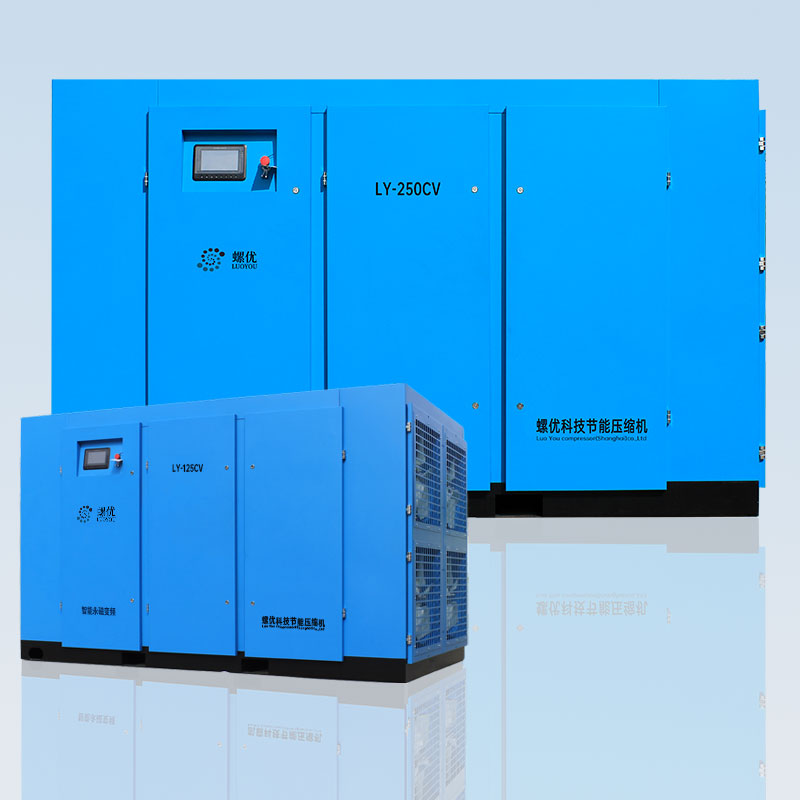
Selecting the right drive technology impacts long-term operational success. A 75kW PM VSD screw air compressor often emerges as the best choice for variable workloads. Permanent Magnet (PM) motors eliminate rotor slip completely. This design delivers higher efficiency across partial load profiles. VSD technology adjusts the motor speed to match exact air demand. You should specify this technology if your facility experiences demand fluctuations exceeding 20% to 30% across shifts. VSD machines also eliminate massive start-up current spikes. Soft starting capabilities protect your electrical grid from sudden power surges. This feature significantly reduces wear and tear on electrical contactors and internal bearings.
Avoid the assumption that VSD always serves as the better option. Fixed-speed machines remain highly relevant in specific industrial applications. They offer a much lower initial capital expenditure (CAPEX). Fixed-speed units also feature simpler internal electronics and easier maintenance profiles. They shine brightest when acting as a dedicated base-load machine. If your facility runs 24/7 at nearly 100% capacity, a fixed-speed compressor delivers exceptional efficiency. Running a VSD machine constantly at maximum speed provides no energy benefit. In continuous high-demand scenarios, fixed-speed equipment delivers unmatched reliability and lower upfront risks.
Chart Representation: Technology Application Fit
| Operating Scenario | Fixed-Speed 75 kW | 75 kW PM VSD |
|---|---|---|
| Continuous 100% Load (24/7) | Excellent Fit | Poor ROI |
| Highly Variable Shift Demands | Poor Fit (Wastes Energy) | Excellent Fit |
| Frequent Start/Stop Cycles | Causes Motor Wear | Ideal (Soft Start) |
| Harsh/Dusty Environments | Very Good (Simple Electronics) | Requires Extra VFD Protection |
Evaluating compressor performance requires universally accepted standards. Always demand data sheets compliant with ISO 1217 Annex C. This authoritative standard ensures a level playing field among different manufacturers. It dictates strict testing conditions for industrial air compressors. ISO 1217 allows a specific tolerance for volume flow (typically ±4%). It also sets a tolerance for specific power consumption (typically ±5%). Demanding this documentation prevents brands from exaggerating their equipment performance. Without ISO 1217 data, you might base your purchase on theoretical laboratory numbers. These theoretical numbers rarely hold up in real-world factory environments.
Specific Energy Requirement (SER) serves as the ultimate efficiency equalizer. It measures exactly how much electrical power produces a specific volume of air. You calculate SER by dividing power input by the actual delivered air. The standard unit is usually kW/(m³/min) or kW/100 CFM. Lower SER values indicate a more energy-efficient machine. When comparing two 75 kW units from different brands, SER reveals the true winner. A machine with a slightly higher upfront cost often features a noticeably lower SER. This efficiency metric gives you the clearest picture of everyday operational performance.
Nameplate specifications always assume standard atmospheric conditions. These conditions usually mean 20°C (68°F) at sea level. Your actual facility location heavily impacts physical performance. High ambient temperatures decrease air density significantly. High elevations have the exact same effect on intake air. When air density drops, the actual mass of air compressed decreases. A 75 kW machine running at 40°C (104°F) will deliver noticeably less FAD than the spec sheet claims. Operating at 1,500 meters (5,000 feet) above sea level requires careful de-rating calculations. Always ask the vendor to adjust their performance guarantees based on your specific site conditions. Failing to de-rate the equipment can leave your production line starved for air.
Installing a 75 kW compressor requires serious infrastructure planning. You must evaluate your electrical footprint thoroughly before delivery. A standard 75 kW machine demands specific heavy-duty breaker sizing. You will also need suitably rated cabling to handle continuous high-amperage loads. If you choose a fixed-speed unit with a Y-Delta starter, plan for inrush currents. These initial current spikes can occasionally exceed three times the normal running current. Your facility's transformers must handle these sudden loads without dropping voltage. Upgrading electrical panels adds significant costs to the installation phase. Identifying these prerequisites early prevents project delays and safety hazards.
Industrial air compressors act as massive localized space heaters. A 75 kW motor generates substantial thermal energy during operation. In fact, it produces roughly equivalent to 70 kW of heat rejection. Managing this heat load is a strict site requirement. You face a choice between air-cooled and water-cooled variants. Air-cooled units require robust ducting and high-volume ventilation fans. Without proper airflow, the compressor room will overheat rapidly. This overheating leads to immediate equipment shutdown. Water-cooled units solve the ambient heat problem but require dedicated cooling towers. They also rely on clean, treated water supplies or industrial chillers. Choose the cooling method that best matches your existing plant utilities.
Every compressor requires a rigid maintenance schedule to survive. You must plan for the lifecycle costs of routine consumables. These items include specialized synthetic oil, oil separators, and heavy-duty air filters. Operating in dusty environments accelerates the replacement frequency of these filters. Beyond basic consumables, you must consider the airend rebuild expectancy. A high-quality 75 kW airend typically lasts between 20,000 and 40,000 running hours. At this stage, bearing replacement and rotor rebalancing become necessary. Budgeting for this major overhaul prevents sudden operational budgets shocks. Reviewing the maintenance manual before purchasing reveals the true complexity of the machine.
Table 1: Estimated Consumable Replacement Intervals
| Component | Standard Environment | Harsh/Dusty Environment |
|---|---|---|
| Air Filter Element | 2,000 Hours | 1,000 Hours |
| Oil Filter | 2,000 Hours | 1,500 Hours |
| Air/Oil Separator | 4,000 Hours | 3,000 Hours |
| Synthetic Lubricant | 4,000 - 8,000 Hours | 2,000 - 4,000 Hours |
Selecting the right 75 kW screw compressor dictates your facility's long-term efficiency. You must carefully align your operating pressure, delivered flow, and drive type. Choosing between a fixed-speed unit and a VSD machine depends entirely on your verified demand profile. Understanding specific energy requirements (SER) empowers you to cut through marketing noise. It helps you identify the most efficient machine for your exact application. Do not let unverified performance claims jeopardize your production line reliability. As a critical next step, schedule a professional compressed air audit today. Ask your shortlisted vendors to provide detailed ISO 1217 Annex C data sheets immediately. Gathering this standardized data protects your investment long before you issue a formal purchase order.
A: A standard 75 kW unit typically produces between 380 and 500 CFM. The exact output depends entirely on the targeted operating pressure (bar/psi). Higher pressure settings always result in a lower CFM output.
A: The standard industry rule of thumb requires 1 to 3 gallons of storage per CFM. For a 75 kW unit, this means roughly 500 to 1,500 gallons (2,000 to 5,000 liters). Sizing varies based on demand spikes and whether the compressor utilizes VSD technology.
A: Yes, in variable demand settings. Permanent Magnet (PM) motors provide significant efficiency gains at low speeds compared to standard induction motors. You must balance this initial premium against your regional electricity rates and specific load profile.


