
- Home
- Products
- Hot
- About Us
- Services
- Industry
- Contact

Views: 0 Author: Site Editor Publish Time: 2026-08-30 Origin: Site


Every maintenance manager faces a familiar dilemma when managing compressed air systems. Replacing an air-oil separator too early wastes your maintenance budget on healthy parts. However, waiting too late exposes your entire facility to catastrophic equipment failure. Making this decision requires careful balance. You must weigh predictive data like pressure drops against baseline manufacturer guidelines. Guessing wrong can shut down your production lines completely. It can even cause a dangerous compressor fire. This article provides a definitive, evidence-based framework for timing this crucial maintenance task perfectly. You will learn how to read the core indicators of media saturation and failure. Ultimately, we will help you determine the exact air-oil separator replacement interval for your specific system.
Timing your maintenance incorrectly carries severe consequences. Facilities face two dangerous scenarios when managing these vital internal components. Maintenance managers must understand these risks fully before establishing service schedules.
Swapping out elements too early drains your operational budget rapidly. You waste precious capital on expensive consumable parts. Technicians also force unnecessary planned downtime on the entire facility. Every hour your compressor sits offline halts critical downstream productivity. Many maintenance teams replace separators blindly based on arbitrary calendar dates. This rigid approach discards filters holding thousands of hours of remaining capacity. You throw away perfectly good fiberglass media. Over a five-year period, premature swaps compound into massive financial waste.
Pushing an element beyond its physical limit invites operational disaster. The risks multiply rapidly across three distinct areas of your plant.
Energy Inefficiency: Saturated elements force the primary motor to work much harder. The restriction acts like a clogged artery in your air system. Each 2 PSI of excess pressure drop increases compressor energy consumption by approximately 1%. Over several months, this hidden energy penalty grows massively. The extra electricity cost easily eclipses the price of a brand-new filter.
Equipment Damage: Severe media saturation introduces a catastrophic threat. Extreme pressure differentials can lead to complete element collapse. The internal steel cage buckles under the immense physical stress. A collapsed filter sends unfiltered oil directly into downstream lines. High-velocity friction across torn fiberglass also generates massive static electricity. In worst-case scenarios, this static discharge causes devastating compressor fires.
Compliance & Yield: Oil contamination ruins modern production lines instantly. Facilities in food processing, medical device manufacturing, or precision machining demand ultra-clean air. Oil sneaking past a failed separator leads to entire batches of scrapped product. It triggers severe regulatory breaches and ruins brand reputation. Customers will quickly reject products tainted by industrial lubricants.
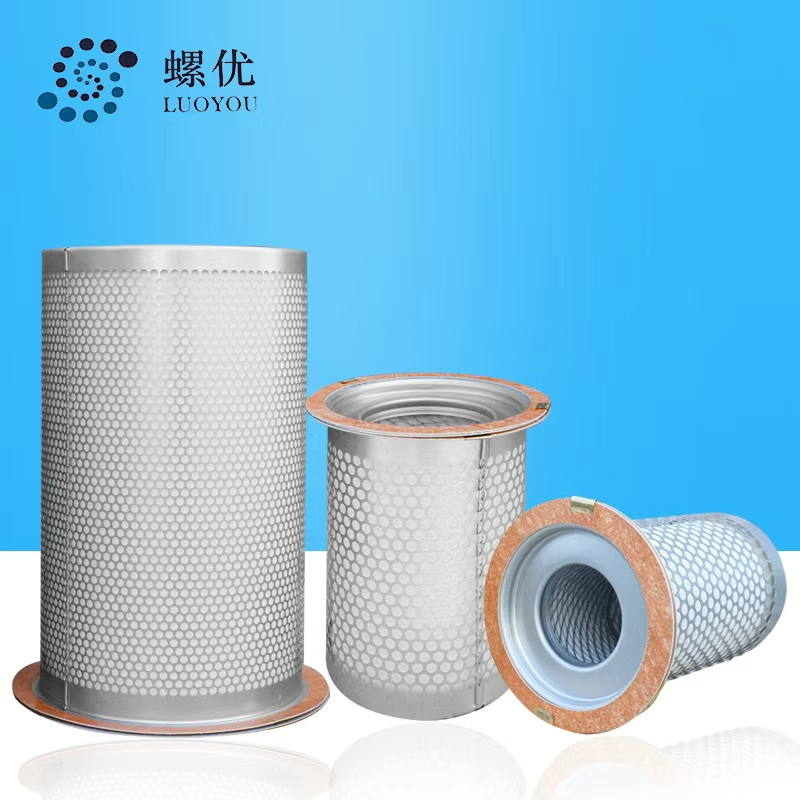
You need actionable data to time your maintenance flawlessly. Monitor these four core indicators during every operational shift.
Equipment manufacturers provide specific operating hour ratings. These benchmarks usually range from 2,000 to 8,000 hours. The exact number depends heavily on your chosen lubricant type. High-grade synthetic fluids typically allow longer intervals than standard mineral lubricants. The ambient operating environment also plays a massive role in lifespan.
However, these hours represent a baseline assumption. They are never an absolute mandate. A dusty foundry environment cuts this lifespan in half quickly. Monitoring actual separator service life requires comparing OEM benchmarks against real-time operational data. Use running hours to schedule your deep inspections. Do not use them to blindly order replacement parts.
Pressure drop tells the real story of filter health. You must know how to read the differential gauge across your separator tank. This instrument measures the pressure difference between the wet side and the dry side.
Establishing a hard threshold prevents catastrophic failures. A new element usually shows a 2-3 PSI drop under full load. A separator differential pressure reading of 10-15 PSI (0.7 to 1 bar) signals immediate replacement requirements. Pushing past 15 PSI drastically increases the risk of element collapse. Make daily gauge checks a strict habit for your operators.
Oil belongs inside the compressor sump exclusively. When it escapes, your separator has officially failed. Visual indicators often appear first. You might notice thick oil misting in the air network. Excessive oil accumulation inside downstream line filters also points to immediate trouble.
Measuring oil consumption rates provides definitive proof. A sudden drop in the compressor sump level demands an urgent investigation. If you find no external puddles, the oil is traveling downstream. This symptom indicates a ruptured or heavily saturated element. Performing a weekly oil carryover check protects your facility. It prevents compromised pneumatics and stops costly product contamination before it spreads.
Compressors need optimal cooling flow to survive long shifts. A clogged separator restricts this vital fluid circulation. The trapped oil cannot return to the primary cooling circuit efficiently.
This restriction causes the compressor to overheat rapidly. The control panel will eventually trip on high-temperature alarms. Frequent thermal shutdowns often point directly to a blinded separator element. Do not ignore these warnings. Resetting the alarm without investigating the root cause will destroy your expensive airend.
Facilities generally adopt one of three maintenance strategies. Choosing the right one depends heavily on your risk tolerance and operational stability.
Time-Based (Preventative): This method involves replacing elements strictly at OEM-specified hours. It ignores actual filter condition entirely. This strategy works best for mission-critical applications. Facilities lacking budget constraints prefer this zero-risk tolerance approach to guarantee uptime.
Condition-Based (Predictive): This approach relies entirely on differential pressure trends. You also use oil carryover diagnostics to make proactive decisions. It maximizes component ROI perfectly. Stable operating environments benefit most from this highly data-driven method.
Hybrid Approach: The hybrid method blends both strategies flawlessly. You use operating hours as a hard ceiling. Condition-based metrics act as the primary trigger for early replacement. You get maximum financial value without exposing your equipment to unnecessary risk.
Replacement Framework Comparison Chart
| Framework Type | Primary Trigger | Best Application | Pros vs Cons |
|---|---|---|---|
| Time-Based | Calendar or Run Hours | Mission-critical systems | Zero risk, but wastes maintenance budget |
| Condition-Based | Pressure Drop & Oil Loss | Stable, clean environments | Maximizes ROI, requires careful monitoring |
| Hybrid Approach | Metrics + Hour Limit | Most industrial facilities | Perfect balance of cost and mechanical safety |
A separator rarely dies a natural death. Outside factors usually kill it prematurely. Proactive screw compressor maintenance directly dictates filter survival rates.
Oil degrades naturally over time. High heat oxidizes the fluid rapidly during heavy demand. Mixing incompatible oils creates a sticky, destructive varnish. This varnish coats the separator media completely. It prematurely blinds the microscopic fiberglass pores. Always use high-quality, approved lubricants. Change them before they break down and ruin your filtration.
Compressors breathe massive volumes of ambient air daily. Poorly maintained air intake filters allow atmospheric dust inside. This dirt mixes directly into the hot circulating oil. The resulting abrasive sludge easily bypasses the main oil filter. It lodges permanently into the delicate separator fibers. Keep your intake filters clean to protect your internal components from dust ingestion.
How you run the machine matters immensely. Short-cycling harms the entire internal system. The oil never reaches optimal operating temperatures during brief runs. This failure to heat up leads to excessive internal condensation. Water mixes into the oil, creating a thick, mayonnaise-like emulsion. This milky mixture destroys separator fibers rapidly. Ensure your compressor runs long enough to burn off internal moisture.
You must follow strict protocols when the time comes to swap the element. Proper execution ensures safety, reliability, and maximum component lifespan.
Not all filters perform equally under pressure. You must evaluate OEM elements against high-tier aftermarket options carefully. Focus on these key sourcing factors:
Do not condemn the separator prematurely. Verify secondary components first. Check the scavenge lines thoroughly before ordering parts. These return lines siphon recovered oil back into the airend. A blocked scavenge orifice tube mimics a failed separator perfectly. Clean the check valves and clear the sight glass to rule out false alarms.
Planning the job prevents costly mistakes. Follow these crucial execution steps to ensure a safe, successful replacement:
Doing a complete fluid service maximizes the new element's service life. Mixing old, degraded oil into a brand-new separator guarantees an early failure.
Managing compressed air systems requires shifting from blind guessing to a data-backed approach. Ignoring filter health destroys your efficiency. Monitoring pressure drops remains the most financially sound method for timing replacements. Watching oil consumption provides a critical secondary safety net. Do not let outdated calendar schedules dictate your maintenance budget entirely.
Take action today to protect your facility. Audit your current compressor logging practices immediately. Ensure your technicians record gauge readings daily. Put differential pressure checks strictly into your weekly maintenance SOP. These simple habits will save you thousands of dollars in wasted parts and prevent catastrophic downtime.
A: A brand new air-oil separator typically shows a differential pressure of 2 to 3 PSI (0.13 to 0.2 bar) under full load. This baseline allows the system to separate oil efficiently without restricting air delivery. Record this initial reading during installation to establish an accurate benchmark for future trend analysis.
A: No. Industrial separators use microscopic fiberglass coalescing media to capture oil mist. Physical cleaning, compressed air blowdowns, or solvent washing permanently destroys these fragile fibers. Damaging the mesh causes immediate oil bypass. You must always replace the entire element once it reaches its saturation point.
A: The logic differs completely. Automotive AOS systems in turbocharged engines rarely use internal replaceable filter elements. They rely on internal baffling to condense oil vapors. You simply drain and physically clean automotive catch cans periodically. Industrial screw compressors require full disposable media replacement to handle massive, continuous air volumes.
A: A blocked scavenge line is usually the primary culprit. The scavenge tube pulls collected oil from the separator bottom back into the compressor. If this tiny orifice clogs with dirt, oil pools inside the element and travels downstream. This massive oil loss occurs without ever causing a high differential pressure reading.


