
- Home
- Products
- Hot
- About Us
- Services
- Industry
- Contact
Views: 0 Author: Site Editor Publish Time: 2026-08-23 Origin: Site


Upgrading industrial pneumatics demands significant capital expenditure. It also plays a critical operational role in facility reliability. Buyers at this stage already know they need high continuous pressure. They also understand the importance of maximizing production efficiency. However, the real challenge lies in validating specific models. You must verify vendor claims without falling for inflated performance metrics. This article provides a rigorous, evidence-based framework for evaluating equipment. We explore system specifications, lifecycle energy expenses, and machinery condition. You will learn how to ensure long-term returns and secure facility operations. By following these guidelines, you can navigate complex technical data confidently. We will help you avoid common procurement pitfalls and select the right machinery for your plant floor.
Matching equipment to actual facility requirements prevents expensive miscalculations. You must validate two-stage compressor specifications before purchasing. Relying purely on nameplate horsepower often leads to improperly sized machinery. Instead, analyze flow rates, pressure limits, and environmental tolerances.
Cross-reference the manufacturer’s stated volumetric flow against your facility's worst-case pneumatic load. Volumetric flow is measured in Cubic Feet per Minute (CFM). You should look closely at Actual CFM (ACFM) rather than theoretical values. Ensure the compressor achieves the required pressure (PSI) directly at the plant floor. Air naturally loses pressure as it travels through pipes, valves, and dryers. Always factor in these pressure drops across the piping network.
Best Practice: Calculate your total air demand by summing the requirements of all end-use tools. Multiply this sum by a utilization factor, since not all tools run simultaneously.
Industrial facilities demand relentless operation. Confirm the equipment is rated for a 100% continuous duty cycle. This rating guarantees the machine can run nonstop without overheating or requiring cool-down periods. Assess cooling mechanisms carefully. You must choose between air-cooled and water-cooled systems based on your installation environment. Compare these cooling methods against ambient temperature extremes to prevent thermal shutdowns during peak summer months.
Environmental conditions heavily influence pneumatic output. Account for potential performance losses if you operate at high altitudes. Air density decreases as elevation increases, which reduces the volume of air drawn into the intake. Poorly ventilated compressor rooms also cause severe performance drops. Require the vendor to provide de-rated performance curves. These documents show exactly how the machine behaves under your specific environmental constraints.
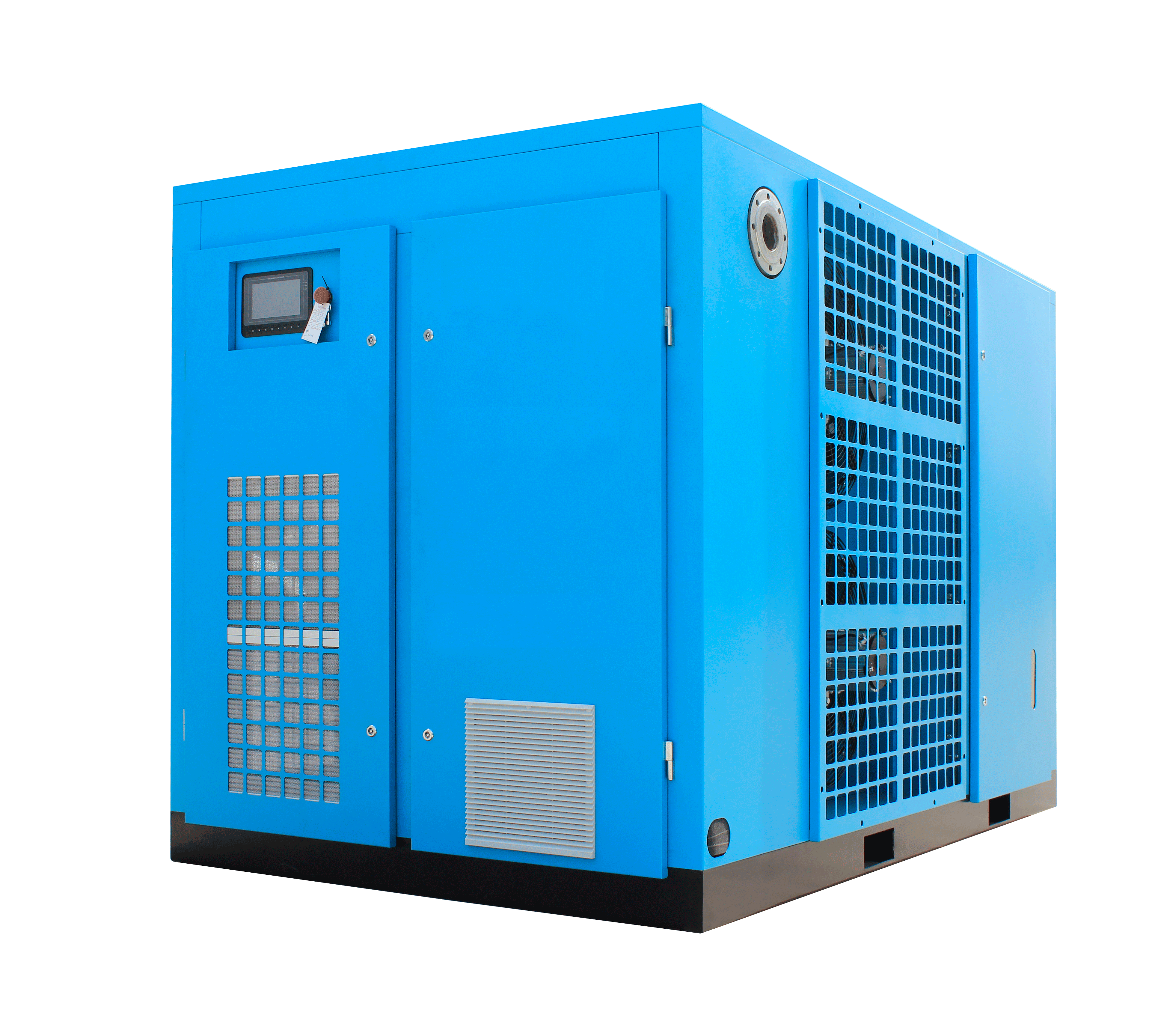
Motor technology drives the financial performance of your pneumatic infrastructure. Deciding whether a permanent magnet compressor fits your operation requires a close look at motor efficiency and your demand profile.
Compare traditional induction motors against permanent magnet (PM) motors. Standard induction motors lose energy through rotor heat. PM motors eliminate these rotor losses entirely. They maintain exceptionally high efficiency even at low operating speeds. While PM technology requires a higher initial capital investment, it fundamentally reduces electrical waste during part-load operations.
Evaluate how the two-stage airend pairs with Variable Speed Drive (VSD) technology. A VSD adjusts the motor speed to match fluctuating plant demand in real-time. VSDs paired with PM motors are highly efficient for shifting loads. However, fixed-speed models remain more economical for continuous, flat-line base loads. If your plant consumes maximum air constantly across all shifts, a fixed-speed drive usually offers better financial returns.
The following data illustrates the fundamental differences between drive configurations.
| Drive Configuration | Part-Load Efficiency | Base-Load Efficiency | Initial Capital Cost |
|---|---|---|---|
| Permanent Magnet VSD | Excellent (Adjusts dynamically) | High | Premium |
| Fixed Speed Induction | Poor (Relies on load/unload) | Excellent | Standard |
Check the design of the intercooler located between the first and second stage. An optimized intercooler rapidly cools the air after initial compression. Cooler air shrinks in volume. This natural shrinkage reduces the physical work required by the second stage. This precise thermal management drives the core 10–15% energy savings typical of a dual stage compressor.
Upfront price tags distract many buyers from long-term financial realities. True profitability depends on ongoing energy consumption and routine maintenance efficiency.
Frame energy consumption as 70-80% of the equipment's lifetime expense. Initial purchase price usually accounts for less than 15%. Require vendors to provide standardized energy consumption data. Ask for CAGI (Compressed Air and Gas Institute) data sheets. These verified sheets allow you to compare the specific power consumption (kW/100 CFM) of competing models accurately.
Check the physical layout of the machine before committing. Technician time is expensive. Are oil filters, separators, and air intake filters easily accessible for routine servicing? If mechanics must remove major panels just to change a filter, your labor costs will multiply. Verify the expected lifespan of the two-stage airend before a major rebuild is required. Industry standards typically measure this longevity in tens of thousands of operating hours—often between 40,000 and 60,000 hours.
Evaluate the onboard PLC or central controller. Modern pneumatics rely on digital intelligence to prevent catastrophic failures. Look for predictive maintenance alerts. You also want remote monitoring integration (IoT) to track metrics from a smartphone or control room. Ensure the controller has the ability to sequence multiple compressors. Sequencing intelligently rotates machinery, minimizing uneven wear across your fleet.
Navigating the secondary market requires different vetting strategies than buying fresh off the assembly line. Follow our compressor buyer checklist to secure reliable equipment regardless of its origin.
Brand-new machinery carries fewer immediate risks, but contractual details still matter immensely.
Purchasing used machinery demands intense scrutiny. You must verify internal component health to avoid buying someone else's deferred maintenance.
Operating Hours: Scrutinize total loaded versus unloaded hours. Loaded hours indicate how long the machine actually compressed air. High unloaded hours indicate previous misapplication or excessive motor wear. It means the machine ran idly, wasting electricity and stressing bearings without producing utility.
Maintenance Logs: Demand verifiable service records. Look for documented oil sampling results. Regular fluid analysis proves the internal gears remained well-lubricated. Verify the dates of previous separator replacements and cooler cleanings.
Visual & Acoustic Inspection: Conduct a thorough physical walkthrough.
The vendor relationship dictates your success long after the installation phase concludes. Treat the selection process as a partnership evaluation rather than a simple transaction.
Disqualify vendors who quote blindly based solely on your existing horsepower. A credible partner should insist on data-logging your current system. They will attach flow meters and amp loggers for at least seven days. This data proves the proposed two-stage screw air compressor matches your actual load profile accurately. Without an audit, you risk severe oversizing.
Evaluate the proximity of factory-trained technicians. If the nearest service center is five hours away, a minor shutdown could halt your production for days. Ask for guaranteed response times enclosed in a formal Service Level Agreement (SLA). Check if proprietary, hard-to-source parts are required for standard Preventative Maintenance (PMs). Open-source filters and fluids offer better long-term flexibility.
Assess your facility's electrical footprint. Check starting amps against your current breaker sizing. PM motors often draw different inrush currents than older induction motors. Map out physical footprint requirements. Ensure you have necessary clearances around the cabinet for proper cooling airflow and unimpeded maintenance access.
Common Mistake: Pushing a machine into a tight corner restricts ventilation. This mistake raises internal operating temperatures and drastically shortens synthetic oil life.
Choosing upgrading equipment constitutes a strategic infrastructure decision, not a simple commodity purchase. Your pneumatic system serves as the heartbeat of your production floor. Always remember that the lowest upfront price often masks hidden electrical inefficiencies and much higher maintenance burdens over the coming decade.
Take decisive action by formalizing your exact specification requirements based on actual pneumatic load. Demand verified CAGI performance sheets from every bidding supplier to keep comparisons honest. Finally, schedule a comprehensive system audit before requesting final RFQs. Armed with empirical data, you can confidently invest in machinery that maximizes uptime and drives tangible operational returns.
A: Dual-stage units typically offer 10-15% greater energy efficiency due to interstage cooling, which compresses air in two steps. The ROI is usually realized in high-demand, continuous-use industrial applications where energy savings offset the higher purchase price within 12 to 24 months.
A: While highly efficient, PM motors operate with strong magnetic fields. They require strict adherence to bearing maintenance and may necessitate specialized handling during major motor overhauls compared to standard induction motors.
A: Establish an accurate baseline of your facility's current compressed air usage (both flow and pressure) and identify your peak vs. minimum shifts. Without this data, it is impossible to correctly size the equipment.


