
- Home
- Products
- Hot
- About Us
- Services
- Industry
- Contact

Views: 0 Author: Site Editor Publish Time: 2026-09-01 Origin: Site


Oil contamination in sensitive manufacturing processes brings massive operational and reputational risks. A single drop of oil can cause severe product spoilage. It triggers strict compliance failures and forces immediate facility downtime. Facility managers face a difficult dilemma every day. They often over-specify massive oil-free rotary screw systems for small tasks. Alternatively, they risk severe contamination using poorly filtered oil-flooded units. We need a better approach for highly specific applications. You can solve this problem by selecting an oil free scroll compressor. Manufacturers engineer this niche solution for demanding environments. It delivers perfect results when you need absolute purity. You will benefit from its unique design if your facility has intermittent duty cycles. It also provides whisper-quiet operation near sensitive workstations. We will explore how this specialized technology differs from standard systems. You will learn exactly when to deploy it effectively across your production floor.
We must first examine the internal mechanics. Scroll compressors utilize a brilliant engineering concept. They rely on two spiral-shaped metal elements. One scroll remains completely stationary. The other scroll orbits around it eccentrically. This orbital motion traps ambient air in crescent-shaped pockets. As the orbiting scroll moves, these air pockets progressively shrink. They push the trapped air toward the center discharge port. This continuous process creates smooth, steady compression.
Crucially, the metal spirals never actually touch one another. They maintain a microscopic clearance at all times. Because they never touch, they experience zero mechanical friction. This eliminates the need for lubrication inside the compression chamber. You get pure air directly from the pump.
We must dispel a common industry myth. Many operators buy standard lubricated compressors. They attach multiple inline carbon filters downstream. They assume this configuration creates perfectly pure air. It absolutely does not. Traditional filters only capture liquid oil droplets. They capture large oil aerosols effectively. However, they cannot stop microscopic oil vapor. Oil vapor passes right through traditional filtration media.
Ambient temperature spikes make this situation much worse. Heat causes trapped oil inside the filter to vaporize again. We call this dangerous phenomenon vapor carryover. You cannot risk this in sensitive processes. True absolute zero oil differs fundamentally from technically filtered air. The scroll design gives you absolute zero.
Think of this technology as a strict operational safeguard. It acts as an insurance policy against catastrophic batch contamination. A contaminated batch destroys your production yields immediately. It ruins your brand reputation overnight. Investing in inherently clean technology prevents these disasters completely.
Let us explore the maintenance requirements of this unique design. Because there is no oil, you skip messy oil changes completely. You never have to dispose of toxic oil-water condensate. You avoid complex oil separator filter replacements. However, the system does require specific scheduled upkeep. The edges of the metal scrolls utilize specialized tip seals. Manufacturers typically make these seals from advanced PTFE materials. These seals prevent air from escaping between the compression pockets.
Over time, these seals experience natural wear. You must schedule tip seal replacements at predictable intervals. Most manufacturers recommend this service every eight thousand to ten thousand hours of operation. This represents a simple, predictable maintenance task. It ensures your machine maintains peak volumetric efficiency over its lifespan. You avoid unexpected mechanical failures entirely.
Food and beverage manufacturing requires absolute vigilance. The FDA and FSMA enforce strict safety guidelines worldwide. You must prevent product adulteration completely. Even trace oil aerosols pose huge operational threats. Microscopic oil droplets alter food taste permanently. They degrade plastic packaging seals during the wrapping process. This leads to rapid food spoilage on store shelves. Ultimately, it triggers devastating consumer product recalls. You cannot rely on standard filters here.
Consider the mechanics of automated food sorting. High-speed pneumatic jets push defective products off the conveyor belt. If this air contains oil vapor, it directly contaminates the passing food stream. The FDA strictly monitors these direct-contact applications. A single failed swab test during an inspection halts your entire production line. The stakes remain incredibly high. True clean technology eliminates this stress. You pass compliance audits easily.
Pharmaceutical companies face even tighter regulatory frameworks. Medical device makers require perfect cleanroom sterility. They need clean compressed air for delicate manufacturing tasks. You use it for medical instrument drying safely. You rely on it for precise pill tablet coating. Cleanroom environments demand strict ISO certification. The ISO 8573-1 Class 0 standard dictates zero added oil.
Here is a breakdown of common air quality classifications:
| ISO 8573-1 Class | Total Oil Concentration Limit | Typical Industrial Application |
|---|---|---|
| Class 0 | 0.00 mg/m³ (Zero Added Oil) | Pharmaceuticals, Food Processing, Semiconductors |
| Class 1 | ≤ 0.01 mg/m³ | High-quality paint spraying, general pneumatics |
| Class 2 | ≤ 0.10 mg/m³ | General workshop tools, packaging |
Electronics and semiconductor fabrication also rely on pure air heavily. Microchips feature delicate nanoscale architectures today. Microscopic oil vapor permanently damages this sensitive circuitry. It coats optical manufacturing sensors with an invisible film. This ruins automated visual inspection systems completely. Pneumatic conveying of electronic components requires pristine air. Component cleaning stations cannot tolerate any vapor residue.
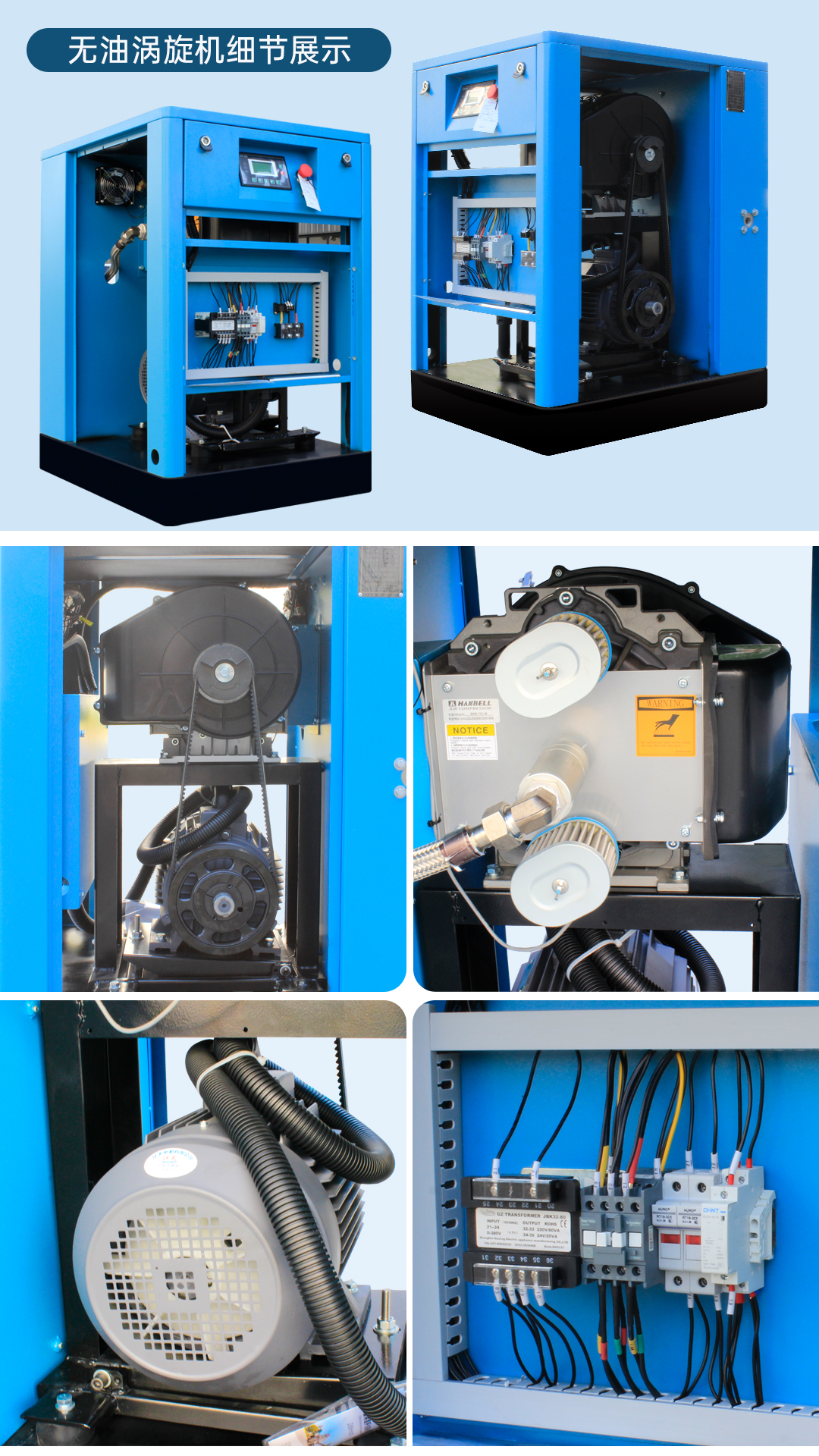
Plant footprint and acoustic levels matter greatly in modern facilities. Traditional compressors create deafening operational noise. They require dedicated, sound-proofed utility rooms. You can take a entirely different approach today. You can install a low noise air compressor right where you need it. Scroll units typically generate between 50 to 65 decibels.
This matches normal conversational volume. You can place them directly on the production floor safely. You do not need massive structural enclosures. We highly recommend point-of-use installation for maximum efficiency.
Point-of-use placement solves multiple mechanical engineering challenges. Moving the compressor closer to the application eliminates long piping runs. Let us look closely at piping dynamics. Every elbow joint in a pipe creates friction. Every extra ten feet of pipe reduces the final air pressure. If your central compressor sits far away, you must generate higher pressure to compensate. This forces the central machine to work harder. It consumes significantly more electricity.
Point-of-use scroll installations eliminate this wasteful over-pressurization. The air travels a very short distance. The pressure remains perfectly stable at the tool. You simplify installation logistics entirely.
Vibration control represents another critical operational advantage. An industrial scroll compressor operates smoothly by design. The continuous, balanced rotary motion creates near-zero vibration. This protects your nearby sensitive equipment perfectly. Coordinate measuring machines require absolute stability to function accurately. Laboratory scales fail under heavy floor vibrations. Scroll technology keeps the surrounding environment perfectly still.
We must evaluate your actual air flow demand realistically. We measure this output in cubic feet per minute. Scroll compressors do not serve every industrial application. They max out at lower capacity ranges compared to massive rotary screws. You should consider them strictly for low-to-medium flow requirements. Over-sizing or under-sizing your equipment creates severe operational headaches.
You must assess your duty cycle carefully before deciding. We break this decision logic down simply for facility managers:
Many modern facilities implement multiplexing for better scalability. You can stack multiple independent scroll modules inside a single enclosure. Manufacturers build sophisticated duplex, triplex, or quad configurations today. The master controller sequences these individual modules automatically.
It responds perfectly to fluctuating plant demand in real-time. If production increases suddenly, another module kicks on instantly. Let us examine this redundancy aspect closer. In a traditional setup, you rely on one massive compressor. If that single unit fails, your whole factory stops working. We call this a single point of failure.
Multiplexed scroll systems eliminate this vulnerability completely. A quad-unit enclosure houses four separate pumps. If one pump experiences a mechanical issue, the master controller isolates it immediately. The remaining three pumps instantly ramp up to cover the deficit. Your production line never experiences a drop in pressure. Your operators keep working smoothly. Proper oil free compressor selection heavily depends on leveraging these modular benefits effectively.
Selecting the right air generation equipment impacts your entire facility. An oil-free scroll unit serves as the absolute optimal choice under specific conditions. It excels when your plant faces stringent air purity regulations. It thrives when you have low-to-medium intermittent flow requirements. It perfectly matches noise-sensitive environments like laboratories and cleanrooms. You eliminate the risks of vapor carryover completely. You gain an efficient, modular, and exceptionally quiet air supply.
We advise plant managers to take decisive action next. Conduct a professional compressed air audit immediately. Map out your exact cubic feet per minute requirements accurately. Baseline your required ISO air quality class securely before making any procurement decision. This systematic approach guarantees you deploy the perfect technology for your specific manufacturing needs.
A: Yes, they can run continuously safely. However, it is rarely the most energy-efficient use case. Engineers optimally design them for environments with varying demand. Their fast start and stop capabilities shine in these dynamic settings. Continuous baseload operations generally favor rotary screw designs. Scroll units perform best under fluctuating daily production schedules.
A: These terms often confuse industrial buyers. "Oil-less" typically means the machine uses no oil anywhere inside. "Oil-free" implies no oil exists directly within the compression chamber. An oil-free unit might still contain a lubricated drive gearbox. However, engineers physically isolate this gearbox from the clean air stream. Scroll technology is generally entirely oil-less.
A: No. They handle ambient moisture exactly like other compressor types. All air compressors produce water condensate due to standard ambient humidity. The mechanical compression process squeezes this moisture out of the incoming air. You still require a properly sized refrigerated or desiccant air dryer downstream. This supplementary equipment removes moisture thoroughly.


