
Choosing between an HPA (High-Pressure Air) compressor and a traditional air compressor rarely comes down to brand preference. Instead, you face a strict technical boundary. Your specific application dictates the necessary machinery. Misunderstanding the inverse relationship between pressure (PSI) and volume (CFM) leads to severe consequences. You risk catastrophic equipment failure. You invite dangerous safety hazards. You also waste valuable capital.
This guide skips surface-level product features. We evaluate actual technical output capabilities. We explore implementation realities. We outline maintenance demands. You will understand exactly how to match mechanical performance to your operational workflow. By the end, you can finalize a confident and safe procurement decision.
Application dictates the machine: HPA compressors deliver extreme pressure (3,000–4,500+ PSI) at low volume, essential for PCP airguns, SCBA/SCUBA, and specific industrial testing. Traditional compressors deliver high volume (CFM) at low pressure (90–150 PSI) for pneumatic tools and shop operations.
Filtration and safety differ drastically: HPA systems require multi-stage moisture and oil filtration to prevent cylinder corrosion and comply with breathing-air standards; traditional compressors have simpler moisture-trapping needs.
Maintenance frequency is not equal: HPA compressors experience significantly higher mechanical stress, requiring shorter service intervals for seals, O-rings, and specialized synthetic oils compared to traditional units.
Cross-compatibility is highly restricted: You cannot safely or practically use a traditional compressor to fill high-pressure tanks, nor is it economically viable to regulate an HPA compressor down to run continuous-use shop tools.
Physics enforce a strict trade-off in fluid dynamics. High pressure and high volume rarely coexist easily. Combining both requires exponential increases in motor size. It also drives equipment costs to astronomical levels. Affordable commercial equipment forces a choice between the two metrics.
Pressure (PSI) measures force. It determines how tightly air gets packed into a confined space. Volume (CFM) measures flow. It dictates how much air moves through a pipeline over a minute. You must prioritize one metric based on your end goal.
An hpa compressor focuses entirely on pressure. These systems utilize multi-stage compression. The machine compresses air in one cylinder. It sends the air through a cooling tube. Then, it squeezes the air again in a smaller cylinder. This sequential process steps the air up to 3,000, 4,500, or even 6,000 PSI. However, the actual air volume delivered per minute remains very low. You will not get a massive rush of air. You get a slow, methodical trickle of immensely dense air.
Traditional air compressors focus on volume. They use single-stage or two-stage mechanics. The pump quickly fills large reserve tanks. They operate at lower pressures, typically between 90 and 175 PSI. The primary goal involves sustained CFM. They prioritize pushing continuous air to drive demanding pneumatic tools without stalling.
Table: Core Differences in Output Focus
Mechanical Metric |
High-Pressure Air (HPA) |
Traditional Shop Compressors |
|---|---|---|
Typical Output Pressure |
3,000 to 6,000 PSI |
90 to 175 PSI |
Typical Airflow (Volume) |
Under 2 CFM |
5 to 50+ CFM |
Compression Method |
3 to 4 Multi-stage cylinders |
1 or 2 Stage cylinders |
Primary Function |
Filling sealed containment vessels |
Powering continuous-flow tools |
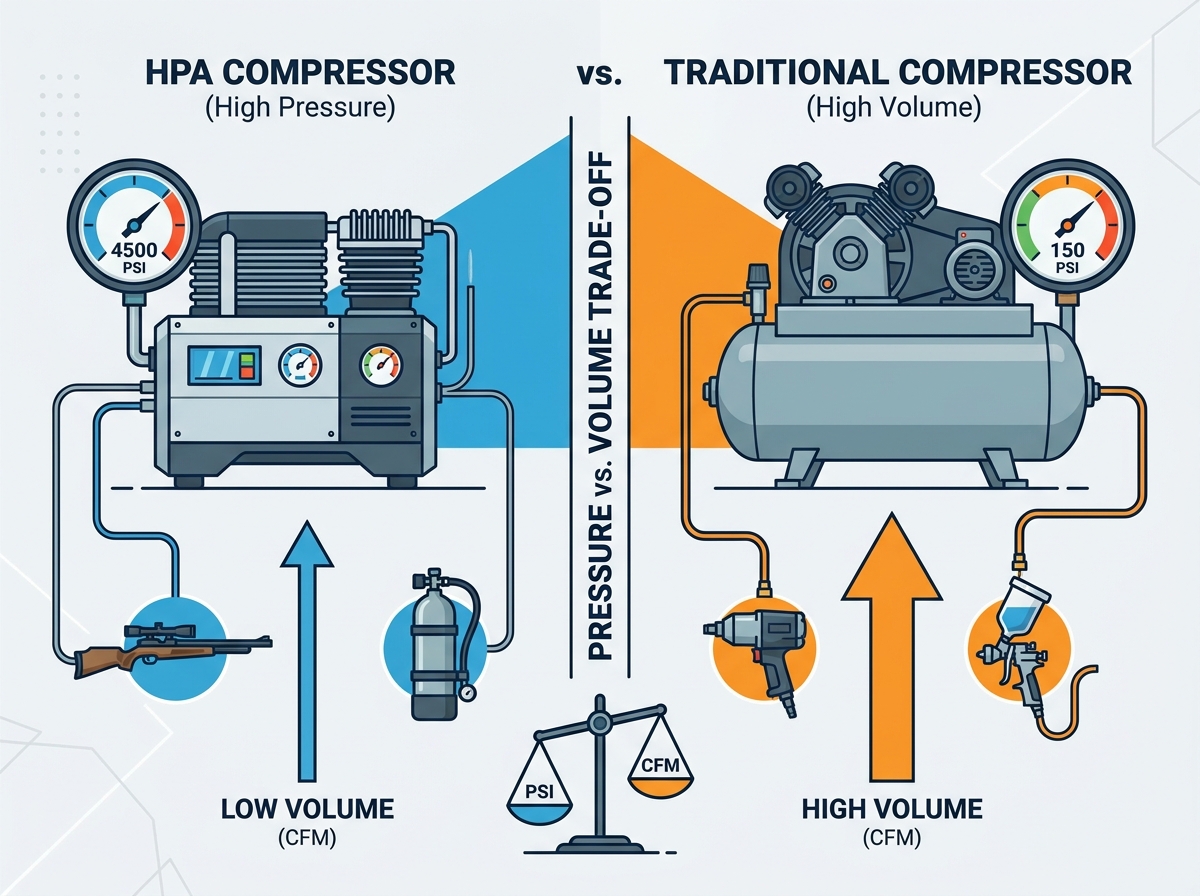
Extreme pressure applications require specialized equipment. You cannot compromise on hardware when dealing with 4,500 PSI. These units fill thick-walled vessels safely. They prioritize dense packing over rapid flow.
Airguns and Paintball: Filling Pre-Charged Pneumatic (PCP) air rifles. Recharging carbon fiber paintball cylinders.
Life Support Systems: SCUBA diving tanks and SCBA (Firefighting) cylinders. These demand certified breathing-air filtration protocols.
Industrial Testing: High-pressure leak testing for pipelines. Specialized aerospace manufacturing applications.
Heat and Cooling Challenges: High pressure generates extreme thermal loads. Air molecules rub together vigorously during severe compression. You must evaluate cooling mechanisms. Air-cooled systems work for brief runs. Water-cooled systems handle longer sessions. However, water-cooled setups require external pumps and radiators. These add potential failure points.
Aggressive Moisture Management: Compressing air to 4,500 PSI forces ambient water out of suspension. The air can no longer hold the moisture. Liquid water drops directly into your system. You must utilize molecular sieve filters. You need coalescing filters. Ignoring this creates internal tank rust. Rust weakens aluminum or steel vessels. This creates a severe explosion hazard.
Duty Cycle Limitations: Consumer HPA units have strict limits. You cannot run them continuously. Exceeding manufacturer run-times melts synthetic seals. The internal friction degrades O-rings rapidly. Always monitor the temperature gauge during operation. Shut down the unit before it reaches the critical redline.
Traditional compressors serve as the backbone of fabrication shops. They power continuous workflows. They push high volumes of air at moderate pressures. They rely on massive storage tanks to buffer the demand.
Automotive and Heavy Repair: Running pneumatic impact wrenches, die grinders, and dual-action sanders.
Surface Preparation: High-Volume Low-Pressure (HVLP) painting and abrasive sandblasting operations.
Manufacturing Lines: General shop air, tire inflation, and driving automated assembly line pneumatics.
CFM Matching Constraints: You must match the compressor output to your tools. Look at the tool consuming the most air. Note its continuous CFM requirement at 90 PSI. You should buy a compressor exceeding this number by at least 30%. This overhead buffer prevents pressure drops during heavy use.
The Tank Sizing Myth: Buyers often assume a larger tank compensates for a weak motor. This remains a dangerous myth. The pump CFM determines recovery time. The tank acts only as a temporary buffer. A massive tank attached to a weak pump simply takes forever to fill. It will eventually stall your workflow.
Oil-Lubricated vs. Oil-Free Dynamics: Oil-lubricated units offer longer lifespans. They run quieter. They disperse heat effectively. Oil-free units require less routine maintenance. They also prevent oil mist from entering paint lines. However, oil-free models typically generate more noise and wear out faster.
Navigating the market requires a structured approach. You must filter out marketing noise. Focus purely on your mechanical needs. The following framework simplifies the final selection.
Start by identifying your mandatory operational metrics. These numbers act as hard disqualifiers. If your required operational pressure exceeds 200 PSI, traditional compressors fail instantly. They physically cannot reach the required density. You must select an HPA unit.
Conversely, look at your workflow demands. If your pneumatic tools require continuous flow exceeding 5 CFM, HPA units fail instantly. An HPA machine cannot deliver sustained volume. Using an HPA unit for a sander will drain the system in seconds. The motor will burn out trying to keep up.
Analyze upfront costs against long-term mechanical stress. HPA units endure immense friction. They often look inexpensive upfront in the consumer market. However, they carry significant maintenance debt. They require frequent teardowns. You will rebuild high-pressure valves regularly. You will replace blown O-rings. The consumable molecular sieves cost a premium. You must budget for these ongoing parts.
Traditional compressors sit on the opposite spectrum. Heavy-duty cast-iron models demand higher upfront capital. Yet, they offer predictable upkeep. Maintenance frequency remains remarkably low. You typically perform yearly oil changes. You swap out basic paper air filters. The mechanical components endure far less strain. They run reliably for decades when maintained properly.
Air quality matters deeply for specific industries. HPA applications often involve human life support. Filling SCUBA tanks requires Grade E breathable air compliance. You must eliminate carbon monoxide. You must strip away hydrocarbon vapors. You need specialized filtration stacks to meet these legal thresholds.
Traditional applications follow different rules. Automotive painting and food processing look to ISO 8573-1 air quality classes. You manage oil mist and solid particulates. A simple inline desiccant dryer often solves shop moisture problems. You do not need breathing-air certification for a pneumatic wrench.
You now understand the fundamental divide. You can begin building a shortlist of potential models. Base your strategy on the exact objects you intend to fill.
If you are filling standalone vessels or cylinders, narrow your focus immediately. Look exclusively at HPA compressors. Prioritize units featuring auto-shutoff relays. These prevent catastrophic over-pressurization. Ensure the unit includes integrated moisture traps. Opt for water-cooling if you plan to fill multiple large carbon fiber tanks back-to-back. Water-cooling drastically improves longevity under heavy use.
If you are driving mechanized tools or shop lines, look at traditional air compressors. Focus on durable construction. Prioritize cast-iron pumps over aluminum housings. Look for motors offering a 100% continuous duty cycle. Size your receiver tank adequately to prevent short-cycling the motor.
Always perform thorough vendor evaluation. Advise your purchasing team to verify parts availability. Niche HPA compressors often flood the market through obscure channels. They suffer from a total lack of domestic replacement parts. A broken seal renders the machine useless if you cannot order a replacement. Demand transparent warranty support before transferring any funds.
Selecting the right air delivery system remains a strict binary choice. Your task demands specific PSI or CFM outputs. You cannot negotiate with physics. High-pressure equipment fills containment cylinders. High-volume equipment powers continuous shop tools. Blurring these lines causes equipment destruction.
You must respect the operational limits of your chosen machine. Monitor duty cycles carefully. Implement robust moisture filtration protocols. Ignoring these steps guarantees premature mechanical failure. Both systems require respect and diligent maintenance to operate safely.
Take immediate action before making a purchase. Audit your workspace. Document the highest PSI requirement of your toughest cylinder. Record the continuous CFM demand of your hungriest pneumatic tool. Let these exact numbers dictate your final investment.
A: No. Shop compressors max out around 150-175 PSI. PCP and scuba tanks require 3,000 to 4,500 PSI. You would need a specialized HPA booster pump in conjunction with the shop compressor, or a standalone HPA unit.
A: Technically possible with specialized high-pressure step-down regulators, but highly impractical. HPA compressors lack the continuous CFM volume required to run air tools, and doing so would rapidly burn out the compressor motor.
A: Generally, no. While oil-free HPA units offer cleaner air and easier portability, the lack of oil cooling and lubrication in high-friction, high-pressure environments typically results in shorter intervals between necessary seal rebuilds.


