
- Home
- Products
- Hot
- About Us
- Services
- Industry
- Contact
Views: 0 Author: Site Editor Publish Time: 2026-10-09 Origin: Site


Selecting the right compressor for sensitive environments goes beyond just looking for an "oil-free" label. Laboratories, medical facilities, and food processing plants need absolute air purity and consistent reliability. Misinterpreting core performance metrics often leads to premature equipment failure. It can also cause severe compliance breaches or introduce disruptive workplace noise. Facility managers must look past basic marketing claims. They need to understand exactly how a machine operates under specific loads. This guide breaks down how you should evaluate these complex systems. We focus on three critical decision-stage metrics. We will thoroughly examine capacity limits, acoustic noise levels, and continuous duty cycles. Mastering these technical areas ensures highly reliable, ISO-compliant air delivery. You will avoid over-specifying your system and wasting valuable energy. By the end of this guide, you will know how to match equipment perfectly to your unique facility requirements.
We must establish what strict air purity actually looks like in practice. The ISO 8573-1 Class 0 standard defines the absolute pinnacle of clean industrial air. True true oil-free scroll compressors eliminate oil from the compression chamber entirely. They guarantee zero risk of downstream oil vapor contamination. They do not rely on inline filters to catch oil droplets. They simply never introduce oil into the airflow in the first place.
When is this technology the right operational choice? You will see them utilized in industries where a single drop of oil ruins entire production batches. Food and beverage processing plants rely on them for sanitary pneumatic sorting. Healthcare facilities need them to power sensitive patient ventilators safely. Research laboratories install an oil-free scroll compressor to protect delicate analytical instruments from vapor buildup.
How do they compare to other traditional designs? Piston compressors create significant mechanical noise and require frequent cooling breaks. Rotary screw designs handle massive air capacities but demand intense maintenance routines. Scroll models bridge this structural gap perfectly. They run noticeably quieter than pistons and need far less maintenance than rotary screws.
| Technology Type | Duty Cycle | Noise Level (dBA) | Ideal Capacity Range | Maintenance Intensity |
|---|---|---|---|---|
| Oil-Free Scroll | 100% Continuous | 50 - 65 (Very Quiet) | Low to Medium | Low (Periodic seal replacement) |
| Oil-Free Piston | Intermittent (Requires cooling) | 70 - 85 (Loud) | Low | Medium (Rings and valves) |
| Oil-Free Rotary Screw | 100% Continuous | 65 - 80 (Moderate) | High to Very High | High (Complex rebuilds) |
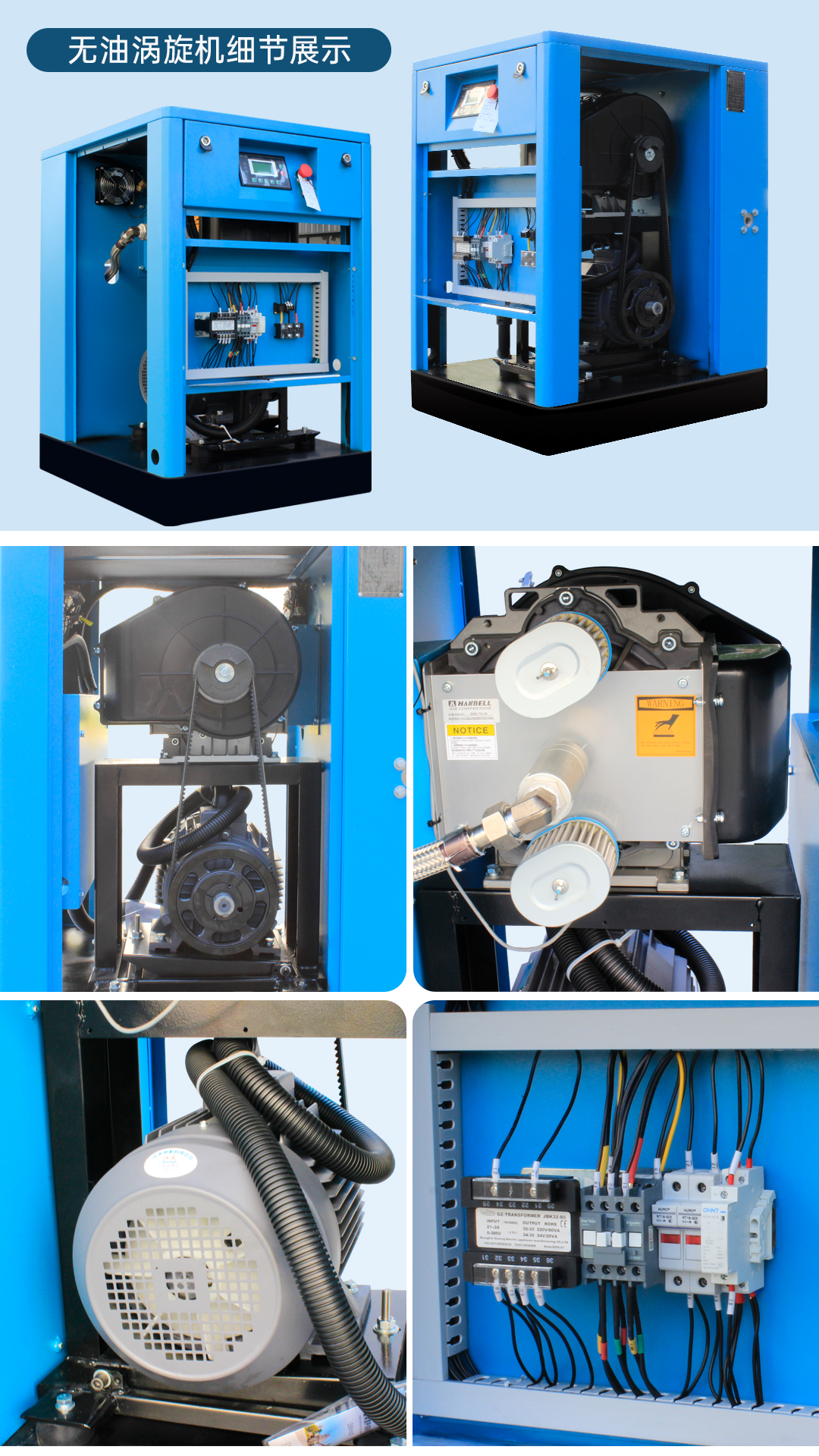
Understanding capacity requires looking at two crucial metrics simultaneously. CFM (Cubic Feet per Minute) measures air volume. PSI (Pounds per Square Inch) measures air pressure. Many industrial buyers make a critical mistake here. They look at peak CFM without referencing the corresponding PSI. Evaluating CFM at your required operating PSI provides the only accurate capacity measurement. Air volume naturally decreases as system pressure increases.
Scroll designs have unique physical and mechanical limitations. Single scroll compression elements typically top out around 10 to 15 horsepower. The physical size of the orbiting scroll cannot scale endlessly. Larger metal spirals become structurally unstable at high operational speeds. Therefore, manufacturers do not build massive single-scroll pumps to meet high facility demands.
Instead, engineers use multiplex solutions to achieve scalability. Manufacturers stack multiple scroll pumps inside a single steel enclosure. You can easily source duplex, triplex, or quad compressor configurations. This cascading design allows facility capacity to scale as your demand grows over time. If one internal pump fails, the others keep running. This builds inherent redundancy directly into your primary air system.
Use this standard shortlisting logic to calculate your system needs accurately. Follow these exact steps to avoid undersizing your equipment:
Duty cycle indicates how long a machine can operate safely within a given timeframe. Continuous production environments demand high operational uptime. Intermittent machines need mandatory cooling breaks to prevent severe overheating. If you ignore duty cycle ratings, you will quickly destroy your internal mechanical components.
Scroll technology offers a tremendous 100% duty cycle advantage. An oil-free scroll compressor uses a remarkably smooth continuous orbital motion. One stationary scroll and one orbiting scroll interlock tightly. They compress air smoothly in a continuous sweep toward the center. This geometry generates far less friction and heat compared to reciprocating pistons. Less internal heat means the machine never needs to stop and cool down. It can run continuously across multiple shifts.
However, industry terminology often causes significant confusion here. Duty cycle does not equal full load. A machine with a 100% duty cycle can certainly run all day. Yet, running it at full load (maximum air capacity) 24/7 is not advisable. Pushing any mechanical device to its absolute physical limit non-stop accelerates wear. It negatively impacts long-term efficiency and degrades moving components prematurely.
Multiplex units solve this full-load dilemma through intelligent variable output control. Smart digital controllers monitor real-time air demand constantly. They turn individual scroll pumps on and off automatically based on pipeline pressure. When plant demand drops, secondary pumps shut down to save energy. When production spikes, additional pumps fire up seamlessly. This matches air delivery perfectly to actual usage. It maximizes energy efficiency while keeping individual pumps below continuous full-load stress limits.
Acoustic performance heavily influences compressor placement inside modern facilities. Scroll units are famous across the industry for their whisper-quiet operation. We must look at the underlying mechanical physics to understand why they perform so well acoustically.
Continuous compression without mechanical valves eliminates heavy operational clatter. Reciprocating pistons slam metal valves open and closed rapidly. This aggressive movement creates loud, pulsating vibrations. Scroll designs feature absolutely no inlet or exhaust valves. The continuous orbital motion sweeps air gently. This smooth process completely removes the heavy mechanical thumping associated with traditional air systems.
Typical sound levels range beautifully from 50 to 65 dBA. This acoustic specification is remarkably low for heavy industrial equipment. A 50 dBA rating practically equates to a quiet modern office environment. A 65 dBA rating mirrors the sound of a normal conversation between two people. Facility employees can work right next to these machines comfortably without wearing heavy ear protection.
This low noise profile creates a massive installation advantage. Facilities save substantial money by installing the compressor directly at the point of use. You do not need to build a dedicated, heavily sound-proofed compressor room. You completely eliminate expensive, complex piping runs across massive factory floors. Point-of-use installation also dramatically reduces pressure drops inside the pipeline. It makes your entire pneumatic infrastructure much more energy efficient.
Every industrial machine requires proper maintenance to function safely over time. While scroll designs are highly reliable, specific internal parts do experience natural wear. Maintaining system trustworthiness means acknowledging these operational realities upfront.
The tip seals and bearings represent the primary wear components. Tip seals sit precisely between the interlocking scroll spirals. They maintain the airtight compression chambers during rapid rotation. Over time, constant friction degrades these seals slowly. When seals wear out, the compressor loses volumetric efficiency. It has to work noticeably harder to deliver the same amount of compressed air. Regular bearing lubrication also remains absolutely critical for the primary motor and orbiting shaft.
When a scroll element reaches its lifecycle limit, replacement becomes highly necessary. This operational limit typically falls between 10,000 and 20,000 working hours. The exact timeframe depends heavily on the specific manufacturer guidelines. Instead of rebuilding the complex scroll element manually, replacing the entire air-end pump is standard practice. Rapid air-end replacement restores the machine to factory-level performance immediately. It prevents unexpected downtime and ensures continuous clean air delivery.
Environmental considerations drastically impact long-term machine longevity. High ambient temperatures degrade mechanical performance quickly. Poorly ventilated installation spaces trap hot air around the compressor enclosure. Excessive heat hardens internal tip seals and evaporates vital bearing grease prematurely. You must strictly implement these specific environmental best practices:
Evaluating industrial air systems requires clear technical focus. If your facility absolutely requires Class 0 clean air, scroll technology provides immense value. It operates effectively at low-to-medium flow rates. It delivers incredibly low workplace noise levels. It easily handles continuous 100% duty cycle operations safely. By thoroughly understanding these exact metrics, you completely avoid over-specifying expensive equipment.
You must take actionable steps before finalizing any purchase decision. First, conduct a comprehensive air audit for your facility immediately. Calculate your exact CFM and PSI needs using the shortlisting formulas provided above. Next, consult directly with a pneumatic systems engineer. They will help you precisely determine if a single unit or a multiplex configuration best suits your available space.
A: Most industrial scroll units operate comfortably up to 116 PSI. Some specialized high-pressure models can reach maximums of 145 PSI. Beyond this range, the physical design limitations of the scroll element make compression highly inefficient. You should always match your required operating pressure closely to the manufacturer's rated maximum.
A: Tip seals typically require replacement between 8,000 and 10,000 hours of operation. However, this interval heavily depends on environmental factors like ambient heat and duty cycle intensity. Always check your specific manufacturer guidelines. Operating in high-temperature areas may require more frequent seal replacements to maintain optimal air delivery.
A: Yes, they handle varying demands exceptionally well through multiplex configurations. A multiplex unit contains several individual scroll pumps inside one enclosure. As your air demand fluctuates, the internal controller cycles individual pumps on or off. This smart staging prevents energy waste while perfectly meeting your real-time air requirements.
A: A 100% duty cycle means the compressor safely runs continuously without overheating. It does not require mandatory cool-down periods like intermittent piston models. However, it should not run if there is no actual downstream air demand. A smart control system will shut the pump down during idle periods to conserve energy.


