
- Home
- Products
- Hot
- About Us
- Services
- Industry
- Contact
Views: 0 Author: Site Editor Publish Time: 2026-10-20 Origin: Site


High-pressure air demands extreme precision and highly capable hardware. Standard shop air compressors typically top out around 150 PSI. You need specialized equipment to safely reach the 3,000 to 4,500 PSI required for modern PCP airguns and SCUBA tanks. Selecting the wrong unit often causes expensive damage and extreme safety hazards. You might experience blown burst discs, severe moisture contamination inside expensive air tubes, or premature motor burnout. These frustrating failures usually happen when users push entry-level pumps past their strict duty cycles. This guide provides a realistic, spec-driven framework for your next purchase. We will help you evaluate units based on your usage frequency and exact fill volumes. You will learn how to match thermal management, filtration systems, and power sources to your specific needs. Let us explore the critical specifications you must understand before making an investment.
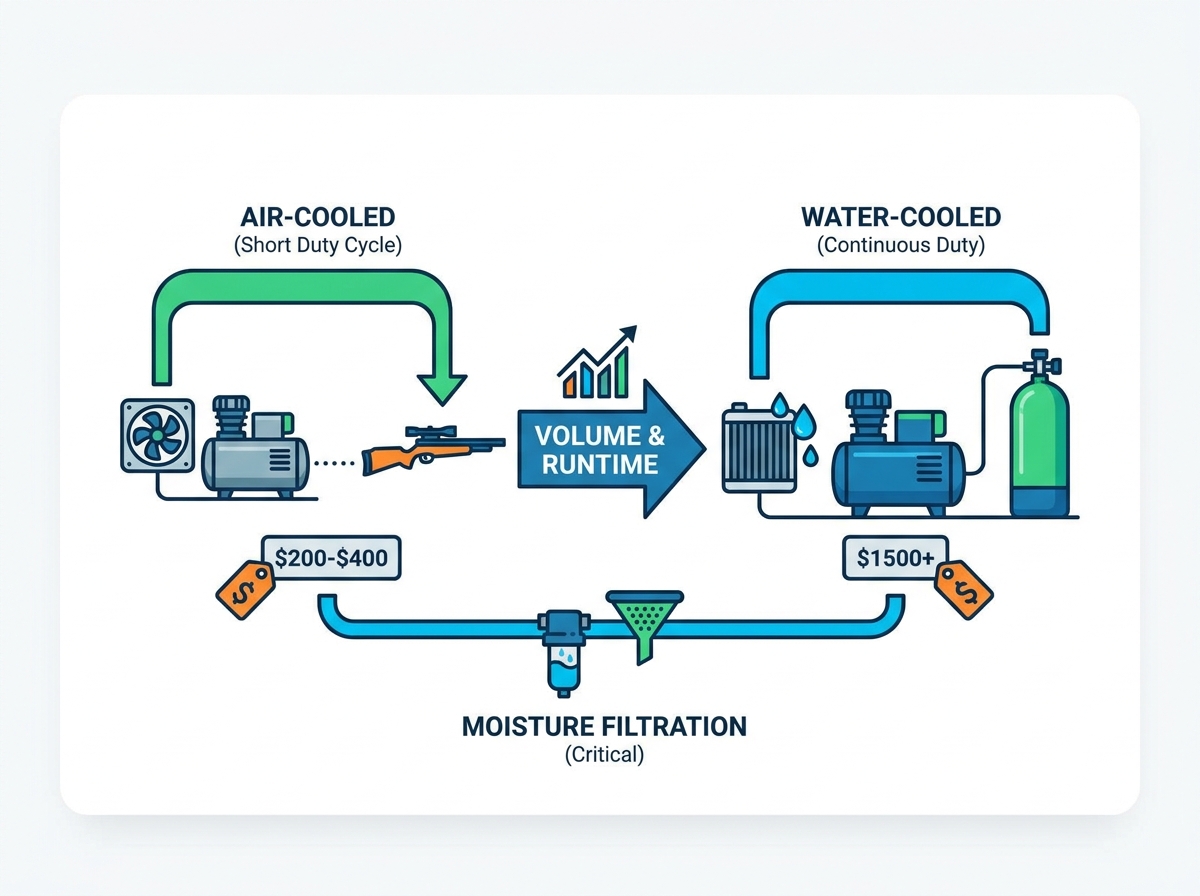
Match cooling to volume: Air-cooled units are strictly for direct-to-gun or small tanks; water-cooled units are required for filling larger carbon fiber or SCUBA cylinders.
Moisture management is critical: Factory-standard moisture traps are often insufficient; budget for secondary inline filtration.
Pricing reflects duty cycle: A $300 unit and a $1,500 unit may both reach 4500 PSI, but the higher-priced unit does so continuously without overheating.
Power flexibility dictates portability: 12V/110V dual-voltage units offer field portability but sacrifice fill speed compared to dedicated 220V benchtop units.
The primary driver of your purchase decision is the specific volume of the vessel you need to fill. You cannot rely on a one-size-fits-all approach when dealing with extreme pressure. Knowing your exact application prevents catastrophic equipment failure and keeps your hobby safe.
Small air cylinders usually hold under 500cc. They require very short run times to reach maximum capacity. You face a low risk of overheating the pump during these quick top-offs. A standard entry-level unit handles these short bursts effortlessly. You plug the hose directly into the device, run the pump for three to five minutes, and bleed the line.
Large carbon fiber tanks range from 45 to 74 cubic feet or more. Filling these requires long, continuous run times. Strict thermal management becomes mandatory. An inadequate cooling system will destroy the pump long before the massive tank fills. You must never attempt to fill a large cascade tank using a pump rated only for small airguns.
You must clearly distinguish between standard high-pressure air and breathable air. SCUBA applications demand strict safety compliance. They require specialized multi-stage filtration and non-toxic, food-grade lubricants. You cannot breathe air from a standard industrial pump safely. Normal mechanical pumps deposit microscopic oil vapors and harmful particulates into the air stream.
Understanding technical specifications prevents costly purchasing mistakes. Finding the right hpa compressor requires matching its performance metrics directly to your daily filling habits.
Verify the unit natively supports your target pressure. Most applications demand 3000 PSI (206 Bar) or 4500 PSI (310 Bar). Do not buy a unit falling short of your maximum requirement. You also need an automatic shut-off feature. This mechanism stops the motor once it reaches the designated pressure. It prevents accidental over-pressurization and potential ruptures. Always double-check the mechanical pressure relief valves. They offer a vital secondary safety layer if the digital relay fails.
Evaluate the real-world fill time carefully. Manufacturer claims often assume ideal, sea-level conditions with zero back-pressure. Expect actual fill rates to decrease dramatically as internal pressure approaches maximum. A pump pushing 50 L/min slows down significantly past 3000 PSI because the motor works much harder. You must account for this performance drop. Ask manufacturers for fill time estimates on specific tank sizes. This provides a much clearer picture of daily performance.
Heat is the absolute enemy of high-pressure pumps. The intense compression process generates extreme friction and thermal load. You must choose a cooling method suited to your run times.
Cooling System Comparison Chart
Cooling Type | Mechanism | Ideal Use Case | Maintenance Level |
|---|---|---|---|
Air-Cooled (Fan) | High-RPM fans blow ambient air over a finned cylinder head. | Direct-to-gun filling, sub-500cc tanks, short 10-minute runs. | Low. Keep vents clear of dust and debris. |
External Water-Cooled | Submersible pump pushes cold water from a bucket through the engine block. | Medium carbon fiber tanks, 20-minute run times. | Medium. Requires ice water preparation and bucket setup. |
Integrated Radiator | Closed-loop system uses coolant, radiators, and heavy-duty fans. | Large cascade tanks, continuous commercial filling. | Low to Medium. Occasional coolant top-offs required. |
High pressure literally squeezes moisture out of ambient air. You must evaluate the included oil and water separator strictly. Standard factory moisture traps rarely capture everything.
Implementation Reality: Budget-friendly units often include tiny, inadequate filters. You must purchase a secondary, larger desiccant filter. Moist air causes rapid internal rusting inside your expensive steel air cylinders. It also damages the delicate brass regulators inside PCP airguns. Use a gold-standard molecular sieve or large cotton desiccant tube inline to ensure completely dry air delivery.
Your operating environment heavily influences your power requirements. You must balance remote portability against raw filling speed and convenience.
12V DC Portability: These compact units run directly off a standard car battery. They are ideal for remote field use and weekend hunting trips. However, they generally feature slower fill rates. They also have much shorter duty cycles. You must let them rest frequently to avoid melting the internal wiring.
110V AC (Standard Outlet): These are highly convenient for standard home garages. Many manufacturers offer dual-voltage (12V/110V) units. They usually require a built-in or external power converter block. They sit perfectly on a sturdy workbench and plug into any standard wall socket.
220V AC (High-Draw): Commercial-grade units require serious electrical power. You need dedicated 220V wiring and a proper shop setup. These massive plugs power heavy-duty, high-CFM motors. They fill massive bulk tanks quickly without tripping your household breakers.
Noise and Vibration: High-pressure pumps run extremely loud. Operating noise often exceeds 80dB, resembling a jackhammer in an enclosed space. Consider purchasing heavy rubber vibration dampening mats. You should place the equipment far away from main living spaces. Proper ventilation is also critical during indoor operation to dissipate the intense heat.
Price directly reflects internal component quality, thermal endurance, and flow rate. You get exactly what you pay for when purchasing a hpa compressor.
HPA Compressor Capability Matrix
Pricing Tier | Average Price | Primary Capability | Best For |
|---|---|---|---|
Entry-Level | $200 - $400 | Direct-to-gun, light duty, air-cooled. | Weekend hobbyists, tight budgets. |
Mid-Range Prosumer | $500 - $1,200 | Medium tanks, integrated cooling, auto-shutoff. | Heavy enthusiasts, small groups. |
Commercial / Industrial | $1,500 - $3,500+ | Continuous duty, breathing air capable (with filters). | Dive shops, paintball fields. |
Capabilities: These handle direct-to-gun filling efficiently. They suit light-duty applications perfectly. They usually utilize basic air cooling fans. Many offer 12V/110V dual-voltage flexibility for field trips.
Risks: You face a high failure rate if you push them beyond their strict duty cycle. They require frequent teardowns. You will regularly replace high-pressure O-rings and blown burst discs. They only provide basic moisture control. Never use them to fill large bulk cascade tanks.
Capabilities: These successfully fill medium carbon-fiber tanks. They feature integrated water cooling or highly robust fan systems. They include adjustable auto-shutoff switches for precise filling. They also boast much better inline moisture filtration right out of the box.
Value: This represents the sweet spot for heavy hobbyists. You gain excellent reliability. You avoid massive commercial installation costs. They handle weekly filling tasks without breaking a sweat or requiring constant rebuilds.
Capabilities: These deliver true continuous duty cycles. They offer incredibly rapid fill rates. They feature multi-stage filtration capable of producing clean, breathing-grade air. Manufacturers build them using highly durable, wear-resistant steel components and slow-turning motors.
Use Case: Dive shops and busy commercial paintball fields rely on these daily. They suit users filling multiple large tanks back-to-back. They are permanent, heavy-duty installations requiring dedicated floor space.
Owning high-pressure equipment demands strict physical maintenance routines. Mechanical neglect leads to dangerous failures, blown lines, and extensive hardware damage.
You must expect to replace high-pressure O-rings regularly. The extreme heat degrades rubber seals quickly. Check valves and burst discs also wear out through normal thermal cycling. Always check aftermarket parts availability before buying any specific brand. A cheap pump becomes useless if you cannot find replacement seals. Keep a comprehensive rebuild kit on hand at all times to avoid downtime.
You must choose between oil-free and oil-lubricated models. Oil-lubricated units generally last much longer because the moving metal parts glide smoothly. However, they require frequent, messy oil changes. You must use specialized synthetic compressor oil rated for high pressure. You also run the risk of microscopic oil vapor entering the air line. Oil-free units deliver cleaner air but wear out faster due to much higher internal friction.
High-pressure air is inherently dangerous. A vessel holding 4500 PSI contains massive destructive energy. Factor in the absolute necessity of regular professional hydro-testing for your carbon fiber tanks. You should also evaluate cheap factory hoses carefully. Upgrade them immediately if they look flimsy. Use rated stainless steel braided lines or heavy-duty Kevlar hoses. Never trust compromised brass fittings or cracked rubber lines under extreme pressure.
Shortlisting Logic: Match your budget directly to your specific tank size. Do not buy a $250 unit to fill a 60-minute SCBA tank—it will overheat, melt internal components, and fail spectacularly.
Next Steps:
Determine your primary power source, deciding between remote field battery operation or standard garage wall outlets.
Calculate the exact cubic inch or liter volume of the vessels you need to fill regularly.
Allocate at least $50 to $100 of your total budget exclusively for secondary inline moisture filtration.
Monitor your running temperatures strictly during every single fill cycle to maximize the lifespan of your pump.
A: No. Shop compressors max out at ~150 PSI. HPA applications require 3,000 to 4,500 PSI. You would need a specialized hpa compressor or a booster pump. Standard garage tools simply cannot generate the extreme pressure required for modern airguns.
A: It is the ratio of continuous run time to mandatory cool-down time. Ignoring this limit is the #1 cause of catastrophic pump failure. For example, a 15-minute duty cycle means 15 minutes of running followed by 15 minutes of cooling.
A: No, breathing air is strictly for SCUBA/life-support. However, you do need deeply dry (moisture-free) air to prevent internal corrosion in your equipment. Water vapor ruins expensive airgun regulators rapidly.
A: Burst discs are fail-safes designed to rupture before the compressor or tank explodes from over-pressurization. They usually blow due to blockages in the line, running past max pressure, or excessive heat buildup.


