
- Home
- Products
- Hot
- About Us
- Services
- Industry
- Contact
Standard shop air systems typically deliver 90 to 150 PSI. You rely on them for general pneumatic tools and basic assembly lines. However, this baseline pressure falls drastically short for specialized manufacturing and heavy industrial processes. We must look toward more capable solutions when operational demands scale up. High-Pressure Air (HPA) systems bridge this massive capability gap. They generate and sustain extreme pressures, usually ranging from 400 PSI up to 6,000 PSI or more. Integrating a dedicated hpa compressor prevents catastrophic process failures. It also ensures strict operational safety in volatile environments. Our goal here is to help facilities managers, procurement teams, and plant engineers properly evaluate these high-pressure solutions. You will learn how to match equipment against specific application requirements, demanding duty cycles, and rigorous compliance standards. We will guide you through core applications, mechanical evaluations, and crucial implementation realities to streamline your next upgrade.
Dedicated HPA compressors offer lower long-term maintenance costs and higher reliability for continuous heavy-duty applications compared to standard compressors paired with boosters.
Accurate sizing—balancing CFM (flow) against extreme PSI (pressure)—is critical; overestimating leads to wasted energy, while underestimating causes pressure drops and equipment wear.
High-pressure environments introduce stringent compliance requirements (e.g., ASME, OSHA) regarding air purity, pressure vessel safety, and routine maintenance protocols.
Industrial facilities often struggle to distinguish between short bursts of high pressure and relentless continuous demand. You might notice noticeable pressure drops during peak production shifts. This indicates your current system cannot handle the pneumatic load. Intermittent needs might only require temporary pressure spikes. Continuous operational demands dictate a completely different approach. We see facilities push standard compressors beyond their designed limits daily. They experience frequent breakdowns and severe production bottlenecks as a result. Recognizing this business problem is your first step toward operational stability.
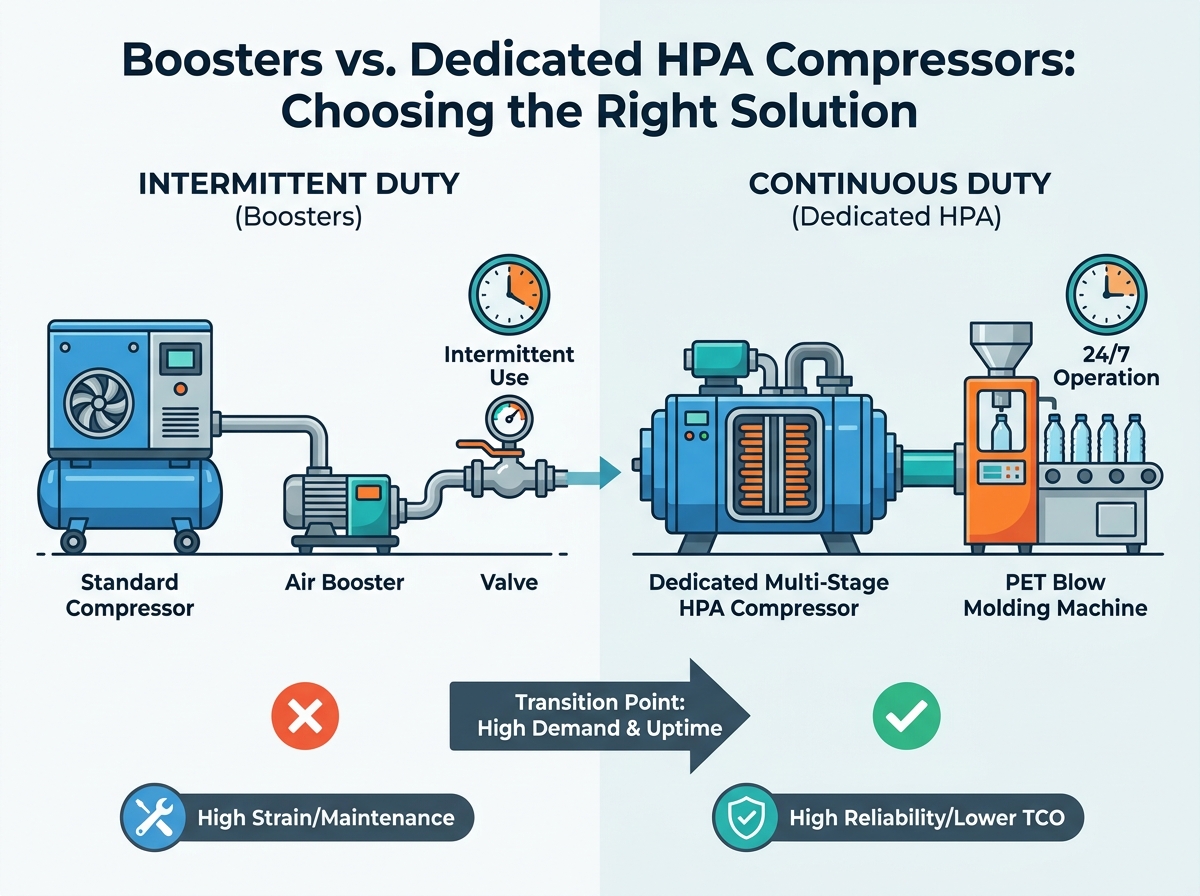
Many engineers initially try connecting a pneumatic or electrical booster to a standard rotary screw compressor. Boosters take standard 100 PSI air and amplify it significantly. They work reasonably well for rare, low-volume tasks. However, boosters possess strict operational limits. They generate excessive heat during continuous operation. A dedicated multi-stage high-pressure unit handles continuous heavy-duty cycles effortlessly. It compresses air in controlled, distinct stages. This cools the air between phases and prevents severe mechanical fatigue over time.
How do you define the tipping point for a major equipment upgrade? You must measure specific operational metrics to define success criteria. We look for a measurable reduction in unplanned downtime. You should also aim to eliminate bottlenecked production lines caused by pressure lags. Achieving consistent product quality serves as another major success metric. If your booster constantly triggers thermal overloads, you need a dedicated high-pressure upgrade immediately.
Plastics manufacturing relies heavily on precise, forceful pneumatic power. High-speed forming of complex plastics requires rapid, consistent bursts of 500 to 600 PSI. The molds must snap shut and inject air instantly to form the plastic bottle. You cannot afford pressure fluctuations here. We evaluate these systems based on their ability to deliver Class 0 oil-free air. Any stray oil vapor ruins the plastic structural integrity. It also illegally contaminates food-grade beverage containers. These plants run on relentless 24/7 schedules. Therefore, you need absolute duty cycle reliability from your compression equipment.
Modern laser cutters use high-pressure air as a highly effective assist gas. The intense laser melts the metal sheet quickly. High-velocity air then blows away the molten metal from the cut zone. This yields cleaner cuts much faster than standard nitrogen delivery systems. We focus heavily on balancing CFM requirements against specific laser wattages. Thicker metals require higher pressures and sustained flow rates to clear the kerf. You must also prioritize rigorous filtration standards here. Particulates and moisture will easily destroy sensitive, expensive laser optics.
The global energy sector demands extreme pneumatic power constantly. Applications include critical well testing, deep pipe purging, and firing offshore seismic airgun arrays. These tasks require extreme pressures reaching up to 5,000 PSI or more. Evaluation focuses heavily on equipment ruggedization. You face severe physical footprint constraints on offshore oil platforms. The equipment must fit into tight, modular skids seamlessly. We also mandate extreme corrosion resistance to survive harsh marine environments and constant salt spray exposure.
Industrial safety relies on rigorous hydro-testing procedures. Technicians pressure-test pipelines, gas cylinders, and heavy industrial valves regularly. This validates structural integrity and provides critical leak detection data. You fill the vessel with water and pressurize it using intense air pressure. Evaluation demands absolute precision pressure control. You must hit exact certification pressures safely and hold them there. We also look closely at intermittent high-stress duty cycles. The system must integrate seamlessly alongside automated safety blow-off mechanisms to protect testing personnel.
Industrial Application | Typical PSI Range | Air Quality Requirement | Operational Duty Cycle |
|---|---|---|---|
PET Blow Molding | 500 - 600 PSI | Class 0 Oil-Free (Strict) | Continuous 24/7 |
Laser Cutting Assist Gas | 250 - 500 PSI | Dry & Particulate-Free | Heavy / Intermittent |
Offshore Seismic Arrays | 2,000 - 5,000+ PSI | Ruggedized / Marine Grade | Extreme / Continuous |
Hydro-Testing Services | 1,000 - 6,000 PSI | Standard Industrial | Intermittent High-Stress |
Standard single-stage units cannot reach extreme pressures safely. We evaluate the mechanical efficiency of specialized 3-stage or even 4-stage compression blocks. Each sequential stage progressively squeezes the air tighter. This physical process generates exponential heat. You must rigorously assess intercooling capabilities between each distinct compression stage. Poor cooling degrades internal seals rapidly. It also encourages dangerous moisture buildup inside the compression chambers. Effective heat exchangers keep temperatures manageable and extend internal equipment life substantially.
Common Mistake: Many operators ignore rising interstage temperatures until a thermal shutdown occurs. Monitoring these temperatures daily prevents catastrophic valve carbonization and internal fires.
High pressure concentrates airborne contaminants dramatically. You must determine the exact filtration levels required for your specific industrial application. ISO 8573-1 outlines strict limits for particulates, liquid water, and oil aerosols. We analyze the integration of specialized high-pressure dryers closely. Desiccant dryers work best for extremely low dew points required in sensitive manufacturing. Refrigerated dryers handle less critical moisture removal tasks efficiently. Proper filtration prevents downstream equipment corrosion and eliminates costly product spoilage.
Heavy-duty compression generates significant kinetic energy during operation. You must carefully account for physical installation realities inside your facility. These large units require specialized heavy-duty anti-vibration mounts. Without them, aggressive vibrations will fracture floor concrete over time. They also demand adequate ventilation for massive heat rejection. Enclosed utility rooms can overheat in minutes without proper airflow. We highly recommend installing sound attenuation enclosures. This protects worker hearing and ensures compliance during indoor plant placement.
Extreme pressures accelerate physical wear on all moving parts. We must conduct a transparent analysis of high-pressure components before installation. You will frequently replace piston rings, high-pressure valves, and specialized synthetic lubricants. These volatile environments do not tolerate deferred maintenance whatsoever. Ignoring service intervals introduces massive operational risk. You face a stark choice between gradual efficiency loss and sudden, catastrophic mechanical failure. Routine inspections keep the system running smoothly. They prevent dangerous over-pressurization events and protect your workforce.
Compressing air to 5,000 PSI requires immense electrical power. We strongly evaluate Variable Speed Drive (VSD) options for these robust systems. A VSD motor adjusts its rotational speed to match actual pneumatic demand. This mitigates severe power spikes during initial motor starts. It also stabilizes the electrical grid inside your facility. You should carefully monitor your baseline energy consumption during daily operations. Understanding physical energy profiles helps you optimize daily load management and prevent overloaded internal circuits.
Handling massive amounts of stored energy requires strict safety oversight. You must navigate ASME pressure vessel codes carefully. Every receiver tank needs proper certification and regular hydro-testing to ensure structural integrity. OSHA also enforces rigid requirements for high-pressure piping networks across industrial plants. We must install redundant safety relief valves at critical junctions. Operator training remains absolutely essential for daily safety. Your team must know how to isolate high-pressure lines and safely bleed off trapped air before performing any maintenance.
Best Practice: Always paint high-pressure piping systems a distinct, highly visible color according to ANSI standards. This prevents maintenance personnel from confusing 5,000 PSI lines with standard low-pressure utility pipes.
Before making a final selection, you must systematically evaluate your facility's true pneumatic needs. Rushing this process leads to severely mismatched equipment. Follow these structured steps to ensure a smooth transition:
Define the Load Profile: Log your actual CFM and PSI requirements over a typical production week. Do not rely blindly on the faceplate ratings of existing equipment. Real-world usage often fluctuates significantly across different shifts.
Vendor Vetting: Shortlist reliable manufacturers based on local serviceability. You need guaranteed parts availability for high-pressure specific components. Prioritize vendors holding deep experience within your specific industry vertical.
The Site Audit: Finalize your decision only after a professional air demand analysis. This detailed site audit accurately sizes your required equipment. It ensures your receiver tanks and existing piping network can handle the new pneumatic loads safely.
You must coordinate directly with your electrical engineering team during the shortlisting phase. Upgrading to a multi-stage hpa compressor often requires dedicated high-voltage sub-panels. Planning this electrical infrastructure early prevents unexpected installation delays.
Matching a robust high-pressure system to your application demands provides immense strategic value. It ensures stable, repeatable operations and protects expensive downstream machinery from pressure drops. Over-pressurizing standard equipment introduces unacceptable safety risks to your personnel. Properly scoped high-pressure systems stabilize production speeds and elevate overall plant safety. You should take immediate steps to measure your actual facility needs today. We strongly recommend scheduling a comprehensive facility air audit as your next action. Alternatively, consult directly with an industrial pneumatics engineer to finalize your equipment sizing. Precise planning guarantees reliable pneumatic performance for years to come.
A: Standard compressors typically max out around 150 PSI using single or dual-stage rotary mechanisms. High-pressure models utilize three or four stages of multi-stage compression. They feature significantly heavier construction, robust intercooling, and operate safely at extreme pressures ranging from 400 PSI up to 6,000 PSI.
A: Boosters are only suitable for intermittent, low-volume use. They amplify existing shop air but generate excessive heat if run continuously. A dedicated high-pressure system is required for continuous, high-volume production to prevent thermal overloads and mechanical failures.
A: High pressure aggressively concentrates airborne moisture and particulate contaminants. This amplified concentration necessitates specialized high-pressure dryers and rigorous filtration schedules. Failing to remove this dense moisture leads to severe internal corrosion and compromised product quality.
A: A properly maintained high-pressure system typically lasts between 10 to 15 years. Lifespan depends heavily on total operating hours, strict adherence to specialized maintenance schedules, and the severity of the specific application's continuous duty cycle demands.


